.avif)
.avif)
.avif)
Your Expert Guide to a Perfect Window Measuring Template for Delmarva Homes

TL;DR: Using a window measuring template is essential for ordering custom blinds, shades, or shutters that fit perfectly. This guide explains how to measure for both inside and outside mounts, tackle specialty windows, and avoid common mistakes. For a stress-free experience, the experts at Home Blinds & Floors offer free in-home consultations across the Delmarva Peninsula, from Salisbury to Rehoth Beach, ensuring flawless results every time.
Struggling with how to get accurate measurements for new blinds or shades? A window measuring template is your best friend for getting custom window treatments right the first time. It's a simple tool, but it's the secret to recording every dimension accurately and avoiding frustrating (and costly) ordering mistakes. At Home Blinds & Floors, we know that precision is the bedrock of a great-looking window treatment, whether you're updating a home in Salisbury or a business in Rehoboth Beach.
This guide will walk you through using a window measuring template, so you can ditch the guesswork. We'll also break down the critical differences between an inside mount and an outside mount. Choosing the right one is just as important as the numbers you write down.
The biggest hurdle for most homeowners is just getting started. A good template gives you a clear, repeatable process for every window, whether it's in your Salisbury living room or a Rehoboth Beach bedroom.
Inside Mount vs. Outside Mount: Choosing the Right Style
Before you even grab your tape measure, you need to decide how your new window treatments will hang. This quick comparison will help you choose the right style for your windows and your home's aesthetic, a key first step for products like plantation shutters and faux wood blinds.
Consideration | Inside Mount | Outside Mount |
|---|---|---|
Look & Feel | Clean, minimalist, and built-in. | Creates a bolder look, making windows appear larger. |
Best For | Deep window casings with enough depth for the hardware. | Shallow windows or when you want to hide imperfect trim. |
Light Control | Allows small "light gaps" on the sides. | Offers superior light-blocking and privacy. |
Obstructions | Requires a clear, unobstructed window frame. | Easily covers cranks, handles, or other frame obstructions. |
Installation | Sits neatly inside the window frame. | Mounts on the wall or trim above and around the window frame. |
Measurement Focus | Requires exact width and height of the inside frame opening. | Needs measurements for the area you want to cover. |
Ultimately, the choice comes down to both function and style. An inside mount is sleek and modern, while an outside mount provides more coverage and can make a dramatic statement. From free in-home consultations to flawless installation, Home Blinds & Floors takes the stress out of selecting window treatments. For a deeper dive, check out our guide on how to choose the right window treatments.
Preparing Your Window Measuring Template
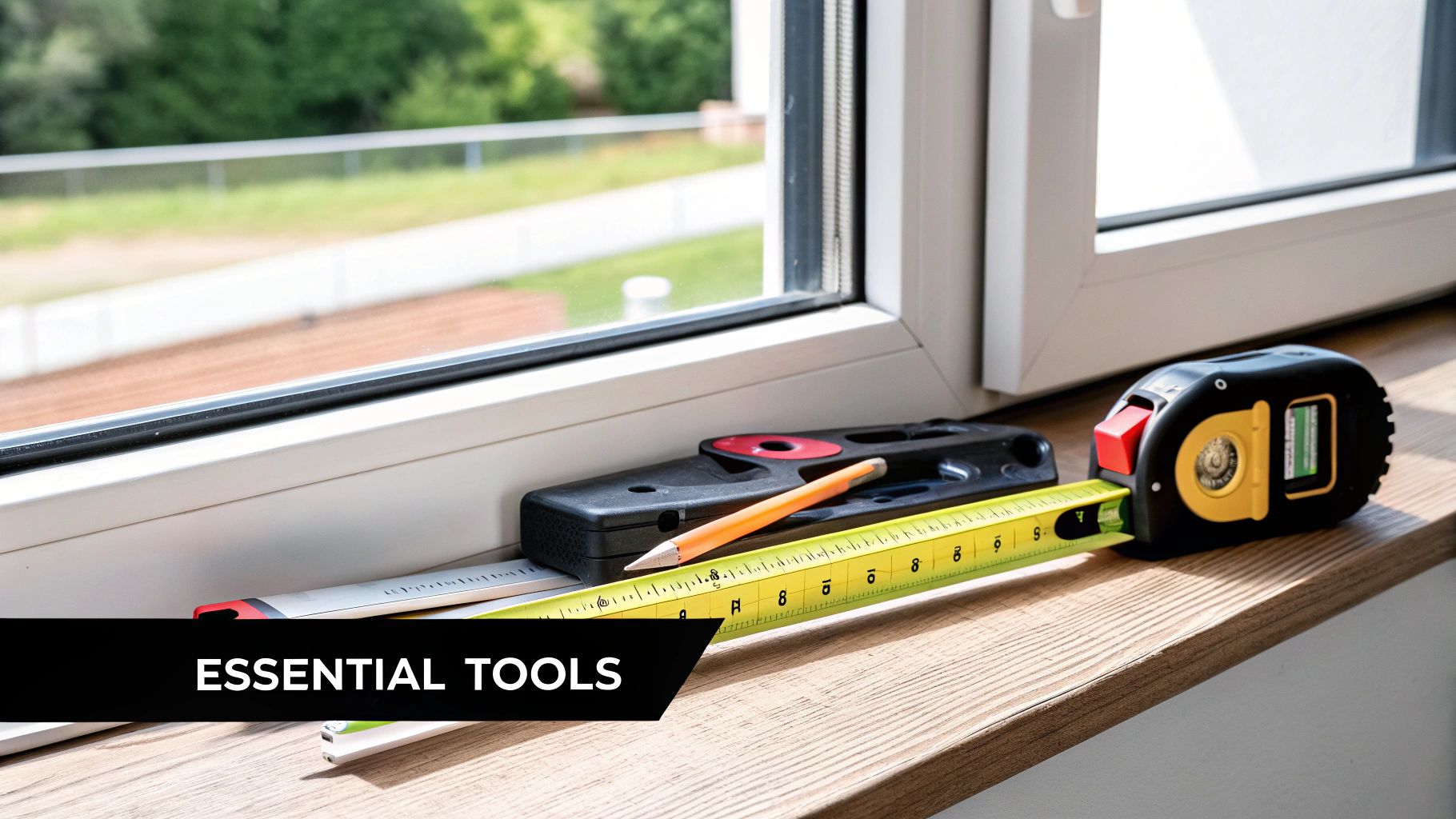
Before you grab your tape measure, the very first thing you need to do is get your hands on a good window measuring template. Think of this simple piece of paper as your project's blueprint. It’s what keeps the whole process organized and turns a jumble of numbers into a clear plan for a perfect fit.
A quality template should have clearly marked spots for every dimension you'll need. Look for one with spaces for multiple width and height measurements, a place to jot down the room location (like "Living Room, Left Window"), and the type of mount you're planning. That little bit of organization is a lifesaver, especially when you're tackling a whole house worth of windows.
Home Blinds & Floors offers a wide selection of custom blinds and shades in Delmarva, with expert installers who bring the showroom to your living room. Our experts show up with proven templates and years of experience, making sure homeowners from Salisbury to Easton get it right the first time.
Printing and Checking Your Template
Once you've found a template you like, printing it correctly is a critical step. Head into your printer settings and make sure you select 100% scale or "Actual Size." You absolutely want to avoid options like "Fit to Page," which can shrink the template and throw off any built-in guides, ruining your accuracy.
After it comes out of the printer, give it a quick check. If your template has a printed ruler on it for reference, pull out your own tape measure and see if they match up. This takes two seconds but confirms your guide is true to scale.
What If You Don't Have a Printer?
No printer? No worries. You can make a perfectly good template yourself with a blank piece of paper and a pen.
Map It Out: First, draw columns for "Window Location," "Width," and "Height."
Get Specific: Under the "Width" column, add three spots for "Top," "Middle," and "Bottom." Do the same for "Height," but with "Left," "Middle," and "Right."
Don't Forget the Details: Be sure to add a line for "Mount Type" (Inside or Outside) and another for "Depth," which is crucial for inside mounts.
This DIY version works just as well as a printed one. The most important thing is to be consistent and clear. Of course, if you'd rather skip the arts and crafts, you can always check out our digital products and guides designed to make the process even easier.
Nailing the Perfect Inside Mount Measurement
Going for that clean, built-in look with an inside mount? It's a popular choice for good reason—it makes window treatments look like they're a seamless part of the window frame. To get that professional finish, though, you have to be precise. Your window measuring template is your best friend here.
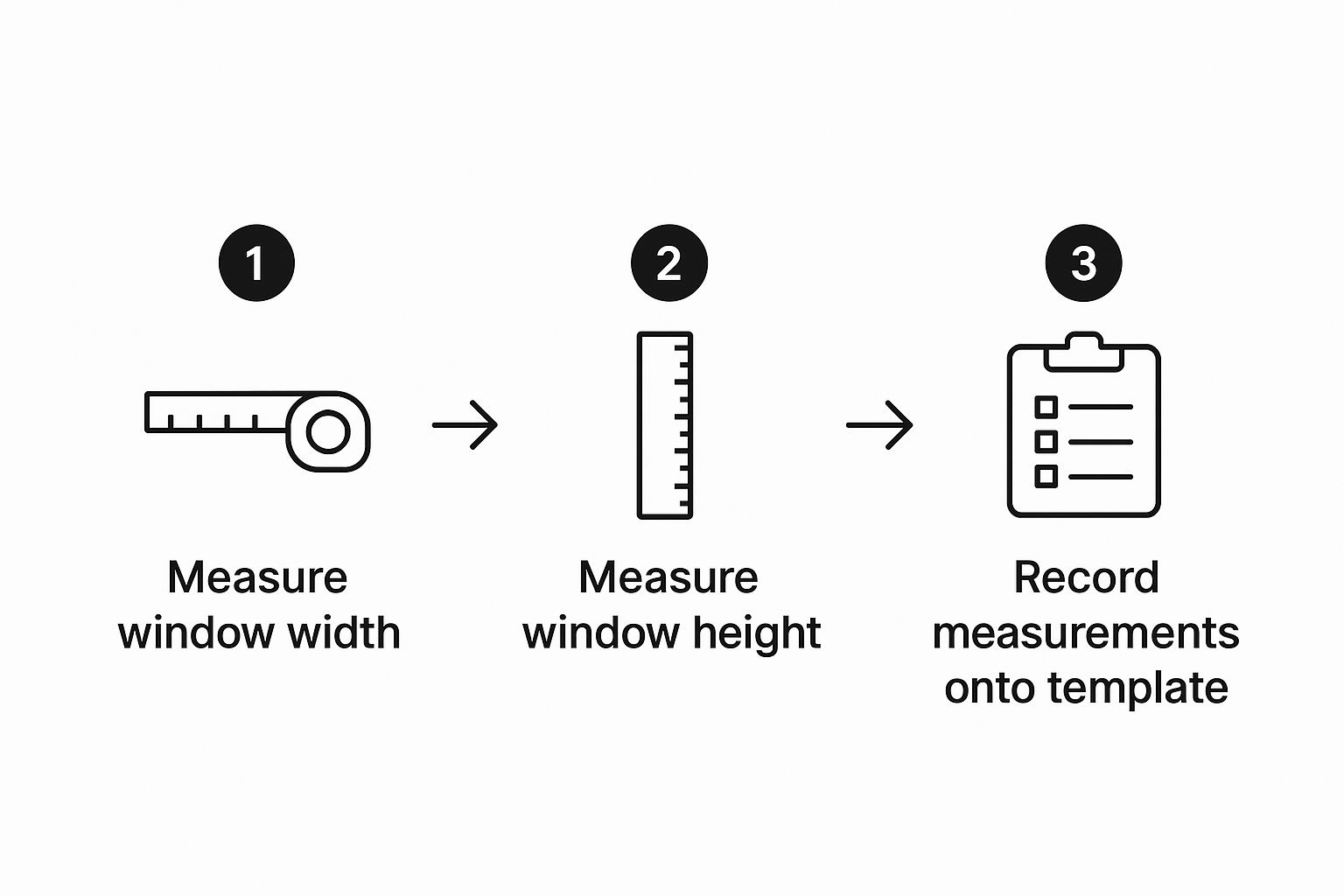
First, Let's Get the Window Width
Windows are almost never perfectly square. That's why we always measure the width in three different spots.
At the Top: Stretch your tape measure across the very top of the window opening.
In the Middle: Do the same thing again, right in the center.
Along the Bottom: Take one last measurement near the sill.
Now you have three numbers. On your template, write down the narrowest of the three. This is the golden rule. Using the smallest width guarantees your blinds or shades won't catch or scrape against the sides. For a deeper dive into this, our complete guide on how to measure windows for blinds has even more tips.
Pro Tip: Always measure to the nearest 1/8 inch. That’s the level of detail that turns a decent fit into a flawless one.
Next, Let's Record the Height
Just like the width, the height can be inconsistent. We’ll use the same three-point technique.
Measure the height on the left side of the window, from the top of the frame down to the sill.
Take another measurement right down the middle.
Finish up by measuring the right side.
As a local, family-run business, Home Blinds & Floors provides personal service, competitive pricing, and professional installation throughout Sussex, Wicomico, Kent, and beyond. We handle all these details so you can just enjoy the result.
Finally, Don't Forget to Check the Depth
This is the last piece of the inside-mount puzzle. Measure from the front edge of the window trim all the way back to the glass. Now, check that number against the minimum depth requirement listed for the specific blinds or shades you're interested in. If your window is too shallow, an outside mount is probably the way to go.
How to Measure for an Outside Mount
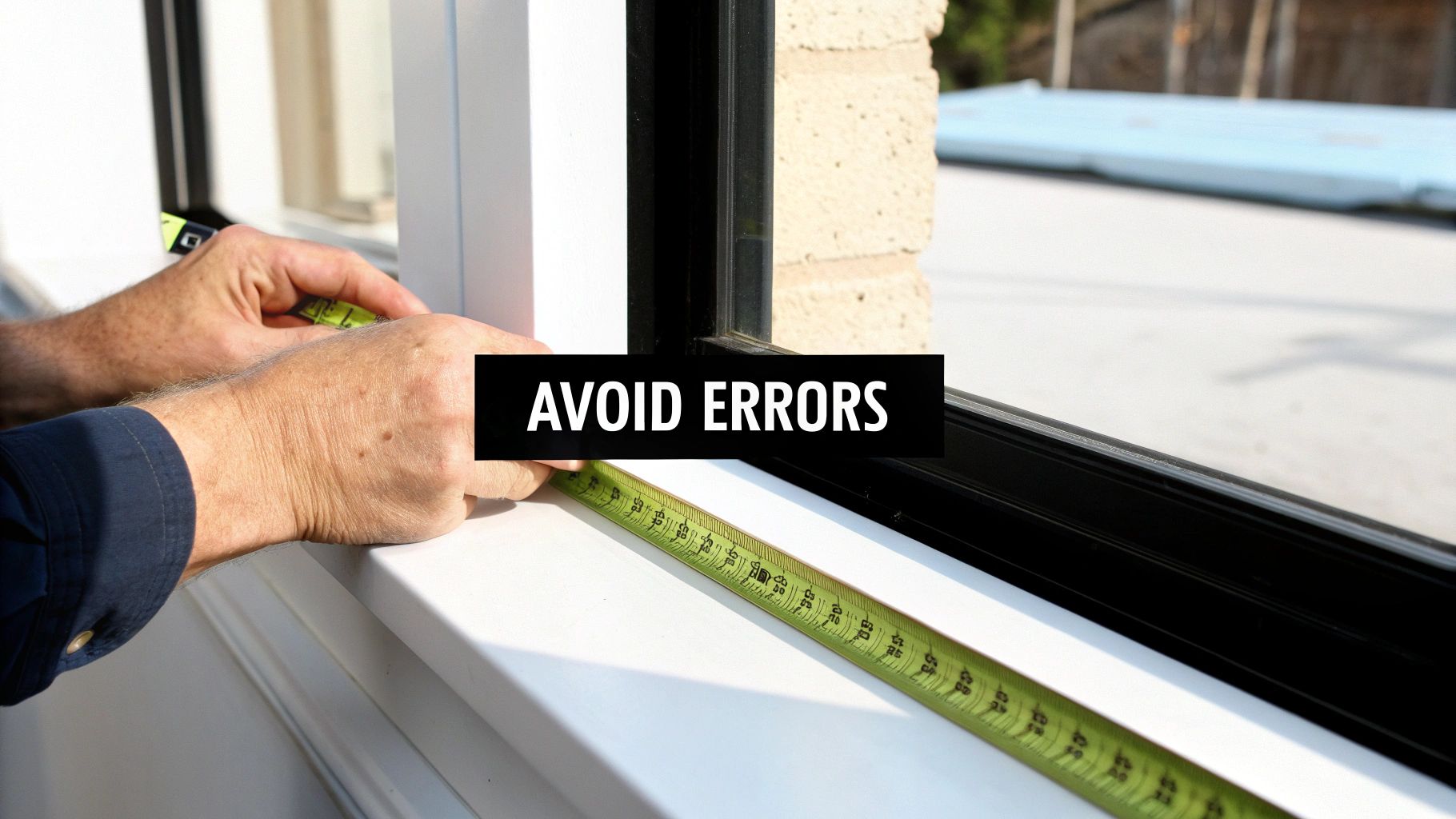
Sometimes, an outside mount is the only practical solution. It's ideal for shallow windows, hiding imperfect trim, or maximizing light blockage and privacy. When you're using your window measuring template for an outside mount, you're defining the entire area on the wall you want the treatment to cover. This can even make a window feel larger and more impactful.
Figuring Out the Best Overlap
The secret to a professional-looking outside mount is the overlap—how far the blind or shade extends past the window opening on all sides.
A good rule of thumb is to add at least 1.5 to 3 inches to each side of the window opening. So, if your window opening measures 36 inches wide, your final blind width should be somewhere between 39 and 42 inches. That extra coverage really does make all the difference.
For the best light control, especially in a bedroom, aim for a larger overlap of 3 inches or more on each side. It's a simple trick that dramatically improves room darkening.
Recording Width and Height on Your Template
An outside mount is simpler—you just need one width and one height measurement.
Width: Measure the full width you want to cover, including your overlap on both sides. Write this single, final number on your template.
Height: Decide how high above the window you want the headrail to sit (usually a few inches). Measure from that point down to where you want the blind to end, typically the windowsill or slightly below it.
While the process is more straightforward, precision is still key. For a deeper dive, take a look at our complete guide on how to measure and install blinds in your Delmarva home.
Keep an Eye Out for Obstructions
Before you finalize your numbers, do one last check. Make sure nothing will get in the way of the treatment, such as:
Thick trim or molding
Nearby doorknobs
Bookshelves or furniture
FAQ: Your Window Measuring Questions Answered
Even with a detailed window measuring template, a few questions can still pop up. Here are answers to some of the most common queries we hear from homeowners across Delmarva.
What are the best blinds for privacy?
For maximum privacy, opaque materials are best. Blackout shades, plantation shutters, and faux wood blinds are excellent choices. An outside mount with a generous overlap (3+ inches on each side) will also eliminate light gaps and prevent anyone from peeking in.
What if my window measurements are uneven?
This is perfectly normal, especially in older homes on the Eastern Shore. For an inside mount, always use the narrowest width and the shortest height measurement. This guarantees your new blinds or shades will fit inside the frame and operate smoothly without scraping the sides.
Should I make deductions from my measurements?
No, do not make your own deductions. Provide the exact, tight measurements of the window opening for an inside mount. The factory is trained to make the necessary small deductions for the hardware to fit. For an outside mount, provide the exact final dimensions you want the finished product to be, including your overlap.
Do you offer solutions for odd-shaped windows?
Yes! Home Blinds & Floors specializes in custom window treatments for arched, angled, bay, and other specialty windows. Our experts know how to measure these unique shapes to ensure a perfect fit for custom solutions like plantation shutters or cellular shades. For more, see our guide on custom blinds for odd-shaped windows.
What cities in Delmarva do you serve?
We are proud to serve homeowners and businesses across the Delmarva Peninsula, including Salisbury, Easton, and Ocean City in Maryland, as well as Rehoboth Beach, Lewes, and surrounding areas in Delaware.
Your Delmarva Window Treatment Experts
In summary, using a window measuring template correctly is the key to a successful DIY window treatment project. However, for guaranteed perfect results without the hassle, trust the local experts. Home Blinds & Floors provides custom window treatments, expert advice, and professional in-home service to homes across the Delmarva Peninsula. From Rehoboth Beach to Easton, our team is here to help you choose the best shades, shutters, or blinds for your space.
Ready to skip the tape measure and get some expert help? Schedule your free in-home consultation today!


Comments