.avif)
.avif)
.avif)
How to Fix Blinds That Are Stuck: A Room-by-Room Guide

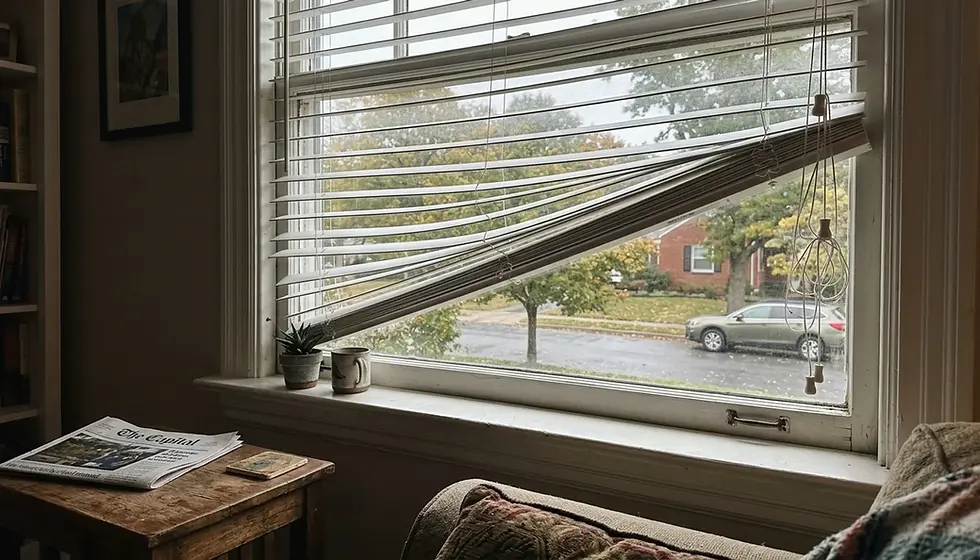
Blinds get stuck for one of four reasons: a jammed cord lock inside the headrail, tangled or frayed lift cords, a bent or obstructed slat, or worn-out internal gears and springs. Most of these fixes take under ten minutes with no tools beyond your hands and a can of compressed air.
Key Takeaways
The most common cause of stuck blinds is a jammed cord lock mechanism inside the headrail, which usually releases with a specific pull-and-release technique rather than force.
Blinds that won't tilt open usually need the slats manually rotated to their full open and closed positions a few times to re-engage the tilt gear.
Cordless and motorized blinds have entirely different failure points, typically battery drain or a motor that needs recalibrating, not a cord lock issue.
Grinding noises, a tilt wand that spins freely, or cords that go limp are signs of a broken mechanism, not a simple jam, and usually mean repair or replacement is next.
If you're troubleshooting more than one set of blinds in your Delmarva home, worn parts across multiple rooms often signal it's time to compare replacement costs against continued repairs.
If you've spent the last twenty minutes yanking on a cord in your living room with nothing to show for it but a slightly crooked headrail, you're not alone. At Home Blinds and Floors, we field calls across the Delmarva Peninsula from homeowners convinced their blinds are broken beyond repair, when the fix turns out to be a two-minute cord lock release. This guide walks through exactly what's happening inside that headrail and how to get your blinds moving again in 2026.
Coastal humidity and salt air add a wrinkle that homeowners inland don't deal with. Blinds installed in a Rehoboth Beach sunroom or a bay-facing window in Lewes see more expansion, contraction, and grit buildup in the tilt mechanism than a blind hanging in a climate-controlled office in Salisbury. As a result, the same jam can have a different root cause depending on where your window sits and how much moisture the mechanism has been absorbing.
This guide covers diagnosis by symptom, step-by-step fixes for corded, cordless, and motorized blinds, and honest guidance on when a jam actually means the mechanism has failed. We'll also flag the coastal-specific wear patterns we see most often in our installation work, so you know whether you're looking at a five-minute fix or a sign it's time to replace.
How Do You Get Blinds Unstuck?
Getting blinds unstuck starts with identifying which of four common failure points is causing the problem: the cord lock, the lift cords themselves, the slats, or internal gears. If the blind won't move up or down at all, the cord lock inside the headrail is the most likely culprit. Importantly, a controlled pull-and-release motion resolves most cord lock jams, while repeated tugging on the cords typically makes the jam worse rather than better.
First, lower the blind as far as it will currently go before attempting any fix. Working with slack cords makes every subsequent step easier and reduces the risk of snapping a cord that's already under strain. Additionally, check for visible obstructions, a slat caught on a windowsill plant, a curtain rod, or a piece of furniture, before assuming the issue is mechanical.
As a result, most stuck blinds fall into one of two categories: a cord lock that needs to be manually disengaged, or slats that have shifted out of alignment inside the headrail track. Both categories are addressed in the sections below with specific, repeatable steps. If you've already tried pulling straight down repeatedly with no luck, stop the attempt immediately. Continued force is the number one reason a simple jam turns into a snapped cord and a mechanism replacement.

Why Won't My Blinds Go Up or Down?
Blinds that won't raise or lower are almost always stuck at the cord lock, a small mechanism inside the headrail where the lift cords pass through a pin that locks the blind at a set height. When the pin gets misaligned or debris builds up around it, the cords can't move freely in either direction, leaving the blind frozen at whatever height it stopped.
The Cord Lock Release Technique
Here's the sequence that resolves this in most cases:
Grasp all lift cords together where they exit the headrail.
Pull straight down gently, just enough to support the blind's weight without forcing it.
Angle the cords toward the center of the blind, roughly 45 degrees away from the nearest vertical edge.
Hold that angle until you feel or hear a faint click, which indicates the pin has disengaged.
Slowly relax the cords back to a straight vertical position and test the blind's movement.
If pulling toward the center doesn't produce a click, try the same motion pulling toward the outside edge instead, since cord lock mechanisms vary slightly by manufacturer and the release direction isn't universal. Additionally, a quick puff of compressed air into the cord lock opening can dislodge dust or grit that's preventing the pin from seating correctly, a common issue in coastal homes where salt air and humidity cycle through open windows.
Avoid spraying lubricant into the cord lock unless the manufacturer specifically calls for it. The wrong lubricant attracts more dust and grit than it displaces, which makes the next jam worse, not better. This risk is especially pronounced in a beach house near Bethany Beach or Ocean City, where airborne salt residue already accelerates buildup inside mechanical parts.
When the Blind Is Stuck at the Top
A blind stuck at the top refers to a blind that won't come down at all, even after the cord lock release technique has been attempted. This specific symptom usually points to one of two causes: a lift cord that has slipped off its internal spool, or a slat that's wedged sideways inside the headrail track. For this fix, open the headrail cover carefully, since most snap or slide off without tools, and look inside for a cord that's crossed over itself or bunched to one side. Straightening that cord by hand and re-threading it through its original guide usually restores movement without needing pliers, screwdrivers, or any other tools.
Why Are My Blinds Not Twisting Open?
Blinds that raise and lower normally but won't tilt open or closed have a disengaged tilt mechanism, a gear system separate from the lift cord that controls slat rotation independently. This is a common complaint in horizontal venetian-style blinds and is almost never related to the cord lock jam described in the previous section.
To re-engage the tilt gear, manually rotate the slats to their maximum open position, then to their maximum closed position, repeating this motion four or five times. This repeated rotation physically forces the tilt gear teeth back into alignment with the wand or cord that normally controls them. In our experience installing blinds across Kent Island and Grasonville waterfront homes, this single step resolves the majority of tilt complaints without ever opening the headrail.
If manual rotation doesn't restore tilt function, the tilt mechanism itself likely has dust or corrosion buildup, especially in homes within a mile or two of the water where salt air infiltrates even sealed headrails over several seasons. In that case, open the headrail and use compressed air or a small stiff-bristle brush to clear visible debris from the gear teeth. Avoid using excessive force on the tilt wand itself; a wand that spins freely without resistance is often a sign the gear has already stripped, a failure compressed air cannot fix.
Notably, if you're noticing this same tilt failure across multiple windows in the same room, especially in an older Eastern Shore farmhouse with original wood blinds, that pattern is less about individual mechanical wear and more about the specific product line reaching end of life across the board.
How to Fix Pull-Down Blinds That Won't Go Up?
Roller-style pull-down blinds that won't retract typically have a spring or clutch mechanism problem, which is mechanically different from the cord lock system in venetian and vertical blinds. The clutch controls tension as you pull the chain or cord, and when the clutch slips or seizes, the blind either won't retract at all or retracts unevenly.
For spring-roller blinds (the kind with no visible cord or chain), the fix usually starts with removing the blind from its brackets, manually rolling it up by hand to reset spring tension, then reinstalling it. If the blind snaps back too fast or too slow after that reset, the spring tension itself needs adjusting, which on most residential roller shades is done through a small tension screw on the roller tube end cap.
For chain-operated or clutch roller shades, a stuck blind is often caused by the clutch gear slipping internally rather than an external obstruction. Check first that the mounting brackets on either end haven't loosened, since a roller tube sitting at a slight angle puts uneven pressure on the clutch and causes binding. Tightening the bracket screws resolves this in a surprising number of cases before you ever need to touch the clutch itself.
If neither adjustment restores smooth operation, the clutch mechanism has likely worn out internally, a repair that on most consumer-grade roller shades costs close to a full replacement once you factor in the part and the labor to access it. In this scenario, we generally recommend replacement over repair, particularly on shades installed more than five or six years ago.

How Do You Fix Stuck Cordless or Motorized Blinds?
Cordless and motorized blinds fail differently from traditional corded blinds because these systems rely on a spring-tension lift mechanism or an electric motor instead of a manual cord lock. A cordless blind that won't move usually has a spring cassette that's over-tensioned or under-tensioned. In contrast, a motorized blind that won't respond is almost always a battery, power, or pairing issue rather than a mechanical jam.
Cordless Blind Troubleshooting
Cordless blind troubleshooting starts with restraint: if a cordless blind feels stuck or resists movement, avoid forcing the blind upward or downward with extra pressure, since cordless systems use an internal spring that can be damaged by force applied against its resting tension. Instead, gently move the blind to its fully lowered position, wait a moment, then attempt to raise it slowly and evenly using both hands at the same height across the bottom rail. Uneven pressure, meaning one side lifted faster than the other, is the most common reason cordless blinds jam mid-track. As a result, the fix for most cordless jams is technique, not force: slow, symmetrical hand placement across the bottom rail, repeated a few times if the blind resists on the first attempt, restores normal spring tension and smooth movement without opening the headrail or touching the internal cassette at all.
Motorized Blind Troubleshooting
For motorized shades that aren't responding, first check the obvious: battery charge level or, for hardwired units, whether the power connection at the headrail has loosened. Many motorized systems, including Hunter Douglas PowerView-compatible shades, also require re-pairing with their remote or smart home app if the motor has been reset or the batteries were recently changed. Additionally, some motors include a manual calibration reset, typically triggered by holding the up and down buttons simultaneously for several seconds, which resolves shades that stop mid-travel or respond inconsistently to commands.
This is genuinely one of the least-covered topics in existing troubleshooting content, and it's worth flagging directly: if your motorized shades were installed within the last two years and are still under warranty, contact your installer before attempting an internal motor repair. Opening a motorized headrail without cause can void coverage that would otherwise handle the fix at no cost to you.
What Are the Warning Signs of a Broken Mechanism vs. a Simple Jam?
A broken mechanism refers to internal gears, springs, or plastic housing that have physically failed, which is different from a simple jam that just needs realignment. Specific warning signs include grinding or clicking noises from inside the headrail, a tilt wand or cord that moves freely without engaging the slats, visible cracks in the headrail casing, and a blind that re-jams immediately after you've just fixed it. Each of these signs points to a mechanical failure that basic troubleshooting won't resolve.
Symptom | Likely Cause | Repair or Replace |
Blind won't move, no clicking sound at all | Cord lock jammed with debris | Repair (cord lock release + compressed air) |
Grinding noise from headrail | Stripped or corroded internal gear | Replace mechanism or blind |
Tilt wand spins freely, slats don't move | Stripped tilt gear | Replace mechanism or blind |
Cords go limp, blind won't hold position | Broken lock spring | Replace mechanism |
Re-jams within days of a fix | Underlying internal wear, not a one-time obstruction | Replace blind |
Blind crashes down suddenly | Complete lock mechanism failure | Replace immediately (safety concern) |
A blind crashing down without warning is the clearest sign of complete lock failure, and this is the opposite problem from a blind stuck at the top. Where a stuck blind is merely frustrating, a blind that fails to hold its position is a genuine safety issue, particularly in a household with young children or pets nearby.
When Should You Repair Versus Replace Stuck Blinds?
Replacement makes more sense than repair when a blind shows major mechanism failure, extensive slat damage, or is old enough that fixing one problem tends to reveal another shortly after. As a practical threshold, if you've already attempted the cord lock release, slat realignment, and a compressed air cleaning without success, you're likely looking at internal gear wear that a DIY fix won't resolve.
Consider replacement specifically when you see numerous warped, cracked, or missing slats across the blind, extensive fraying at the cord entry points, or a blind that's required more than one fix in the past year. Age matters too: a set of blinds installed a decade ago in a Milton or Middletown home has likely absorbed enough seasonal humidity swings that one repair now often just delays the next failure by a few months.
There's also a safety dimension worth weighing seriously. Traditional corded blinds present a strangulation risk for young children and pets, which is why cordless and motorized options have become the standard recommendation for family homes and vacation rentals alike. If your household includes kids, pets, or short-term rental guests who won't know a specific blind's quirks, upgrading to a cordless or motorized system during a replacement removes that risk entirely rather than just patching around it.

Data & Evidence: Comparing Your Repair Options
Comparing repair options means weighing three practical paths against each other: a DIY fix, a professional repair call, or full replacement. DIY fixes cost nothing beyond your time and work well for cord lock jams, tilt misalignment, and minor debris buildup, which together account for the majority of stuck blind complaints. Professional repair services make sense when you've diagnosed a broken mechanism but the blind itself is otherwise in good condition, particularly for premium products where individual parts can be sourced and swapped. Full replacement, in contrast, is the right call when multiple slats are damaged, the mechanism has failed more than once, or the blind is old enough that further repair is only a temporary patch.
Approach | Best For | Typical Timeline |
DIY fix (cord lock, slat, tilt) | Simple jams, debris buildup, minor misalignment | 5 to 15 minutes |
Professional repair | Diagnosed mechanism failure in an otherwise sound blind | Varies by part availability |
Full replacement | Recurring failures, extensive slat damage, aging products | Measurement to install, typically one to two visits |
At Home Blinds and Floors, our team regularly walks Delmarva homeowners through exactly this decision during in-home consultations. We've measured and replaced blinds in enough coastal properties, from Annapolis colonials to Ocean City high-rise condos, to know that a blind jamming for the third time in a year almost never means it needs a fourth fix. Instead, a third jam means the internal components have reached the end of their functional life, and a custom-fit replacement designed for the room's specific light and humidity conditions is the more cost-effective path forward.
What Maintenance Prevents Blinds From Getting Stuck Again?
Preventing future jams comes down to two habits: regular dusting and gentle operation. Wipe down slats and headrails with a dry or slightly damp cloth every few weeks to prevent the dust and grit buildup that causes most cord lock and tilt mechanism jams in the first place, and avoid yanking cords or over-rotating the tilt wand past its natural stopping point.
Coastal homes need an extra step. In properties near Rehoboth Beach, Bethany Beach, or the Ocean City waterfront, salt air settles into mechanisms faster than in inland homes across Centreville or Easton. As a result, a monthly pass with compressed air on the headrail openings, even when the blind is functioning normally, catches debris before it hardens into a jam. This single habit is the difference between blinds that last one season near the water and ones that hold up for several.
If you're weighing whether to keep repairing older corded blinds or move toward something more resilient, our custom blinds and shades pages walk through the material and mechanism differences that matter most in a coastal climate. And if warped or cracked shutters are part of what's driving the frustration, it's worth reading about how faux wood compares to real wood blinds for Delmarva homes before you commit to a repair or a replacement.
Practical Guidance: A Step-by-Step Troubleshooting Checklist
Work through this checklist in order before deciding a blind is beyond repair:
Lower the blind fully to release tension before attempting any fix.
Check for visible obstructions: furniture, plants, or a curtain rod in the track.
Attempt the cord lock release: pull down, angle toward center at 45 degrees, hold for a click.
If unsuccessful, repeat the release pulling toward the outside edge instead.
For tilt issues, manually rotate slats to full open and closed positions four to five times.
Open the headrail and clear debris with compressed air or a soft brush.
For cordless blinds, raise and lower evenly with both hands, avoiding one-sided pressure.
For motorized blinds, check battery or power connection, then attempt a manual reset.
Listen for grinding, clicking, or a wand that spins freely; these indicate mechanism failure.
If the blind re-jams within days, stop repairing and start comparing replacement options.
Common mistakes to avoid: pulling straight down repeatedly with force instead of angling the cords, spraying general-purpose lubricant into a cord lock, and ignoring a blind that's crashed down even once. A single crash event, even if the blind seems to work fine afterward, usually means the lock spring has already partially failed and full failure is a matter of time.
Frequently Asked Questions
How do you fix a blind that won't go down?
Gently pull the lift cords straight down together, then angle them sideways toward the center of the blind at roughly 45 degrees until you feel a click. This angled pull releases the cord lock pin that's holding the blind in place. If that technique doesn't work, check for tangled cords or a slat that's shifted crooked inside the headrail track, since either of these can also prevent a blind from lowering.
What is the most common cause of blinds that won't roll down?
The most frequent cause is a stuck cord lock, followed by tangled or off-track lift cords and bent or misaligned slats. In coastal homes, dust and salt residue buildup inside the cord lock accelerates this issue compared to inland properties, where mechanisms stay cleaner for longer between cleanings.
Can you fix stuck blinds without removing them from the wall?
Yes. Most fixes, including the cord lock release, tilt gear re-engagement, and headrail cleaning, can be done while the blind stays mounted on the wall or window frame. Removal is typically only necessary for full mechanism replacement or when slats need to be redistributed after significant damage, situations that go beyond routine troubleshooting.
Why do my blinds keep getting stuck at the same spot every time?
A blind that jams at a consistent height usually has a specific obstruction fixed at that point in the track, such as a bent slat, a knot in the lift cord, or a worn spot in the headrail guide. This pattern differs from random jamming, which more often points to a cord lock or tilt gear issue rather than a fixed obstruction. In other words, a repeatable jam location means the problem is physical and localized, while random jamming means the problem lives inside the cord lock or tilt mechanism itself. Checking the exact height where the blind sticks, and inspecting the slat and cord at that specific point, usually reveals the obstruction directly.
Is it safe to use WD-40 or similar lubricant on stuck blind mechanisms?
Avoid general-purpose lubricants unless the manufacturer specifically recommends them for that mechanism. Standard lubricants attract dust and grit, which often makes the jam worse within a few months. Compressed air is the safer first option for clearing debris from a cord lock or tilt gear, since compressed air removes particles without leaving a residue that attracts more buildup.
How often should window blinds be cleaned to prevent jamming?
Dusting slats and headrails every few weeks prevents most jams. In coastal Delmarva homes near Rehoboth Beach, Bethany Beach, or Ocean City, a monthly pass with compressed air on the headrail openings is worth adding, since salt air accelerates debris buildup in the mechanism compared to inland locations such as Centreville or Easton.
When should you call a professional instead of continuing to DIY the fix?
Call a professional once you've confirmed a broken mechanism rather than a simple jam, meaning grinding noises, a tilt wand that spins freely, or repeated re-jamming within days of a fix. At that point, continued DIY attempts risk further damage, and a professional can assess whether the specific blind is worth repairing or better replaced.
Conclusion
Most stuck blinds trace back to a jammed cord lock or a misaligned tilt gear, and both issues usually respond to the specific pull-and-release or manual rotation techniques covered above rather than force. For example, working through the checklist above resolves the majority of cases in under fifteen minutes. If the blind still won't cooperate after that checklist, or it's showing grinding noises and repeated jams, that combination of symptoms is your signal the mechanism has failed rather than simply stuck.
As you weigh repair against replacement heading into 2026, remember that coastal wear accelerates faster than most homeowners expect, particularly on original builder-grade blinds that have already seen several seasons of salt air and humidity. Home Blinds and Floors has spent years fitting and installing custom blinds, shades, and shutters across the Delmarva Peninsula, and our team is happy to walk you through whether your current window treatments are worth repairing or ready for an upgrade.

If your blinds have jammed for the third time this year, it might be time to stop repairing and start planning a replacement built for your home's exact light and humidity conditions. Get started with Home Blinds and Floors for a free in-home consultation across the Delmarva Peninsula, and we'll help you choose a window treatment that won't leave you wrestling with a cord lock again next season.
Content powered by inkSTR.co

Comments