.avif)
.avif)
.avif)
7 Beach-Resistant Custom Shades Perfect for Bethany Beach, DE Homes

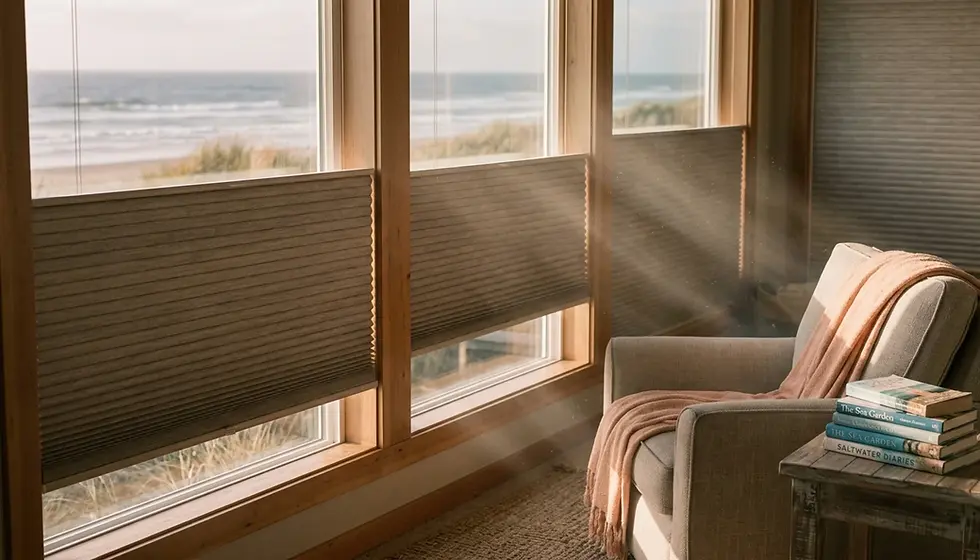
Custom shades for Bethany Beach, DE properties are not a one-size-fits-all purchase. Salt air corrodes aluminum components within a season or two. High coastal humidity warps real wood. Intense sun off the Atlantic fades standard fabrics faster than you'd expect from interior window treatments inland. Choosing the wrong material isn't a style mistake; it's a costly replacement cycle that most homeowners in Sussex County learn the hard way.
At Home Blinds and Floors, we've worked with coastal property owners across the Delmarva Peninsula long enough to know which products actually survive a Delaware shore winter and which ones look good in a showroom but fail within 18 months of salt air exposure. This guide covers the seven best custom shade types for Bethany Beach homes, ranked by beach-environment suitability first and budget considerations second.
Salt air and humidity demand specific materials: aluminum-free components, moisture-resistant fabrics, and UV-stabilized finishes are non-negotiable for Bethany Beach homes.
Solar shades are the top energy performer: they block intense oceanfront sun while preserving water views, a priority for bay-facing and oceanfront windows along the Delaware shore.
Double cell cellular shades achieve an R-value of 3 to 4, compared to approximately 2 for single cell, providing up to 50% better insulation in Bethany Beach's hot summers and cold winters.
Vacation and second-home owners should prioritize cordless and motorized operation for guest safety, simplified remote management, and reduced wear between turnovers.
Faux wood consistently outperforms real wood in high-humidity coastal environments; real wood warps, delaminates, and discolors in the moisture-heavy air common to Sussex County.
Most custom shade orders in the Sussex County market are professionally installed within approximately two weeks of order, making the timeline shorter than many homeowners assume.
Bethany Beach sits in Sussex County as one of Delaware's designated "Quiet Resorts," drawing a mix of year-round residents and second-home owners who aren't always on-site to manage maintenance. That combination of coastal exposure and part-time occupancy creates specific demands that standard window treatment advice simply doesn't address. The seven picks below are built around those demands.
If you want to go deeper on specific product categories before reading the full list, the custom shades resource hub at Home Blinds and Floors covers everything from fabric selection to motorization options across the Delmarva region. For a broader look at all window treatment types suited to coastal homes, the custom window treatments blog category is a useful starting point.

What Makes a Window Shade "Beach-Resistant" for Coastal Delaware Properties?
Beach-resistant window shades are products engineered to withstand the three primary environmental stressors of coastal Delaware living: salt air corrosion, persistent humidity, and ultraviolet radiation from direct and reflected sunlight. A shade that performs well in an inland Delaware home can deteriorate noticeably within one or two seasons in a Bethany Beach property, particularly if the home sits oceanfront, bay-side, or within a few blocks of the water.
Specifically, salt air attacks metal components. Standard aluminum headrails, brackets, and tilt mechanisms oxidize and seize up. Fabric shades without UV-stabilized coatings lose color and tensile strength faster than manufacturers' warranties anticipate for non-coastal installations. Real wood slats absorb atmospheric moisture, expanding and contracting with temperature swings until they warp, crack, or delaminate entirely.
The materials that consistently perform well in Sussex County coastal conditions share three traits. First, they use polymer, stainless steel, or coated steel hardware rather than bare aluminum. Second, the fabrics or slat materials are either inherently moisture-resistant or treated to resist mold and mildew. Third, any UV-exposure rating accounts for the amplified intensity of reflected sunlight off water and sand, not just direct sun from a standard inland window angle.
For a detailed look at how insulation performance translates to energy savings in the Delmarva climate specifically, the guide on single vs. double cell shades for Delmarva homeowners breaks down the R-value differences in practical terms.
1. Solar Shades: The Best Option for Oceanfront and Bay-Facing Windows
Solar shades are roller-style window coverings made from open-weave, PVC-coated polyester fabric that blocks UV radiation and reduces glare while preserving outward views. For Bethany Beach properties with water views, solar shades are the first recommendation from our team at Home Blinds and Floors, because they solve the most common coastal complaint: intense sun that heats up rooms and damages furniture without giving homeowners a reason to close the blinds completely.
The openness factor, expressed as a percentage, determines how much light and view you retain. A 3% openness fabric blocks significant glare while still allowing a clear view of the ocean or bay. A 10% openness fabric admits more light and is better suited for windows that get indirect sun. For south- and west-facing windows on Bethany Beach properties, a 3% to 5% openness solar shade strikes the right balance between view preservation and UV protection.
Hunter Douglas's solar shade lines include fabrics with GREENGUARD Gold certification for indoor air quality. The E Screen GREENGUARD Gold Certificate validates that these fabrics meet rigorous chemical emission standards, which matters for enclosed beach homes that are often shut up for weeks between visits. The PVC-coated polyester construction resists moisture and mold without requiring seasonal treatment.
Best for: Oceanfront and bay-facing windows, sunrooms, screened porches with interior windows Price range: Typically $150 to $400 per window for custom solar shades, depending on size and motorization One honest caveat: Solar shades provide no privacy at night when interior lights are on; pair with a blackout liner or a layered treatment for bedrooms
2. Double Cell Honeycomb Shades: Top Choice for Year-Round Energy Efficiency
Double cell honeycomb shades, also called cellular shades, are fabric window coverings constructed with two parallel air pockets that trap insulating air between the window glass and the room interior. According to data from Home Blinds and Floors' Delmarva-focused product guides, double cell cellular shades achieve an R-value of approximately 3 to 4, compared to roughly 2 for single cell versions, representing up to 50% better insulation performance.
That insulation difference is significant for Bethany Beach homes. Sussex County summers push temperatures into the 90s, and bay breezes don't always offset radiant heat through large windows. Winters bring cold Atlantic winds that drop indoor temperatures near glass even with good HVAC systems. Double cell shades create a meaningful thermal barrier on both ends of the seasonal spectrum.
For coastal Delaware homeowners weighing single vs. double cell options, the energy cost argument typically favors double cell despite the higher upfront price. The cordless top-down/bottom-up configuration, available through brands including Hunter Douglas and Graber, is especially practical for Bethany Beach vacation homes where guests need intuitive operation without a manual.
Best for: Bedrooms, living areas with large windows, homes occupied year-round or used heavily in both summer and winter Price range: Generally $200 to $500 per window for double cell custom cellular shades One honest caveat: The honeycomb structure can collect dust and pet hair; cordless versions are easier to wipe clean than corded alternatives

3. Faux Wood Roller Shades and Blinds: The Practical Standard for High-Humidity Rooms
Faux wood window treatments are made from PVC or a composite polymer material designed to mimic the appearance of real wood while resisting the moisture absorption that causes natural wood to warp, swell, and crack in coastal environments. In the Bethany Beach area, faux wood is the practical default for kitchens, bathrooms, and any room that gets regular exposure to salt air through open windows or doors.
Real wood slats absorb ambient humidity. At the Delaware shore, where summer humidity regularly sits above 70% and salt-laden sea breezes are constant, even well-sealed real wood blinds begin warping within a few seasons. Faux wood components don't absorb moisture, won't delaminate, and hold their color and structural integrity through the humidity swings that damage natural materials.
Better Blinds & Shades, a locally owned Sussex County window treatment company, highlights cordless faux wood blinds as one of their primary recommendations for Bethany Beach homeowners, and that's a reasonable position. Cordless mechanisms remove the safety liability of hanging cords in vacation rentals and the mechanical failure points that standard corded blinds develop under heavy guest use. Their product video on cordless faux wood blinds walks through the operational differences in practical detail.
For a side-by-side analysis of how faux wood and real wood compare across Delmarva-specific climate conditions, the faux wood vs. wood blinds guide from Home Blinds and Floors covers the durability and cost trade-offs in depth.
Best for: Kitchens, bathrooms, laundry rooms, any room with direct salt air exposure Price range: Faux wood blinds typically run $80 to $250 per window for custom sizes One honest caveat: Faux wood has a slight plastic sheen up close; for formal living rooms or primary suites where appearance is a priority, cellular or solar shades may read as more refined
4. Motorized Roller Shades: The Smartest Pick for Absentee and Second-Home Owners
Motorized roller shades are custom window coverings that operate via an electric motor controlled through a remote, wall switch, smartphone app, or smart home system integration. For Bethany Beach second-home owners who manage their property remotely for part of the year, motorized shades solve a practical problem that manual window treatments cannot: the ability to open or close window coverings without being present.
This matters more than it might seem at first. A Bethany Beach home left closed up in October with manually lowered blackout shades will bake in late-season sun and build up heat in enclosed rooms. A homeowner who can raise shades remotely via a smartphone app before arriving for a weekend visit, or lower them automatically at sunset to prevent UV damage, is managing their property more intelligently than manual operation allows.
The Louver Shop serving the Bethany Beach area has featured motorized window treatments as a primary product line, and customer reviews specifically mention the appeal of coordinating installations remotely. One review notes a project covering all 17 downstairs windows of a beach home, a scale that makes manual operation cumbersome and motorization practically justified.
Hunter Douglas's PowerView motorization system integrates with Apple HomeKit, Amazon Alexa, and Google Home. Graber's Z-Wave motorized shades connect to standard smart home hubs. Both brands are available through Home Blinds and Floors with professional installation across Sussex County. If you want to understand the full scope of motorized shade options, the shades service page outlines the systems we install and configure.
Best for: Second homes and vacation rentals, high windows above staircases or in vaulted spaces, whole-home smart home setups Price range: Motorized shades typically add $150 to $400 per window over manual pricing depending on the motor system and smart home integration level One honest caveat: Motorized systems require occasional battery replacement or hardwiring; confirm which power option fits your property before ordering
5. Roman Shades in Performance Fabric: Coastal Style Without Sacrificing Durability
Roman shades are soft fabric window coverings that fold into horizontal pleats when raised and lie flat when lowered, creating a clean, tailored look that complements coastal cottage and contemporary beach house interiors equally well. The critical distinction for Bethany Beach properties is fabric selection: standard Roman shade fabrics made from natural fibers absorb moisture, mold, and salt, but Roman shades constructed from solution-dyed acrylic or coated polyester performance fabrics hold up in high-humidity coastal conditions.
Solution-dyed fabrics bind color at the fiber level during manufacturing rather than applying it as a surface treatment. As a result, UV exposure doesn't strip color the way it does with conventional dyed textiles. For south-facing rooms in a Bethany Beach home that receive direct afternoon sun amplified by water reflection, solution-dyed Roman shades retain their appearance significantly longer than standard options.
Bethany Resort Furnishings includes Roman shades in their Bethany Beach product lineup, positioning them as a design-forward treatment. That's accurate; Roman shades do add a level of softness and elegance that roller formats can't match. But the design benefit only translates to a good long-term investment when the fabric is specified for coastal use. Performance fabric Roman shades from brands like Norman, available through Home Blinds and Floors, address this directly.
Best for: Dining rooms, primary bedrooms, living areas where aesthetics are a priority alongside durability Price range: Custom Roman shades in performance fabric typically run $200 to $500 per window One honest caveat: Roman shades require more careful cleaning than hard-surface window treatments; professional cleaning or careful hand washing is needed for performance fabrics to maintain their finish
6. Sliding Panel Shades: The Right Solution for Patio Doors and Wide Openings
Sliding panel shades are large fabric panels mounted on a track system that slide horizontally to cover wide openings, including sliding glass doors, multi-panel patio doors, and oversized windows common in Bethany Beach properties designed to maximize ocean or bay views. Standard vertical blinds are a dated alternative for these openings; sliding panels provide the same light control and privacy with a cleaner, more contemporary visual profile and fewer mechanical failure points.
Bethany Beach homes tend to have generous patio door systems facing water or outdoor entertaining areas. Vertical blinds in those locations get hit by salt air every time the door opens, and the individual vanes bend, yellow, and break under the combination of UV exposure and repeated handling by guests or family members. Sliding panels use fewer moving parts and hang from a track rather than individual hooks, reducing the maintenance burden.
For detailed guidance on selecting the right fabric weight and opacity for sliding door panels in coastal Delaware, the guide to vertical shades for sliding glass doors in Delmarva covers the specific trade-offs between panel types, including how track configurations differ for two-panel versus four-panel door systems. The sliding door treatments resource offers additional context on configurations used across the Eastern Shore market.
Best for: Sliding glass doors, wide patio openings, large panoramic windows in living rooms or great rooms Price range: Custom sliding panel systems typically start around $300 for a single door opening and scale with panel width and fabric selection One honest caveat: Sliding panels need clear floor space on at least one side to stack when open; measure your layout before committing to panel width
7. Plantation Shutters in Composite or PVC: The Premium Long-Term Investment
Plantation shutters for coastal homes are wide-louvered interior shutters constructed from composite polymer or PVC rather than natural wood, providing the classic architectural look of traditional plantation shutters without the warping, cracking, and paint degradation that wood shutters experience in high-humidity salt air environments. For Bethany Beach properties, composite shutters represent the highest upfront cost among window treatment options but the lowest long-term replacement frequency.
Specifically, composite plantation shutters won't absorb moisture through seasonal humidity swings. They don't require repainting. The louver adjustment mechanism holds up through heavy use, which is a real consideration for vacation rental homes where guests operate window treatments without the care that an owner would apply. Well-specified composite shutters installed by a professional can reasonably last 20 years or more in a coastal Delaware environment.
The Louver Shop, which has served the Bethany Beach market since 1972, built much of its local reputation on plantation shutter installations at beach homes. Their reviews reflect projects spanning entire home first floors, which illustrates the scale at which beach homeowners invest in shutters as a long-term architectural feature rather than a decorative accessory. Bethany Resort Furnishings similarly includes their Wood Mates plantation shutters among their primary product offerings for the area.
Home Blinds and Floors installs plantation shutters across the Bethany Beach service area with in-home consultation and professional fitting. The shutters service page outlines the composite and PVC shutter lines we carry, including options from Hunter Douglas and Graber suited specifically to coastal Delaware conditions. You can also explore the full range of considerations in the custom shutters blog category for deeper product comparison content.
Best for: Living rooms, dining rooms, primary suites, any room where a permanent, architecturally integrated window treatment adds resale value Price range: Custom composite plantation shutters typically range from $400 to $900 per window installed, depending on window size and configuration One honest caveat: Shutters are a permanent installation. If you change your interior design direction, shutters don't adapt the way fabric treatments do; choose a neutral louver color that works with multiple decor schemes

How Do These 7 Options Compare? A Side-by-Side Framework
Comparing custom shades for Bethany Beach, DE properties requires evaluating four dimensions simultaneously: salt air resistance, humidity tolerance, UV performance, and suitability for vacation rental or second-home use. The table below maps each of the seven picks against those criteria using a straightforward three-tier scale: strong, moderate, or limited performance in each category.
Shade or Blind Type | Salt Air Resistance | Humidity Tolerance | UV Protection | Vacation Rental Suitability | Relative Cost |
Solar Shades | Strong | Strong | Strong (spec-dependent) | Moderate (needs privacy layer) | Mid-range |
Double Cell Cellular Shades | Strong (polymer hardware) | Moderate | Moderate | Strong (cordless TDBU) | Mid-to-high |
Faux Wood Roller Blinds | Strong | Strong | Moderate | Strong (cordless, durable) | Lower-mid |
Motorized Roller Shades | Strong (polymer/SS hardware) | Strong | Moderate to strong (fabric-dependent) | Strong (remote management) | High |
Roman Shades (performance fabric) | Moderate | Moderate (fabric-dependent) | Strong (solution-dyed) | Moderate (requires careful cleaning) | Mid-to-high |
Sliding Panel Shades | Strong | Strong | Moderate to strong | Strong (simple operation) | Mid-range |
Composite Plantation Shutters | Strong | Strong | Moderate (louver angle controls) | Strong (durable, no cords) | High (lowest lifecycle cost) |
The framework above reflects the primary question most Bethany Beach homeowners face in 2026: whether to optimize for lowest upfront cost or lowest total cost of ownership. Faux wood and sliding panels deliver strong coastal performance at a lower initial price. Composite shutters and motorized systems cost more upfront but replace far less frequently than standard indoor-only products installed without considering the coastal environment.
According to the Hunter Douglas Fabric Selection Guide, performance fabric specifications including UV resistance ratings, openness factors, and coating types vary significantly between product lines. Reviewing those technical specs before selecting a fabric for a coastal property is worth the effort, or better yet, having a consultant do it during an in-home visit.
What Should Vacation Rental Owners in Bethany Beach Prioritize?
Vacation rental window treatments at Bethany Beach properties require a distinct specification checklist beyond what a primary residence owner would use. Guest safety, ease of operation, damage resistance, and low maintenance between turnovers are the four criteria that matter most for short-term rental owners in Sussex County, according to our experience at Home Blinds and Floors working across the coastal Delaware market.
Cordless operation is non-negotiable from a safety standpoint. Corded blinds and shades represent a documented hazard for young children, and many vacation rental platforms now encourage or require cordless alternatives. Beyond safety, cords are the first mechanical component to fail under repeated guest handling. Removing cords removes the most common service call trigger.
Motorized shades address a second vacation rental-specific challenge: remote management. Several Louver Shop customer reviews from the Bethany Beach area mention owners coordinating installation and service remotely because they aren't present at the property full-time. That same remote management capability extends to day-to-day use: smart home integrated motorized shades let an owner open window coverings before a guest arrives, close them after checkout to prevent UV damage to furnishings, and check shade positions through an app without a physical visit.
The third priority is material durability under guest traffic. Plantation shutters in composite material survive the most handling. Cellular shades in cordless top-down/bottom-up configuration are nearly guest-proof. Roman shades in delicate natural fabrics are the worst choice for a rental; they soil easily, require professional cleaning, and a careless guest can permanently damage a panel in one incident.
For solar shades specifically, the GreenScreen Revive GREENGUARD Gold Certificate is a useful specification to reference when sourcing fabrics for rental properties. GREENGUARD Gold certification means the fabric meets strict chemical emission thresholds, which is relevant for enclosed beach homes that may sit shut for days or weeks between guest stays.
How Do You Choose the Right Custom Shade for Your Specific Bethany Beach Window?
Selecting custom shades for a Bethany Beach, DE home starts with a window-by-window assessment rather than a whole-house decision. Different orientations and room functions call for different solutions, and the coastal exposure level varies meaningfully depending on how close the property sits to the water and which direction the window faces.
Follow this practical framework when evaluating each window:
Identify the primary problem. Is it glare reduction, heat gain, privacy, UV damage to furnishings, or energy efficiency? Each problem has a clearest solution: solar shades for glare and UV, cellular shades for insulation, faux wood or composite shutters for moisture-prone rooms, motorized shades for remote management.
Note the window's sun exposure. South and west-facing windows in Bethany Beach receive the most direct sun, amplified by water and sand reflection. These windows benefit most from high-performance solar fabrics or composite shutters. North-facing windows can use lighter cellular shades without the same UV protection priority.
Factor in room function and guest behavior. Vacation rental bedrooms need blackout or near-blackout capability and cordless safety. Living areas prioritize view preservation and light control. Bathrooms and kitchens need moisture-resistant materials above all else.
Consider your management situation. If you manage the property remotely for part of the year, motorized shades deserve serious consideration for at least the main living areas and primary bedrooms. The added cost typically pays back in convenience and reduced UV damage to furnishings.
Confirm hardware specifications. For any window treatment in a salt-air environment, verify that the headrail, brackets, and mounting hardware are polymer, stainless steel, or coated steel. Bare aluminum components are the most common failure point in coastal installations.
Schedule an in-home consultation before ordering. Custom window treatment providers serving the Bethany Beach area, including Home Blinds and Floors, offer free in-home consultations as a standard part of the process. A professional measurement visit catches window dimension irregularities, identifies the best mounting options, and gives you a fabric sample assessment in actual light conditions rather than showroom lighting.
According to market data compiled by Better Blinds & Shades for the Sussex County area, most custom window treatment orders are professionally installed within approximately two weeks of order. That timeline makes the process considerably less disruptive than most homeowners expect, particularly if you're coordinating a beach house renovation or pre-season refresh.
Frequently Asked Questions About Custom Shades for Bethany Beach, DE
What window treatment materials hold up best in Bethany Beach's salt air environment?
Faux wood (PVC or composite polymer), solution-dyed performance fabrics, and fiberglass-reinforced composite plantation shutters consistently outperform natural wood, standard aluminum blinds, and untreated fabric shades in Bethany Beach's salt air. Metal components should be stainless steel or polymer-coated rather than bare aluminum, which oxidizes and seizes within one to two seasons of salt air exposure. Cordless mechanisms reduce mechanical failure points further.
Are solar shades worth it for oceanfront or bay-facing windows in Bethany Beach?
Yes, particularly for south- and west-facing windows that receive direct and reflected sunlight. Solar shades in a 3% to 5% openness factor block UV radiation and reduce glare while preserving water views, which is the primary reason most Bethany Beach homeowners install them. They don't provide privacy after dark, so bedrooms typically need a layered treatment or a light-filtering liner paired with the solar fabric.
How do double cell honeycomb shades reduce energy costs in coastal Delaware?
Double cell cellular shades trap air in two parallel honeycomb chambers, creating a thermal barrier with an R-value of approximately 3 to 4, compared to roughly 2 for single cell versions. That difference represents up to 50% better insulation performance between the two configurations. For Bethany Beach properties dealing with both hot summers and cold Atlantic winters, the added insulation reduces both cooling and heating load, which translates to measurable utility savings over a full year of use.
What are the best custom shades for a Bethany Beach vacation rental property?
Cordless cellular shades, composite plantation shutters, and motorized roller shades are the three strongest choices for vacation rental properties in Bethany Beach. Cordless operation eliminates the safety liability of hanging cords in a rental setting and removes the most common mechanical failure point under guest use. Motorized shades add remote management capability for absentee owners. Composite shutters provide the highest durability under heavy handling and the lowest long-term replacement frequency.
How long does custom shade installation take in the Bethany Beach area?
Most custom window treatment orders in the Sussex County, Delaware market are professionally installed within approximately two weeks of order. The process begins with an in-home consultation for measurements, then product ordering and fabrication, followed by a professional installation visit. Home Blinds and Floors offers free in-home consultations for Bethany Beach properties and serves the area as part of its broader Delmarva Peninsula coverage.
Do I need motorized shades if I only visit my Bethany Beach home seasonally?
Motorized shades are particularly practical for second-home owners in Bethany Beach precisely because of seasonal or part-time occupancy. A smart home-integrated motorized system allows you to open or close shades remotely before arriving, lower them at sunset automatically to prevent UV damage to furnishings during extended absences, and manage the property's window treatments from anywhere with a smartphone. The convenience benefit compounds with the number of windows and the length of time the property sits unoccupied.
Can I get custom shades that work with my existing smart home system in a Bethany Beach vacation home?
Yes. Hunter Douglas's PowerView motorization system integrates with Apple HomeKit, Amazon Alexa, and Google Home. Graber's motorized shade line supports Z-Wave smart home protocols. Both systems are available through Home Blinds and Floors with professional installation and smart home configuration support. Confirming your existing hub or ecosystem before ordering ensures the motorized shades you select connect to your current setup without requiring a separate hub purchase.
Choosing the Right Custom Shades for Your Bethany Beach Property
Custom shades for Bethany Beach, DE homes succeed or fail based on one factor above all others: whether the materials and hardware were specified for a coastal salt air environment, not just for indoor residential use. Solar shades protect views and furnishings on water-facing windows. Double cell cellular shades cut both heating and cooling costs across Sussex County's full seasonal range. Faux wood stands up in bathrooms and kitchens where natural materials deteriorate. Motorized systems solve the remote management challenge that part-time and second-home owners face every season.
The investment in getting the specification right pays back over years of service life. Standard indoor window treatments installed in a beach home without considering salt air, humidity, or UV exposure typically need replacement within three to five years. Properly specified coastal products from quality brands like Hunter Douglas, Graber, or Norman, professionally measured and installed, routinely last 15 years or more under Bethany Beach conditions.
In 2026, the window treatment options available for coastal Delaware properties have never been more technically sophisticated, particularly on the motorization and smart home integration side. If you're planning a window treatment refresh for your Bethany Beach home this season, the place to start is a free in-home consultation where someone can assess your actual windows, light conditions, and management situation before recommending a single product.
Home Blinds and Floors offers free in-home consultations across the Bethany Beach service area and throughout Sussex County. You can explore the full range of shade options we carry on the shades page, read through what clients across the Delmarva Peninsula have experienced on our reviews page, or reach out directly through our contact page to schedule a consultation at your Bethany Beach property.

If you're ready to spec the right window treatments for your Bethany Beach property, schedule a free in-home consultation with Home Blinds and Floors. A single visit covers every window in your home and gives you a firm quote before you commit to anything.

Comments