.avif)
.avif)
.avif)
Faux Wood vs Wood Blinds: A Guide for Delmarva Homes

TL;DR: For humid areas in Delmarva homes (kitchens, bathrooms, sunrooms), faux wood blinds are the best choice due to their moisture-proof durability. For rooms where elegance and natural beauty are key (living rooms, studies), real wood blinds offer a premium, lightweight option. Your room's location and your budget will be the deciding factors.
Trying to decide between the classic warmth of real wood blinds and the durable practicality of faux wood for your Delmarva home? At Home Blinds & Floors, we help homeowners across the Eastern Shore find the perfect balance of style, light control, and privacy with custom window treatments tailored to your unique space. It's a common question, and the right answer often depends on the specific room and our coastal climate.
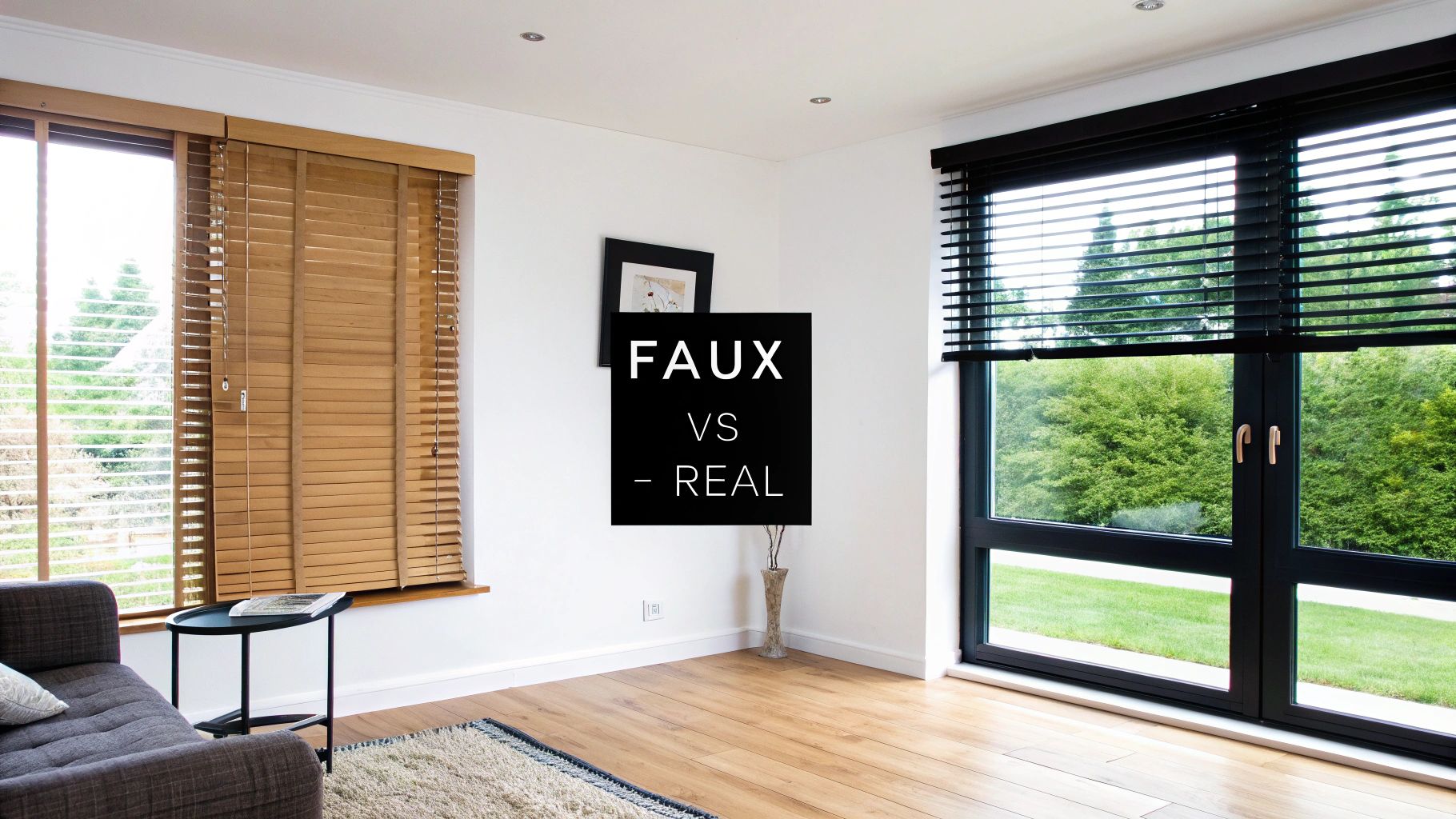
The rise in popularity of faux wood isn't just something we're seeing locally; it's happening everywhere. In fact, faux wood blinds now command a solid 22% market share globally. Why? Because they perform incredibly well in damp, humid areas where real wood would quickly warp and fail. It’s a practical solution for a common problem.
This kind of decision-making process pops up all over home design. You see similar trade-offs when comparing manufactured wood flooring vs laminate options, where you're weighing authenticity against durability and cost.
To make things a little easier, we've put together a simple comparison. And if you want to dive even deeper, our guide on choosing the perfect custom window blinds has even more detailed insights.
Faux Wood vs Real Wood Blinds at a Glance
For a quick overview, this table cuts right to the chase. It’s designed to help Delmarva homeowners see the key differences at a glance and make a decision that feels right for their home and lifestyle.
Feature | Faux Wood Blinds | Real Wood Blinds |
|---|---|---|
Material | Durable PVC or composite materials | Genuine hardwood (e.g., basswood) |
Moisture Resistance | Excellent; will not warp, crack, or peel | Poor; susceptible to warping and damage |
Best For | Kitchens, bathrooms, laundry rooms, coastal homes | Living rooms, bedrooms, dining rooms, offices |
Cost | More budget-friendly | Premium price point |
Weight | Heavier, may not be ideal for very large windows | Lighter, easier to lift on large windows |
Durability | Highly durable and scratch-resistant | Can dent or scratch more easily |
Maintenance | Easy to clean with a damp cloth | Requires gentle dusting and specific wood cleaners |
Ultimately, the table shows there's no single "best" option—just the best option for a specific room and a specific need. Hopefully, this side-by-side look clears things up and points you in the right direction.
Key Differences: Faux Wood vs. Real Wood Blinds
When you start looking at window treatments, the choice between faux wood and real wood blinds is one of the first big decisions you'll make. It’s about more than just a quick features list. For homeowners here on Delmarva, this choice really affects the long-term look, feel, and durability of your space. Getting into the details of material, aesthetics, and even weight is how you make a decision you'll be happy with for years to come.
As a local, family-run business, Home Blinds & Floors provides personal service, competitive pricing, and professional installation throughout Sussex, Wicomico, Kent, and beyond. We bring our showroom right to your door, so you can see and feel the difference between these materials in your own home, with your own light.
Material Composition and Durability
The core difference is simple: what they're made of. Faux wood blinds are engineered products, usually built from tough PVC or a composite material. They are designed from the ground up to handle daily life, making them incredibly resistant to scratches, dents, and the fading that comes from our strong coastal sun.
Real wood blinds, on the other hand, are crafted from genuine hardwoods—basswood is a popular choice. We love basswood because it's both lightweight and strong, a perfect combination for window coverings. But, because it's a natural product, it is inherently a bit softer and can be more prone to dings or scratches in a busy part of the house.
Key Takeaway: If you're in a bustling Salisbury home with kids and pets, or outfitting a commercial space in Easton, the sheer resilience of faux wood is a huge plus. Real wood offers that classic charm but does best in a calmer environment where it can stay looking its best.
This is the kind of trade-off homeowners face all the time. For more on how different materials stand up to our local climate, take a look at our guide on the best blinds for your Delmarva home, where we explore these choices in more detail.
Aesthetic Appeal and Authentic Finishes
Let's be honest, the first thing most of us notice is how they look. Real wood blinds bring an authentic, one-of-a-kind warmth that's tough to truly replicate. Every single slat has its own unique grain, knots, and texture, which adds a beautiful, organic character to a room. You can stain them to let that natural beauty shine through or paint them for a crisp, timeless finish.
That said, faux wood has come a long way. Today's high-quality faux wood blinds come in an amazing variety of finishes, including some incredibly realistic wood grain textures and a whole spectrum of colors. Their big advantage is consistency. Every slat is a perfect match, which creates a clean, uniform look that's ideal for a modern home or when you're covering a whole bank of windows.
Aesthetic Comparison:
Real Wood Blinds: Deliver authentic, unique grain patterns and a natural warmth that really elevates a living room or home office.
Faux Wood Blinds: Provide a flawless, consistent finish that's perfect for modern styles or any room where you want a crisp, uniform appearance.
While real wood has an undeniable elegance for premium spaces like a formal dining room, the market shows a clear trend. Industry analysis reveals that while real wood is prized for its natural warmth, faux wood’s moisture resistance makes it the go-to for over 60% of installations in humid spaces like kitchens and bathrooms. A recent industry report highlights these global trends in material preferences.
Weight and Its Impact on Large Windows
Here’s a practical point that often gets overlooked: the weight. Because they're made of dense composite or PVC, faux wood blinds are noticeably heavier than their real wood cousins. This doesn't matter much on a small window, but it can have some real implications.
This is where real wood shines. Its lighter weight makes it the clear winner for oversized windows. They're just easier to operate, and the reduced stress on the cords and internal parts can help them work smoothly for longer.
Custom Window Blinds vs. Store-Bought Options
Here on the Delmarva Peninsula, our coastal climate is a major factor in just about every home improvement decision we make. The constant humidity, salty air, and intense summer sun mean that when you're choosing between faux wood and real wood blinds, moisture resistance isn't just a nice-to-have feature—it's essential. This is probably the single most important difference between the two.

From free in-home consultations to flawless installation, Home Blinds & Floors takes the stress out of selecting window treatments. Our experts will measure your windows and help you choose the material that gives you the best blend of style and smooth, long-term function for your specific needs.
Faux Wood: The Unbeatable Choice For Humid Spaces
In rooms that see a lot of moisture—think bathrooms, kitchens, laundry rooms, and even sunrooms—faux wood is the undisputed champion. These blinds simply will not warp, crack, swell, or peel, no matter how steamy things get. That kind of durability makes them a smart, long-term investment for the toughest spots in your home.
This resilience also makes cleaning a breeze. Since the material is non-porous, you can wipe them down with a damp cloth to get rid of dust, grime, or kitchen splatters without worrying about damage. For a busy household, that low-maintenance aspect is a huge win. The performance is so dependable that it's often compared to other tough materials; we dive into a similar topic in our guide comparing faux wood and vinyl blinds.
The Vulnerability Of Real Wood In Coastal Climates
Real wood, for all its timeless beauty, is naturally porous. It absorbs moisture right out of the air, a trait that makes it a risky choice for the Eastern Shore’s humid environment. When real wood blinds are constantly exposed to high humidity, a few problems can start to pop up.
Common Problems for Wood Blinds in Humid Areas:
Warping: The slats can twist or bend, which ruins their clean lines and affects how they operate.
Cracking: As the wood expands and contracts with moisture fluctuations, the finish can start to crack and peel.
Swelling: The slats might swell up, making it tough to raise, lower, or tilt the blinds.
To keep their structural integrity and beautiful finish, real wood blinds really need a stable, climate-controlled room. They are best saved for drier spaces like bedrooms, living rooms, and formal dining areas where humidity isn’t a concern.
While the beauty of real wood is undeniable, its susceptibility to moisture makes faux wood the smarter, worry-free investment for most rooms exposed to Delmarva’s coastal climate.
Cost, Insulation, and What You Get for Your Money
Choosing between faux wood and real wood blinds isn't just about looks—it's about making a smart financial decision for your home. You have to think beyond the initial price tag and consider the total cost of ownership. The right choice can bring you years of satisfaction and even save you money in the long run.
Home Blinds & Floors offers a wide selection of custom blinds and shades in Delmarva, with expert installers who bring the showroom to your living room. We'll help you weigh cost-benefit scenarios to find a solution that fits your budget perfectly.
Let's get right to it: faux wood blinds are significantly more affordable than real wood. The materials and manufacturing process for PVC and composite blinds are simply less expensive than sourcing and finishing genuine hardwood, and those savings get passed on to you. This makes faux wood a go-to solution for covering multiple windows at once.
Real wood blinds, on the other hand, are a premium home upgrade. They come with a higher price tag, but they can add real, tangible value to your property, much like installing hardwood floors. In the right room—think a formal dining room in Easton or a classic study in a historic Lewes home—they feel like a luxury feature that elevates the entire space.
Insulation and Energy Efficiency
Your blinds do more than just control light; they also act as a barrier against outside temperatures. Because of its natural cellular structure, real wood has a slight edge here. Those tiny, natural air pockets in the wood grain are great at slowing down heat transfer, helping to keep rooms cooler in the summer and a bit cozier in the winter.
Over time, this can lead to some modest energy savings, especially in rooms where you spend the most time, like bedrooms and living rooms. If maximizing insulation is a top priority, you can dive deeper in our guide to the best blinds for insulation.
Expert Insight: While both types offer decent insulation, real wood's natural makeup gives it slightly better performance. Honestly, though, for most Delmarva homes, the difference you'll see on your energy bill will be pretty small. That makes durability and moisture resistance the more critical factors for long-term value.
Prioritizing Child and Pet Safety
If you have kids or pets running around, safety isn't just a feature—it's everything. Dangling cords on window treatments are a serious hazard, which is why the industry has moved toward much safer designs. Thankfully, both faux wood and real wood blinds are available with modern, safer operating systems.
Cordless Lift Systems: Just push up or pull down on the bottom rail to adjust the blinds. It’s that simple, and it completely removes dangerous, dangling cords from the equation.
Motorization: For the ultimate in safety and convenience, motorized blinds are a game-changer. Control them with a remote, an app on your phone, or link them to your smart home system. They're also a perfect solution for those high, hard-to-reach windows.
These modern systems are essential for creating a worry-free home. For a deeper dive into these options, check out our guide on the safety and style of cordless window blinds.
Making the Right Choice for Your Delmarva Home
So, which is it: faux wood or real wood? The truth is, the right choice really boils down to the specific room and the unique environment of your home. It’s less about one being universally "better" and more about matching the material's strengths to your everyday life and design goals.
Thinking room by room is always the best way to go. This approach guarantees you get the performance, look, and value you expect from your new window treatments. For a busy family home near Rehoboth Beach, faux wood blinds are a no-brainer for kitchens, bathrooms, and laundry rooms. For a formal dining room in a historic Easton home, nothing beats the classic elegance of real wood blinds.
This decision tree gives you a great visual for walking through the key factors—like customization, safety, and maintenance—that will point you toward the right material.
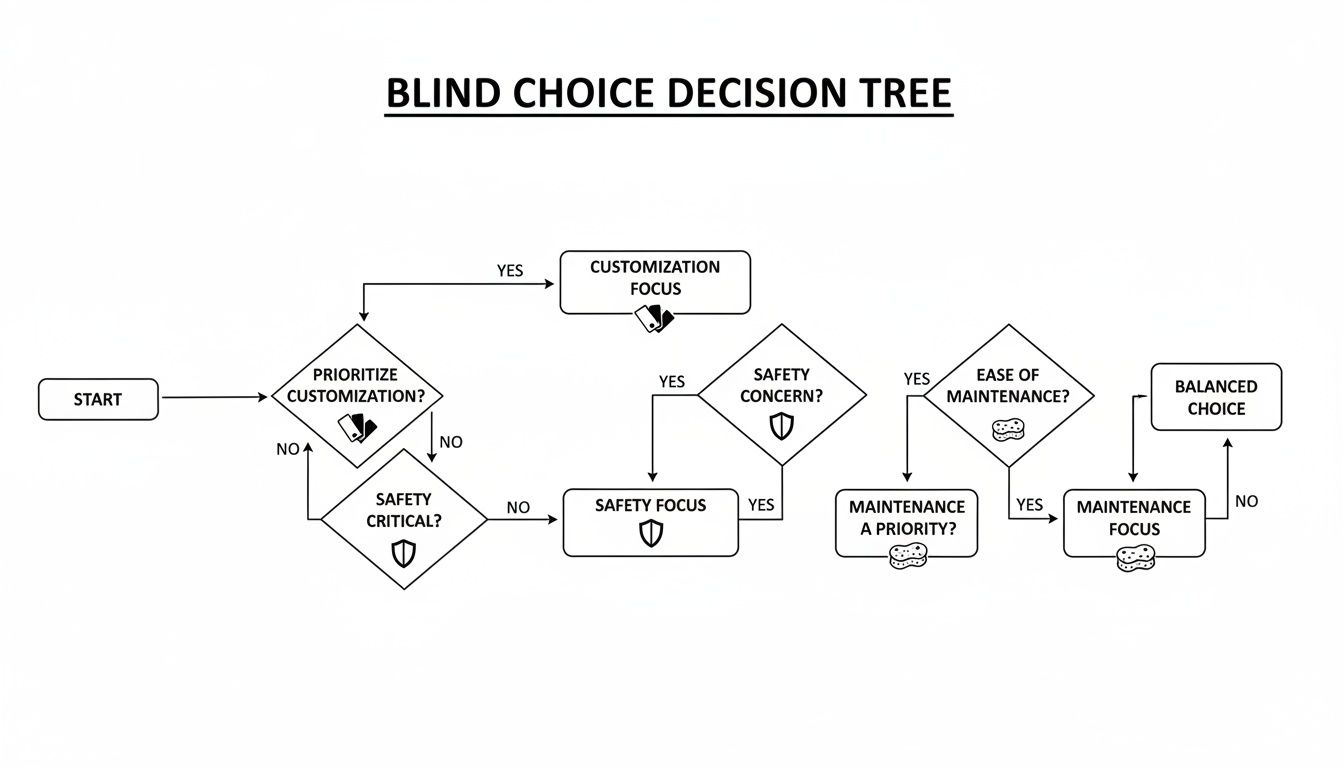
When you can picture how each material will function in your own space, you move past a simple faux wood blinds vs wood blinds debate and start creating a home that’s both beautiful and practical.
FAQ: Faux Wood vs. Real Wood Blinds
When you're deciding between faux wood and real wood blinds, a few questions always come up. Here at Home Blinds & Floors, we've heard them all from folks across the Delmarva Peninsula, from Salisbury to Kent Island. Let's clear things up so you can feel great about your choice.
Do faux wood blinds look cheap?
Not at all. While older versions may have looked plasticky, today’s high-quality faux wood blinds feature realistic wood grain textures and a solid, substantial feel that convincingly mimics genuine hardwood. From a normal viewing distance, it's often hard to tell the difference.
Are real wood blinds a good choice for coastal homes in Delaware and Maryland?
For rooms like bedrooms, living rooms, and offices that have stable humidity, real wood blinds are an excellent, beautiful choice. However, for kitchens, bathrooms, or any area exposed to the high humidity of our coastal climate, we strongly recommend faux wood blinds to prevent warping, cracking, or swelling.
Which blinds are better for privacy and light control?
Both faux wood and real wood blinds offer excellent, adjustable control over light and privacy. The ability to tilt the slats gives you precise command over sunlight and outside views. For all practical purposes, both styles are top-performers, and your decision should focus more on the room’s humidity and your budget.
How much do custom window treatments cost in Delmarva?
The cost varies widely based on material, window size, and features like motorization. Faux wood blinds are generally more budget-friendly, making them a great option for outfitting multiple rooms. Real wood blinds are a premium investment that can add to your home's value. We provide a free in-home consultation with an exact quote tailored to your home.
What cities in Delmarva do you serve?
Home Blinds & Floors is proud to serve homeowners and businesses across the Delmarva Peninsula. Our service area includes Salisbury, Easton, Rehoboth Beach, Ocean City, Kent Island, and surrounding communities throughout Sussex, Wicomico, and Kent counties.
Why Work with Home Blinds & Floors?
In summary, Home Blinds & Floors provides custom window treatments, expert advice, and in-home service to homes across the Delmarva Peninsula. From Rehoboth Beach to Easton, our team is here to help you choose the best shades, shutters, or blinds for your space. We handle everything from the initial measurement to the final installation, ensuring a perfect fit and a stress-free experience.
Schedule your free consultation today.


Comments