.avif)
.avif)
.avif)
Louvered Shutters vs Raised Panel: Which Style Fits Your Home?


Choosing between louvered shutters vs raised panel shutters is one of the most common decisions homeowners on the Delmarva Peninsula face when refreshing their home's exterior or interior window treatments. Louvered shutters feature horizontal angled slats that allow airflow and light filtration, while raised panel shutters display solid rectangular panels with a raised three-dimensional profile, resembling a classic cabinet door. Both styles are widely available in wood, vinyl, and composite materials, and both are priced comparably for standard sizes. The right choice depends on your home's architectural style, your climate, and whether you prioritize ventilation or a cleaner, more formal look.
Louvered shutters are the most popular window shutter type in America, suited for Colonial, Cape Cod, and farmhouse-style homes where airflow and a relaxed aesthetic matter.
Raised panel shutters deliver a formal, structured appearance that complements Georgian, Federal, Colonial, and traditional brick homes without the maintenance complexity of slats.
Both styles are available from manufacturers like Mid-America in standard widths from 9.25 inches to 18 inches and standard heights from 25 to 80 inches, with custom sizing available at a premium.
Pricing between the two styles is nearly identical for standard vinyl; raised panel typically costs slightly less than board and batten but is comparable to louvered in most product lines.
Coastal homeowners in areas like Rehoboth Beach, Bethany Beach, and Ocean City should weigh humidity resistance and salt-air durability as primary factors alongside aesthetics.
A hybrid combination shutter, louvered on top and raised panel on the bottom, offers a middle-ground option that many homeowners overlook entirely.
What Is the Difference Between Raised Panel and Louver Shutters?
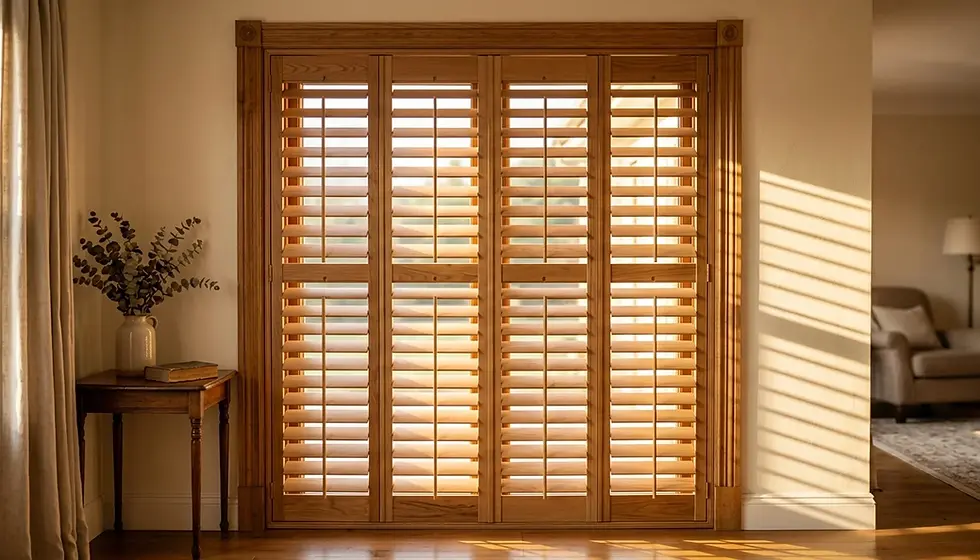
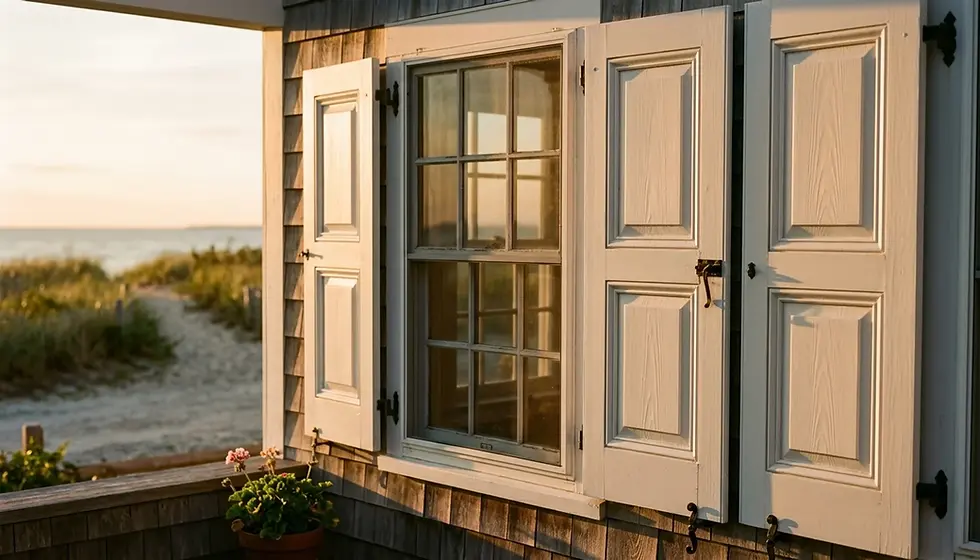
Louvered shutters are a window shutter style defined by a series of horizontal angled slats, called louvers, set within a fixed frame. Raised panel shutters are a window shutter style defined by solid rectangular sections that project outward from the frame in a three-dimensional profile. The distinction affects everything from how light passes through them to how they perform in coastal humidity and how much time you spend cleaning them each season.
Specifically, louvered shutters let air and filtered light pass through the slats even when the shutter is closed. This made them genuinely functional on older homes before air conditioning, and today they retain that visual association with ventilation and open-air living. Raised panel shutters, in contrast, are fully solid. They offer no airflow but deliver a heavier, more architectural presence on the facade.

For homeowners on the Eastern Shore, this functional difference matters less today than the aesthetic signal each style sends. Louvered shutters read as relaxed, coastal, and traditional without being stiff. Raised panel shutters read as formal and heritage-oriented. Neither choice is wrong; each serves a different architectural language.
At Home Blinds and Floors, we regularly advise clients across communities from Lewes and Milton to Easton and Centreville on exactly this question, and the architectural style of the home is almost always the deciding factor once homeowners understand the actual visual difference between the two profiles.

What Is the Most Popular Style of Shutters?
Louvered shutters are the most popular window shutter style in America, based on data from leading vinyl shutter manufacturers including Mid-America, which produces louvered shutters across a wider range of standard height increments than any other single style. Their dominance comes from versatility: the angled slat profile works on everything from a narrow Cape Cod window to a tall colonial facade without looking out of place.
The global shutters window covering market was valued at USD 8.2 billion in 2026 and is projected to reach USD 13.5 billion by 2033, according to MarketsizeandTrends research, growing at a CAGR of 5.8% through the forecast period. Within that market, wooden and composite shutters represent the leading product segments. Louvered profiles account for a significant share of that residential volume, particularly in North America, where the U.S. shutters market alone was valued at USD 4.2 billion in 2026.
Raised panel shutters hold strong ground in the Northeast and Mid-Atlantic, where Colonial and Federal architecture is most concentrated. In Maryland and Delaware specifically, both styles appear frequently on older homes, and the choice between them often reflects the home's original construction era as much as current owner preference.
Board and batten shutters round out the three primary shutter families, best suited for farmhouse, craftsman, and cottage-style homes. If your home falls into that vernacular rather than colonial or traditional, board and batten deserves consideration alongside the louvered and raised panel options. Our shutters installation service covers all three styles with professional measurement and fitting for Delmarva homes.
Are Plantation Shutters Still in Style in 2026?
Plantation shutters remain a widely specified interior shutter option in 2026, though the design conversation around them has shifted toward selectivity rather than blanket application. The criticism that appeared in 2026 and 2026 centered not on the shutter style itself but on the overuse of stark white plantation shutters on every window in every room regardless of architectural context. When applied thoughtfully, they remain a strong design choice.
The trend shaping 2026 installations is the move toward natural-toned and painted-wood plantation shutters rather than stark bright white. Warm whites, soft greiges, and painted-to-match-trim finishes are replacing the high-contrast look that dominated the previous decade. For coastal homes in Rehoboth Beach and Bethany Beach, off-white and driftwood tones coordinate well with the bleached palette typical of Eastern Shore interiors.
Smart home integration is also influencing shutter selection this year. By 2027, industry projections from Research and Markets indicate that 35% of new shutter installations will incorporate smart features, representing a USD 4.7 billion revenue opportunity globally. Motorized plantation shutters with voice control and app-based operation are gaining traction in higher-end coastal properties and vacation rental homes across the Delmarva Peninsula.
If you are asking whether plantation shutters are dated, the honest answer is: no, but uniform white plantation shutters on every window in a home built after 2000 can feel formulaic. Mix with complementary treatments, vary the louver size by room, or pair shutters on street-facing windows with softer shades on interior rooms for a layered result. Our custom shutters category covers the full range of options available for Delmarva homes today.

Why Are People Getting Rid of Plantation Shutters?
Homeowners are removing plantation shutters for three specific reasons: design fatigue from overexposure, practical cleaning challenges in high-humidity coastal environments, and the shift toward lighter, less structured window treatment aesthetics. None of these reasons make plantation shutters objectively inferior. They do signal that shutter selection requires matching the product to the context rather than installing them by default.
The cleaning issue is real, particularly for coastal properties in Ocean City, Bethany Beach, and Ocean Pines. Salt air deposits on louvered shutter slats, whether interior plantation or exterior louvered styles, require more frequent maintenance than solid panel shutters. Each individual slat needs wiping, and wider louvers (3.5 to 4.5 inches) present more surface area per slat than traditional exterior louvered shutters with thinner slats. Homeowners who underestimated this maintenance burden are the most likely candidates for replacement.
The design shift is also about proportion. Plantation shutters installed without professional measurement can overwhelm smaller windows or create a heavy, closed-off feel in rooms that would benefit from more natural light. This is not a flaw in the product; it is a flaw in the specification process.
The practical fix is not necessarily removing shutters but replacing them with the right style for the room and window size. Interior louvered shutters with narrower slats suit cottage-style windows with their taller lower sash and shorter upper sash. Raised panel shutters, either exterior or interior café-style applications, work on windows where a cleaner solid profile reduces visual noise. Working with a consultant who measures your specific windows before ordering prevents the mismatch that drives most removals.
Louvered Shutters vs Raised Panel: A Side-by-Side Comparison
Comparing louvered shutters vs raised panel across the attributes that actually matter to a homeowner purchasing in 2026 requires going beyond the basic aesthetic description. The table below covers the practical decision points: ventilation, maintenance, cost, installation complexity, climate performance, and the architectural styles each serves best.
Attribute | Louvered Shutters | Raised Panel Shutters |
Visual Profile | Horizontal angled slats; open, airy appearance | Solid raised rectangular sections; formal, structured look |
Light and Ventilation | Allows filtered light and airflow through slats | Fully solid; no airflow or light filtration |
Maintenance | Higher: each slat requires individual wiping | Lower: flat panels wipe clean quickly |
Privacy (exterior decorative) | Moderate: slat angle creates visual breaks | High: solid surface blocks sightlines completely |
Typical Cost (vinyl, standard) | Comparable to raised panel in most product lines | Comparable to louvered; slightly less than board and batten |
Installation Complexity | Slightly higher: slat alignment requires precision | Lower: solid frame installs with straightforward mounting |
Best Architectural Styles | Colonial, Cape Cod, farmhouse, coastal cottage | Georgian, Federal, traditional brick, formal Colonial |
Coastal Humidity Performance | Good with vinyl or composite; wood warps faster | Good with vinyl or composite; solid panel resists moisture better than slats |
Storm and Wind Protection | Functional if properly mounted; slats can catch wind | Solid panel provides more uniform wind resistance when functional |
Standard Heights (Mid-America) | 25 to 80 inches in 4-inch increments | 31 to 80 inches in 4-inch increments |
Standard Widths (Mid-America) | 9.25, 12, 14.5, 16.5, 18 inches | 9.25, 12, 14.5, 16.5, 18 inches |
One detail most buyers miss: Mid-America louvered shutters start at a minimum height of 25 inches, while raised panel shutters start at 31 inches. If your windows are on the shorter side, louvered may be your only standard-size option, and ordering custom sizing adds a meaningful cost premium. Confirm your window dimensions before committing to either style.
Which Style Performs Better in Coastal and Humid Climates?
Exterior shutter performance in coastal and high-humidity climates depends more on material selection than shutter style, but the physical profile of each style creates real differences in moisture exposure and maintenance burden. Louvered shutters, with their open slat construction, collect more airborne salt, pollen, and moisture in the gaps between slats than the smooth surface of a raised panel shutter. In practice, this means louvered exteriors in beachfront communities from Lewes to Ocean City require more frequent rinsing to prevent salt deposit buildup.
For functional shutters intended to provide storm protection, the IBHS Selection Guide for Shutters and Other Protective Barriers from the Insurance Institute for Business and Home Safety is the authoritative reference. The IBHS guide evaluates shutters specifically as protective barriers against wind-driven rain, and its criteria favor solid, tightly fitted panels over open-slat designs for wind and impact resistance. This is a meaningful consideration for homes in Delaware and Maryland's coastal zones, where storm seasons create real structural exposure.
Raised panel shutters in vinyl or high-density composite perform well in the freeze-thaw cycles common to the northern Delmarva Peninsula communities like Middletown, DE and Centreville, MD. The solid panel structure expands and contracts more uniformly than a slat assembly, reducing the risk of individual components loosening or cracking over multiple seasons.
Wood shutters in either style require painted finishes and annual inspection in coastal environments. Faux wood and cellular PVC composites outperform natural wood significantly in salt air. For most coastal homeowners, the material choice matters more than the style choice when long-term durability is the priority.
Does Your HOA or Neighborhood Have a Say in Your Shutter Style?
Homeowner association rules and local historic district guidelines can restrict or mandate specific shutter styles, and this is a practical factor that most shutter guides overlook entirely. In established communities across the Delmarva Peninsula, particularly in Rehoboth Beach's historic neighborhoods and Maryland Eastern Shore towns with designated historic districts like Easton and Cambridge, your shutter choice may require prior approval.
HOA architectural guidelines most commonly specify the following: approved shutter styles (louvered, raised panel, or board and batten), acceptable material types (wood only, or vinyl permitted), color restrictions tied to the community's approved palette, and whether shutters must be functional or may be decorative. Some associations in resort communities along the Delaware coast restrict bright whites and require neutral or historically appropriate tones.
Historic district reviews in Maryland and Delaware require that exterior changes, including shutter replacement, match the period-appropriate character of the structure. For a Federal-style brick townhome in Easton's historic core, raised panel shutters in a dark painted wood or painted composite are almost always the architecturally correct choice. Louvered shutters on the same structure may not pass a certificate of appropriateness review.
Before ordering, contact your HOA architectural review committee or your municipality's historic preservation office with the specific style, material, and color you are considering. Getting that written approval before installation prevents costly reversals. Our team at Home Blinds and Floors regularly helps clients in Annapolis, Easton, and Rehoboth Beach navigate exactly these approval processes before we proceed to measurement and installation.
What Is the Hybrid Combination Shutter Option?
The combination shutter is a shutter style that pairs a louvered top section with a raised panel bottom section within a single shutter unit. This hybrid profile is a genuine product category, not a custom fabrication workaround. Mid-America produces combination shutters as a standard specialty option, making them accessible at prices comparable to single-style shutters rather than requiring a fully custom order.
The combination style solves a specific visual problem: homes where neither a fully louvered nor a fully raised panel shutter looks proportionally correct. On taller windows common in two-story Colonial and Georgian homes, a full-height louvered shutter can appear visually busy across its entire length. A raised panel bottom grounds the lower portion while the louvered top maintains the airflow-associated texture at eye level.
For cottage-style windows with their characteristic taller lower sash and shorter upper sash, combination shutters offer another advantage. The panel section can align with the lower sash while the louvered section corresponds to the upper opening, creating a visual logic that a single-style shutter would not achieve as naturally.
If you find yourself drawn to both styles and unable to commit, do not default to one arbitrarily. The combination option exists precisely for this scenario. It is underspecified in most shutter guides, but it is a practical solution that many Delmarva homeowners discover only after a consultation with a window treatment professional.
Does Your Shutter Choice Affect Resale Value?
Shutter style affects resale value primarily through curb appeal and architectural coherence rather than through the monetary value of the shutters themselves. Buyers evaluating homes in communities like Kent Island, Grasonville, and Salisbury respond to whether the exterior details feel intentional and matched to the home's style. A raised panel shutter on a Federal brick home reads as appropriate and adds perceived quality. The same raised panel on a Cape Cod cottage may feel mismatched and actually reduce buyer confidence in the property's overall aesthetic decisions.
The more direct resale consideration is material durability. Vinyl and composite shutters in good condition require no disclosure and no buyer concern at the point of sale. Wood shutters showing paint failure, warping, or salt damage in coastal markets become a negotiating point. Buyers in beach communities from Bethany Beach to Ocean Pines are experienced at spotting deferred exterior maintenance, and shutters are one of the first things they notice.
Replacing deteriorated shutters before listing consistently returns more value than their material cost. A complete set of exterior shutters in the correct style for the home's architecture presents as a finished, cared-for exterior. That perception carries more weight in an appraisal narrative than any single line-item feature.
The safest resale position: choose the style that is architecturally correct for your home's original design language, install it in a quality composite or cellular PVC material, and keep the color within the established palette for your neighborhood. That combination maximizes curb appeal for the broadest pool of prospective buyers.
How to Choose Between Louvered and Raised Panel: A Decision Framework
Choosing between louvered shutters and raised panel shutters becomes straightforward once you work through four specific criteria in sequence. Start with architectural style, move to climate and maintenance tolerance, check HOA rules, then finalize with budget and sizing.
Match your home's architectural vocabulary first. Georgian, Federal, and traditional brick homes: raised panel. Colonial, Cape Cod, farmhouse, and coastal cottage: louvered. If your home does not fit neatly into either, the combination shutter is worth a consultation.
Assess your maintenance tolerance for coastal conditions. If your property is within a mile of the ocean or a tidal bay, and you are not prepared to rinse shutter exteriors seasonally, raised panel is the lower-maintenance choice. Solid surfaces shed salt and debris faster than slat assemblies.
Check HOA and historic district requirements before you measure. Get written approval for your specific style, material, and color. This step prevents the most expensive mistake in the process.
Confirm standard sizing before choosing a supplier. Measure your window height and width precisely. If your windows fall below 31 inches in height, raised panel may not be available in a standard size from major manufacturers, making louvered the practical default or requiring a custom order at premium cost.
Consider the hybrid combination shutter if you are genuinely undecided. It is not a compromise; it is a legitimate design solution that suits taller windows and mixed architectural contexts well.
Select material based on your climate zone. For Delmarva Peninsula homes, cellular PVC composite and high-density vinyl outperform painted wood in longevity and salt-air resistance. Reserve wood for interior applications where the aesthetic benefit justifies the higher maintenance demand.
If you are still uncertain after working through these steps, an in-home consultation eliminates the guesswork. A professional can evaluate your actual windows, your home's exterior character, and your specific neighborhood context before recommending a style and material combination.
Frequently Asked Questions
What is the main functional difference between louvered and raised panel shutters?
Louvered shutters feature angled horizontal slats that allow airflow and filtered light to pass through even when the shutter is closed. Raised panel shutters are fully solid, with no openings. For decorative exterior shutters, this functional difference is largely aesthetic today, but it matters for homeowners selecting interior shutters for light control or for functional exterior shutters intended to provide storm protection.
Which shutter style is easier to clean and maintain?
Raised panel shutters are easier to maintain because their smooth, solid surface wipes clean with a damp cloth in a single pass. Louvered shutters require wiping each individual slat, and in coastal environments like Rehoboth Beach or Ocean City where salt air deposits accumulate, this becomes a meaningful time commitment. Vinyl and composite materials reduce maintenance requirements for both styles compared to painted wood.
Are louvered or raised panel shutters better for a coastal home?
For coastal homes on the Delmarva Peninsula, raised panel shutters in vinyl or composite material generally outperform louvered shutters in durability because solid panels shed salt and moisture more efficiently than slat assemblies. For wind and storm protection, the Insurance Institute for Business and Home Safety (IBHS) recommends tightly fitted solid panel barriers over open-slat designs. Material selection, specifically cellular PVC or high-density vinyl over painted wood, matters more than style in salt-air environments.
Do louvered and raised panel shutters cost the same?
Yes, louvered and raised panel shutters are priced comparably across most product lines for standard sizes. Both fall below board and batten shutters in cost for equivalent dimensions according to Mid-America's product structure, which is one of the most widely referenced vinyl shutter manufacturers in the U.S. Custom sizing for either style adds a significant premium over standard incremental heights and widths.
Can I mix louvered and raised panel shutters on the same house?
Mixing styles on the same facade is generally not recommended for homes where visual consistency is a priority. However, the combination shutter, which pairs a louvered top section with a raised panel bottom within a single unit, is a purpose-built solution that blends both profiles intentionally. Mid-America produces combination shutters as a standard specialty product. For homeowners who genuinely suit both styles, this is a cleaner solution than mixing full-style shutters across different windows.
Will my HOA allow either shutter style?
HOA rules vary significantly by community. Many associations on the Delmarva Peninsula specify approved shutter styles, materials, and colors in their architectural guidelines. Historic districts in Maryland and Delaware, including areas of Easton and Cambridge, may require period-appropriate styles that match the home's original construction era. Always request written approval from your HOA architectural review committee or local historic preservation office before ordering and installing any exterior shutters.
What window treatment options work alongside exterior shutters for interior light control?
Exterior shutters address curb appeal and facade character but do not control interior light or privacy on their own. For interior light control, cellular shades, roller shades, and interior plantation shutters are the most common companions to exterior shutter installations. Cellular shades are particularly effective for energy efficiency in coastal homes with significant sun exposure. You can explore the full range of interior options in our custom window treatments resources or review our cellular shades category for energy efficiency comparisons.
Making the Right Choice for Your Delmarva Home
The louvered shutters vs raised panel decision comes down to a clear hierarchy: architectural style first, then climate and maintenance tolerance, then HOA rules, and finally sizing and budget. Louvered shutters win on versatility and that relaxed coastal character that suits Cape Cod, farmhouse, and Colonial homes throughout the Eastern Shore. Raised panel shutters win on low maintenance, formal presence, and solid-surface performance in humid coastal environments. Neither is universally superior. Each is the right answer in the right context.
What is universally true in 2026 is that material quality matters more than style choice for long-term satisfaction. A well-specified vinyl or composite shutter in the appropriate style for your home will outperform a wood shutter in the wrong style by every measure that matters: durability, cost over time, and buyer perception at resale.
If your project involves both exterior shutters and interior window treatments, the specification decisions interact. A formal raised panel exterior pairs naturally with structured interior treatments. A louvered coastal exterior often works better alongside softer interior shades rather than heavy drapery. Thinking about both layers together produces a more cohesive result than treating them as separate decisions.

Ready to work through the specifics for your home? Get started with Home Blinds and Floors for a free in-home consultation. Our team serves communities across the Delmarva Peninsula from Rehoboth Beach and Lewes to Easton, Salisbury, and Kent Island, measuring your actual windows and recommending the style and material combination that fits your home's architecture, your coastal environment, and your budget.

Comments