.avif)
.avif)
.avif)
Louver Shutters Interior: The Complete Buyer's Guide for 2026

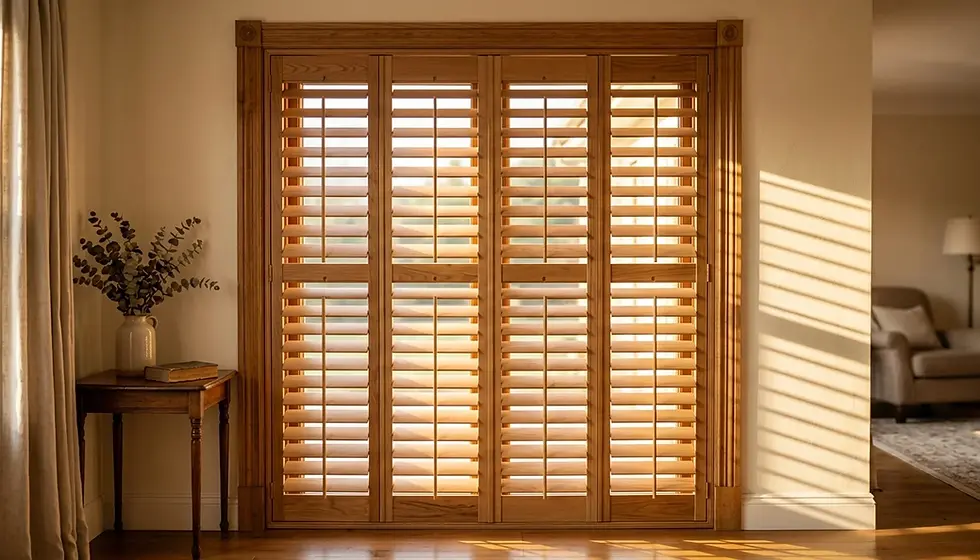
Interior louver shutters are hinged or tracked wooden or synthetic panels installed directly on a window frame, featuring adjustable horizontal slats (louvers) that rotate to control light, airflow, and privacy. In 2026, they remain one of the most requested window treatment upgrades among homeowners on the Delmarva Peninsula, and for good reason: a well-fitted set of shutters can serve a home for decades with minimal maintenance.
Interior louver shutters feature adjustable horizontal slats available in sizes from 1.25 inches (traditional) up to 4.5 inches (plantation), with larger louvers providing better outside views when open.
Material options include real hardwood (basswood, poplar, oak), faux wood poly resin vinyl, and hybrid polymer; faux wood and polymer perform best in high-humidity rooms like bathrooms and kitchens.
According to Transparency Market Research, the North America interior shutters market was valued at USD 16.87 billion in 2026 and is projected to reach USD 30.73 billion by 2035.
Louver size is the single most important specification decision: 3.5-inch and 4.5-inch louvers are the current design standard for living rooms and bedrooms, while 1.25-inch louvers suit historic or colonial-style homes.
Professional in-home measurement eliminates the most common and costly installation mistakes, particularly for specialty windows like arched frames, bay windows, and sliding glass doors.
A divider rail is structurally required for any panel taller than 66 inches, and frame style (L-Frame, Z-Frame, Casing, Bullnose) determines how much the shutter protrudes into the room.
What Are Interior Louver Shutters?
Interior louver shutters are window coverings consisting of a rigid frame holding a series of horizontal rotating slats, called louvers, that tilt open or closed to manage light and privacy. Unlike fabric window treatments, louvered shutters are permanently mounted to the window frame and function independently of curtains or blinds. They are available in wood, composite, and vinyl materials, and the louver slat width is the primary specification that defines both the look and the functional performance of the product.
The term "plantation shutter" refers specifically to interior louver shutters with wider slats, typically 2.5 inches or larger. Traditional louvered shutters use narrower 1.25-inch slats that replicate colonial and craftsman architectural details. Both belong to the broader category of paneled shutters, which also includes solid raised-panel and board-and-batten designs.
At Home Blinds and Floors, we install louvered shutters across the Delmarva Peninsula from Rehoboth Beach to Kent Island, and the question we hear most often is not "what are louver shutters?" but rather "which louver size is right for my room?" That is exactly where this guide starts.

What Louver Sizes Are Available and Which One Should You Choose?
Interior louver shutters are available in four standard slat widths: 1.25 inches (traditional), 2.5 inches (transitional plantation), 3.5 inches (standard plantation), and 4.5 inches (wide-view plantation). The slat width affects how much of the outdoors you see when the louvers are fully open, how much light enters the room when partially adjusted, and how the shutter reads visually against the wall.
Louver Size | Best Room Type | View-Through When Open | Best Architectural Style | Trade-Off |
1.25 inch | Historic homes, small windows | Limited | Colonial, Federal, Craftsman | Looks dated in modern interiors |
2.5 inch | Bathrooms, smaller windows | Moderate | Traditional, cottage | Fewer slats visible; less "airy" look |
3.5 inch | Living rooms, bedrooms, kitchens | Excellent | Transitional, coastal, contemporary | Slightly more expensive than 2.5 inch |
4.5 inch | Large windows, great rooms | Maximum | Modern, open plan, coastal luxury | Heavier panels require sturdy frame |
Blindsgalore identifies the 3.5-inch configuration as their top-selling louver size and describes it as a "designer's choice" because it provides superior view-through compared to narrower alternatives without the structural weight demands of 4.5-inch slats. That tracks with what we see across consultations at Home Blinds and Floors: clients who choose 3.5-inch louvers rarely second-guess the decision.
For historically accurate installations, the Louver Shop offers traditional shutters with 1.25-inch louvers that replicate the most historically exact interior shutter style. For large open-plan coastal homes along the Bethany Beach or Lewes shoreline, 4.5-inch louvers open up the view entirely, which is often the point.
What Materials Are Interior Louver Shutters Made From?
Interior louver shutters are manufactured from three primary material categories: real hardwood, faux wood poly resin vinyl, and hybrid polymer composites. Each material performs differently across cost, durability, moisture resistance, and paint finish quality, and the right choice depends heavily on which room the shutters will occupy.
Real Hardwood Shutters
Real wood shutters are milled from species including basswood, poplar, red oak, cypress, mahogany, and yellow pine. Basswood is the industry standard because it is lightweight relative to its strength and accepts paint and stain finishes without grain interference. According to Southern Shutter Company, their movable louver line uses basswood or pre-primed poplar as the default species, with oak, cypress, and mahogany available for specific architectural or finish requirements.
Wood shutters held a 48.9% material segment share in the North America interior shutters market in 2026, according to Transparency Market Research. That dominance reflects homeowner preference for the warmth, weight, and finish versatility that real wood provides. The practical limitation is moisture: real wood can warp in bathrooms and kitchens with sustained humidity exposure.
Faux Wood (Poly Resin Vinyl) Shutters
Faux wood shutters use a hollow core poly resin vinyl construction with aluminum inserts in the louvers for reinforcement at roughly 20-inch intervals, depending on panel width. Blindsgalore's faux wood shutter line carries a 25-year warranty and is fully waterproof, making it a strong candidate for bathrooms, laundry rooms, and kitchens where real wood risks warping. The trade-off is weight: wider faux wood panels are heavier than comparable hardwood panels, which affects how smoothly bi-fold configurations operate over time.
Hybrid Polymer Shutters
Hybrid polymer shutters, like those offered by the Louver Shop under their LouverWood label, use a composite core that claims three times the insulation value of standard wood shutters. Polymer composites resist moisture, support wide paint color ranges, and hold their shape in temperature-fluctuating spaces. For Delmarva coastal homes where salt air accelerates corrosion and humidity stays elevated through summer, polymer shutters are often the most practical long-term investment.

What Frame Styles and Mounting Options Do Interior Shutters Come In?
Interior louver shutter frame style determines how the shutter mounts to the window, how much it projects into the room, and how much light control you gain at the perimeter edges. The four primary frame types are L-Frame, Z-Frame (including Bullnose Z-Frame), Casing Frame, and Trim Frame, each suited to different window depths and architectural conditions.
L-Frame
The L-Frame is the most versatile option and works for both inside-mount (fitting within the window recess) and outside-mount (attaching to the wall or casing surrounding the window) installations. It requires a minimum inside-mount depth of 3 inches. For outside-mount applications, a minimum clearance of 2.75 inches from the window face is the standard requirement.
Z-Frame and Bullnose Z-Frame
The standard Z-Frame sits flush against the window casing for a built-in appearance. The Bullnose Z-Frame variant projects 0.75 inches into the room while recessing 1.3125 inches into the window opening, creating a visual reveal that reads as architectural millwork. Coastal homeowners who want shutters to feel like original features of the home, rather than a window treatment added after the fact, frequently choose the Bullnose configuration.
Casing Frame
The Casing Frame projects 2.4375 inches into the room, the deepest of the standard frame options. This profile suits windows set into thick walls or recesses where the frame needs to bridge the gap between window and living space. It adds visual weight to the window and works well in rooms with high ceilings where scale matters.
For inside-mount installations across any frame type, Southern Shutter Company recommends a 1/8-inch deduction from the measured opening dimension to provide necessary clearance for smooth panel operation.
Which Tilt Mechanism Is Better: Front Tilt Bar or Hidden Gear?
Interior louver shutters use one of two tilt mechanisms to rotate the louver slats: a front tilt bar (a visible vertical rod running down the center of the panel face) or a hidden gear system (an internal mechanism concealed inside the vertical jamb with no visible hardware). The choice affects both aesthetics and ease of use.
The front tilt bar is the traditional and more widely available option. It uses a vertical tilt rod connected to each louver, with decorative cufflinks and end caps. It is straightforward to operate and to repair if a louver loses tension. The downside is visual: the rod divides the panel and breaks the clean horizontal line of the louver slats.
The hidden gear tilt system routes the adjustment mechanism inside the stile (the vertical frame member), leaving the louver face completely unobstructed. The result is a cleaner, more contemporary look that reads as almost frameless from a distance. Hidden tilt systems cost more and are somewhat more involved to service, but for living rooms and bedrooms where the shutter face is prominently visible, the aesthetic difference is significant.
Our team at Home Blinds and Floors consistently recommends hidden tilt for primary living spaces and front tilt for utility spaces like bathrooms and laundry rooms, where budget efficiency matters more than sightline aesthetics.
How Do You Choose Louver Shutters for Specialty Windows?
Specialty and non-rectangular windows, including arched tops, bay windows, casement windows, and sliding glass doors, require custom configurations that standard off-the-shelf shutters cannot address. Each window type demands a specific approach to frame design, panel configuration, and measurement protocol.
Arched and Radius Windows
Arched windows require a separate fixed arch panel above the louvered operating panels. Southern Shutter Company offers sunburst radials, eyebrow arches, and quarter-round arch tops as custom configurations. The arch panel is typically fixed (non-operating) while the rectangular portion below uses standard movable louvers. When measuring for an arched shutter, the radius of the arch must be specified separately from the rectangular window dimensions below the spring line.
Bay Windows
Bay windows present an angle challenge: the three or five panels of a bay sit at angles to each other, which means hinges must allow panels to fold into the bay's geometry without binding. The solution is typically a multi-panel individually hinged configuration with a T-Post center support. Blindsgalore's four-panel individually hinged format with T-Post supports bay configurations up to 144 inches wide. The T-Post itself has a 1.25-inch visible center width, which adds a narrow vertical element at the center joint.
Sliding Glass Doors and Wide Openings
Sliding glass doors and wide picture windows require a bi-fold or tracked configuration that clears the opening completely when stacked. A four-panel bi-fold supports widths from 40 to 96 inches. Individual panels have a maximum width of 36 inches; anything wider requires splitting into additional panels for structural stability. For a full guide to treating wide glass door openings, the options for sliding glass door window treatments in Delmarva covers the trade-offs between shutters, vertical shades, and panel tracks in detail.
Tall Windows and Divider Rails
Any panel measuring 66 inches or taller structurally requires a divider rail, a horizontal crossbar that splits the panel into upper and lower operating sections. This prevents louver sag and maintains tilt tension across the full panel height. Off-center divider rail placement is available, which allows the split point to align with a window sill or furniture line rather than the geometric midpoint.

Which Room Benefits Most From Interior Louver Shutters?
Interior louver shutters perform differently depending on room function, window size, and the balance of privacy versus light that each space requires. A room-by-room approach is the most practical framework for making the right material and louver size decisions.
Living Room
Living rooms prioritize view-through and light quality over maximum privacy. A 3.5-inch or 4.5-inch louver in a real hardwood or hybrid polymer finish gives you the broadest outside view when open and the cleanest aesthetic when closed. Hidden tilt mechanisms work especially well here because the panel face is on full display. Frame choice matters more in living rooms than anywhere else: a Bullnose Z-Frame or Casing Frame adds architectural depth that flat L-Frames lack.
Bedroom
Bedrooms need stronger light blocking for morning sleep, particularly in coastal homes where east-facing windows catch early sun directly. Shutters are described as room-darkening by most manufacturers, though expect light lines of up to 1/16 inch at louver edges due to standard manufacturing tolerances. Pairing shutters with a blackout cellular shade on a separate headrail handles the gap for serious light blockers. Louver size in the 2.5-inch to 3.5-inch range suits most bedroom window proportions.
Bathroom
Bathrooms demand moisture-resistant materials above all else. Faux wood poly resin vinyl or hybrid polymer are the correct choices for any bathroom with a shower or bath. Real wood in a bathroom will expand and contract with humidity cycles, eventually causing louver binding and finish cracking. A 2.5-inch louver is proportionally appropriate for the smaller window sizes common in bathrooms, and front tilt bar mechanisms are easier to clean in wet environments than hidden gear systems.
Kitchen
Kitchens share the moisture concern of bathrooms, adding grease and steam to the maintenance equation. Faux wood shutters wipe clean with a damp cloth. The Louver Shop's heritage hardwood line works in kitchens that use effective ventilation, but polymer is the safer long-term recommendation for most coastal cooking environments. Consider modern window treatment options for Delmarva kitchens if you are weighing shutters against roller shades or cellular shades for your specific kitchen configuration.
Do Interior Louver Shutters Provide Sound and Thermal Insulation?
Interior louver shutters provide measurable insulation against both heat transfer and sound, a performance dimension that competitors rarely discuss but that homeowners consistently ask about. Closed louvered shutters create an air gap between the window glass and the room interior, functioning as a thermal buffer that reduces heat gain in summer and heat loss in winter.
Louver Shop states that their LouverWood composite shutters offer three times the insulation value of standard wood shutters. For context, any interior shutter in the closed position meaningfully reduces the rate of heat transfer compared to an uncovered window, particularly single-pane glass common in older Eastern Shore homes. North American building codes increasingly orient toward sustainability benchmarks, which is driving stronger demand for energy-efficient window treatments across both residential and commercial segments, according to Market Reports World's architectural louvers data.
On sound insulation, louvered shutters provide a modest acoustic benefit when fully closed. The rigid panels absorb and deflect some external noise, particularly higher-frequency sounds like traffic and wind. The improvement is not equivalent to acoustic glazing or heavy drapes, but it is real and noticeable in rooms facing busy roads. For coastal properties in Ocean City or Rehoboth Beach where summer crowds create constant ambient sound, combining shutters with cellular shades on a dual-mount headrail adds meaningful noise attenuation. Our page on cellular shades explains how the honeycomb cell structure contributes additional sound dampening beyond what shutters alone provide.
What Do Interior Louver Shutters Cost, and Is Professional Installation Worth It?
Interior louver shutters are categorized in the North American market across three price tiers: under USD 400, USD 400 to USD 800, and above USD 800 per window, reflecting the range from basic faux wood configurations to premium hardwood custom installations. These price points cover the product itself; professional measurement and installation add to the total project cost.
The case for professional installation comes down to risk. Individual shutter panels max out at 36 inches wide; misjudging a window's actual dimension by even 1/8 inch creates a gap or a binding fit that requires reordering. For specialty windows with arched tops, bay angles, or non-standard depths, the measurement protocol is specific enough that a single error is expensive. DIY installation works well for straightforward rectangular windows, and Blindsgalore notes that over 99% of their customers measure and install their own window coverings without professional assistance.
But "without professional help" does not mean "without errors." What it means is that most buyers complete the installation successfully. The buyers who run into problems are almost always those with out-of-square window frames, unusual mounting depths, or specialty configurations. For Delmarva homes, many of which include older construction with irregular framing, a professional in-home measurement from Home Blinds and Floors catches those issues before the shutter is manufactured. Custom products are non-returnable once produced.
You can also explore our custom window treatment cost guide for the Delmarva Peninsula for a broader pricing context that covers blinds, shades, and shutters across different budget tiers.
How Do You Customize the Finish and Hardware on Interior Louver Shutters?
Interior louver shutters offer extensive customization beyond louver size and material: paint finish, wood species, hinge hardware, tilt mechanism, and frame style all combine to determine the final aesthetic. The finish options in 2026 range from factory-painted white and off-white to custom color matching and natural wood stains.
Southern Shutter Company matches all paint finishes to Sherwin Williams, Benjamin Moore, and PPG color systems by supplying the manufacturer's color name and color number. This means your shutters can match your existing trim paint exactly, a detail that separates custom shutters from off-the-shelf products. The Louver Shop's Heritage Hardwood line is crafted from American hardwood and carries a lifetime warranty on components and finish.
Hinge hardware finishes include antique brass, brushed nickel, chrome, oil rubbed bronze, polished brass, white, and stainless steel powder coated black, according to Southern Shutter Company's specification list. Hardware finish selection should coordinate with your existing door hardware and plumbing fixtures rather than matching them exactly. A mixed-metal approach where shutters use brushed nickel while door hardware uses matte black reads as intentional in 2026 design; identical matching across every element tends to read as dated.
For hinge quantity, Southern Shutter recommends four hinges per pair for shutters up to 48 inches tall, six hinges for 48 to 96 inches, and eight hinges for panels from 97 to 120 inches. Under-hinging is a common mistake in DIY installations that causes panels to sag and louvers to gradually lose alignment.
Our broader custom shutters resource library covers additional configuration options for homeowners comparing shutter styles across different architectural contexts.
Frequently Asked Questions About Interior Louver Shutters
What is the difference between louver shutters and plantation shutters?
Plantation shutters are a subcategory of interior louver shutters defined by wider slat widths, typically 2.5 inches or larger. Traditional louver shutters use narrower 1.25-inch slats that replicate historical colonial-era designs. In everyday use, the terms are often used interchangeably, but technically every plantation shutter is a louvered shutter, while not every louvered shutter qualifies as a plantation style. The distinction matters when matching a shutter to the architectural period of a historic home.
Can interior louver shutters be installed in bathrooms?
Yes, but material selection is critical. Faux wood poly resin vinyl and hybrid polymer shutters are fully waterproof and the correct choice for bathrooms with regular humidity exposure. Real wood shutters can warp and crack in sustained moisture environments, leading to louver binding and finish failure. If you prefer the look of painted wood, a high-quality polymer with a painted finish is visually indistinguishable from real wood and will outlast it significantly in wet conditions.
What louver size gives the most privacy?
Smaller louver widths, specifically 1.25-inch and 2.5-inch slats, provide more overlap between slats when closed, resulting in slightly better light blocking at the edges. However, all interior louvered shutters in the closed position provide substantial privacy regardless of louver size. The manufacturing tolerance for light gaps is up to 1/16 inch at each louver edge. Louver size has a much greater impact on view-through when open than on privacy when closed.
Do interior louver shutters require a divider rail?
A divider rail is structurally required for any shutter panel measuring 66 inches or taller. The divider rail is a horizontal crossbar that splits the panel into upper and lower operating sections, preventing louver sag and maintaining tilt tension across the full height. For shorter panels under 66 inches, a divider rail is optional and can be added for visual effect or to allow independent upper and lower light control. Off-center rail placement is available to align with window sills or furniture.
How do I choose between a front tilt bar and hidden tilt mechanism?
Choose a hidden gear tilt system for living rooms, bedrooms, and any room where the shutter panel face is prominently visible from normal seating or standing positions. The hidden mechanism leaves the louver face completely unobstructed, which reads as more contemporary and architectural. Front tilt bar mechanisms are a practical and cost-effective choice for bathrooms, laundry rooms, and secondary spaces where aesthetics are less critical and easy cleaning matters more than visual refinement.
Can interior louver shutters be installed on arched or non-rectangular windows?
Yes. Arched windows use a fixed arch panel above the standard operating louvered section, with options including sunburst radials, eyebrow arches, and quarter-round arch tops. Bay windows use multi-panel hinged configurations that follow the bay's angled geometry. Sliding glass doors and wide picture windows use bi-fold or tracked configurations that stack clear of the opening. Each specialty window type requires precise custom measurement and specific frame engineering; professional in-home measurement is strongly recommended for any non-rectangular opening.
How do I clean and maintain interior louver shutters?
For routine maintenance, wipe louvers with a dry microfiber cloth or a slightly damp cloth to remove dust. Avoid soaking any shutter material with water, including faux wood and polymer, to protect the hardware and frame joints. Compressed air works well for cleaning tilt mechanism channels. For painted wood shutters, a mild soap solution on a damp cloth handles grease and fingerprints without damaging the finish. Hunter Douglas provides detailed cleaning and maintenance instructions for their shutter and window treatment lines that apply broadly to similar products.
What is the North American interior shutters market size in 2026?
According to Transparency Market Research, the North America interior shutters market was valued at USD 16.87 billion in 2026 and is projected to reach USD 30.73 billion by 2035, expanding at a compound annual growth rate of 5.6% from 2026 to 2035. The United States accounts for 88.2% of that revenue. The growth is driven by rising home renovation spending, demand for energy efficiency, and growing adoption of smart and motorized shutter systems across both residential and commercial segments.
Making the Right Choice for Your Home in 2026
Interior louver shutters remain one of the most durable and versatile window treatment investments available in 2026, combining light control, thermal performance, and long-term aesthetic value in a single product. The North America interior shutters market's projected growth to USD 30.73 billion by 2035 reflects the sustained consumer confidence that these products earn through performance over decades.
The practical decision framework is straightforward. Start with room function: bathrooms and kitchens require moisture-resistant materials (faux wood or polymer). Select louver size based on window scale and architectural style: 3.5-inch or 4.5-inch for most modern living rooms and bedrooms, 1.25-inch for historic homes requiring period accuracy. Choose your frame style based on how much the shutter will project into the room. And if your window is anything other than a standard rectangular opening, get a professional measurement before ordering.
Choosing the right louver configuration for your specific windows involves more variables than any single online guide can fully resolve for your situation. The balance of material, louver size, frame style, tilt mechanism, and custom finish is best worked through in person, in your actual space. That is exactly what we do at Home Blinds and Floors: bring the samples, take the measurements, and give you a specific recommendation grounded in what will actually work in your home for the next 20 years.

If you are ready to see how interior louver shutters look in your specific space, schedule a free in-home consultation with Home Blinds and Floors. We serve homeowners across the Delmarva Peninsula from Rehoboth Beach and Lewes to Easton, Salisbury, and Kent Island, and we bring samples of every material and louver size directly to your window. You can also browse our full shutters installation service page to see the product lines we carry, including options from Hunter Douglas, Norman, and Graber.

Comments