.avif)
.avif)
.avif)
Panelled Window Shutters: A Complete Buyer's Guide for 2026

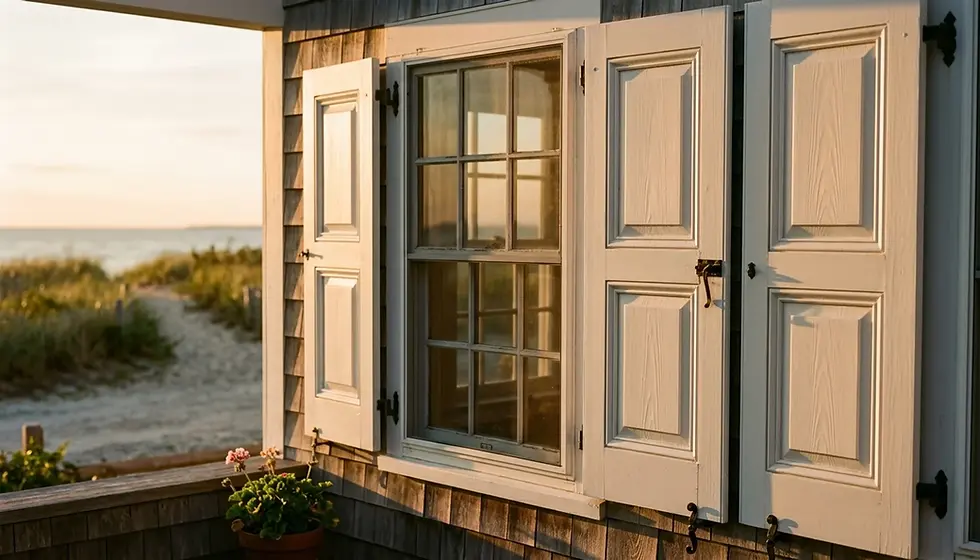
Panelled window shutters are solid window coverings made from one or more flat or raised rectangular panels framed by vertical stiles and horizontal rails. They are available in both exterior and interior configurations, in materials ranging from vinyl and composite to solid wood, and they consistently outperform blinds and curtains on insulation, privacy, and long-term durability. If you are weighing your window treatment options in 2026, shutters with a panel design deserve a serious look.
Panelled window shutters refer to shutters constructed with one or more solid panels (raised or flat/recessed) framed by stiles and rails, distinct from louvered shutters that use angled slats.
Composite panelled shutters reduce heat loss by approximately 60%, compared to 51% for wood and just 28% for roller blinds, according to Transparency Market Research.
Plantation-style interior shutters offer an R-value of 3 to 6, the highest thermal performance among common window coverings, versus an R-value of 1.5 to 4 for standard blinds.
Exterior vinyl panel shutters start at roughly $38 to $45 per pair for standard sizes; custom-made versions with mullion details can reach $157 or more per pair depending on configuration.
The North America plantation shutters market was valued at $4.5 billion in 2021 and is forecast to reach $7.1 billion by 2026, reflecting strong ongoing demand (Transparency Market Research).
Choosing between raised panel and flat/recessed panel designs is primarily a matter of architectural style: raised panels suit colonial and federal homes, while flat panels complement craftsman and contemporary architecture.
TL;DR Summary
Panelled shutters come in exterior and interior versions; exterior ones are largely decorative, while interior panelled shutters provide genuine insulation and light control.
Material choices include vinyl, composite, solid wood, and faux wood, each with different performance profiles for coastal, humid, or cold climates.
Mullion configuration (center, offset, double, triple) changes the visual proportion of the shutter and must match your window dimensions to look correct.
Measuring correctly for panelled shutters requires accounting for frame projection, reveal depth, and mounting clearance, not just the glass opening size.
The global window shutters market is projected to reach $4.02 billion in 2026 and grow to $5.21 billion by 2030 at a CAGR of 6.7% (Research and Markets, 2026).
At Home Blinds and Floors, we consistently find that homeowners on the Delmarva Peninsula get the most longevity from composite or vinyl panelled shutters because of salt air exposure and seasonal humidity swings.
Panelled window shutters sit at the intersection of architectural detail and practical home performance. They are one of the few window treatments that do real work on your energy bill, your privacy, and your home's exterior appearance simultaneously. Yet most buyers walk into this decision with only a vague sense of what the differences between panel types actually mean.
This guide fills that gap. It covers every decision point you will face when selecting panelled shutters: the distinction between raised and flat panels, how mullion placement affects appearance, which materials hold up in specific climates, how to measure correctly, and how to maintain them long term. Whether you are researching exterior shutters for a coastal home or interior panel shutters for a Delmarva property, you will leave with a concrete framework for making the right call.

What Is the Difference Between Panel and Louvered Shutters?
Panel shutters and louvered shutters represent the two primary categories of window shutter design. Panel shutters are constructed from solid rectangular sections of material (either flat or raised) framed by stiles and rails, with no openings or slats. Louvered shutters, by contrast, use a series of angled horizontal slats within the same frame, allowing air and partial light to pass through even when the shutter is closed.
The practical difference is significant. Panel shutters provide complete visual block-out and stronger structural protection when closed. Louvered shutters allow ventilation and some light transmission. For exterior use on traditional and colonial homes, both styles are historically accurate, but panel shutters tend to appear on the window sections closest to the sill (often combined with louvered upper sections on the same window). Notably, interior plantation shutters are technically a form of louvered shutter, not a panel shutter, though both categories are often sold under the general heading of window shutters.
For buyers researching interior window coverage, the distinction matters practically. Custom shutter installation can deliver either style depending on your architectural priorities and light control needs. Panel designs are the stronger insulation choice; louvered designs offer more flexibility for everyday light management.
Raised Panel vs. Flat Panel: Which Looks Right on Your Home?
Raised panel shutters feature a central panel section that projects outward from the surrounding frame, creating visible shadow lines and dimensional depth. Flat panel shutters (also called recessed panel shutters) inset the panel below the frame surface rather than projecting it, producing a cleaner, more geometric profile.
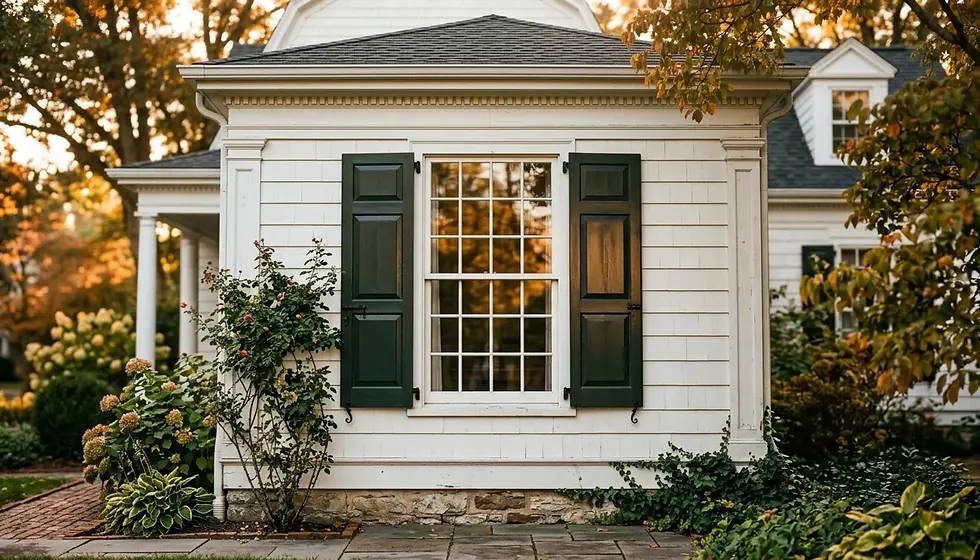
Architecturally, raised panels are the correct choice for federal manor homes, traditional colonial homes, and craft cottages, where dimensional exterior detailing is historically appropriate. Flat or recessed panels suit craftsman bungalows, transitional homes, and contemporary builds where clean lines and minimal ornamentation are the design intent. Getting this choice wrong is one of the most common mistakes we see, because the wrong panel profile can make even expensive shutters look out of place on the facade.
What Are the Latest Trends in Window Shutters?
The most significant trend in window shutters as of 2026 is the convergence of energy performance and aesthetic customization. According to Research and Markets, increasing demand for energy-efficient shutters is one of the primary growth drivers in the current forecast period, with consumers seeking products that deliver measurable insulation benefits alongside strong visual appeal. The global window shutters market is projected to reach $4.02 billion in 2026, up from $3.78 billion in 2026, representing a CAGR of 6.5%.
Several specific shifts are shaping the category this year. First, composite and sustainable materials are gaining market share as buyers move away from solid wood for exterior applications in humid or coastal climates. Composite shutters, made from materials like treated wood fiber, phenolic resins, and zinc borate (as used in Larson Shutter's Rockbridge line), resist moisture, rot, and termites while delivering thermal performance that exceeds solid wood. Second, motorized and automated shutters are growing fastest among high-income households, according to Wise Guy Reports (2026), as smart home integration becomes a baseline expectation rather than a premium add-on.
The third trend is more subtle but highly relevant for buyers purchasing panelled shutters specifically: mullion customization. Manufacturers including Exterior Solutions and Mid-America now offer center, offset, double, and triple mullion configurations across their vinyl panel lines, enabling buyers to match the visual proportions of their shutters to specific window dimensions and architectural styles with far greater precision than was possible a decade ago.

What Is the Most Popular Shutter Style?
The most popular shutter style in North America remains the raised panel vinyl shutter for exterior applications, and the louvered plantation shutter for interior use. On Amazon's best-sellers list for exterior panel window shutters, vinyl raised panel designs in black dominate the top positions: the Polaris Homeside Raised Panel Vinyl Shutter (14.5 inches by 47 inches) holds the top spot at $38.74 with over 1,100 reviews, and the Exterior Solutions standard raised panel shutter (15 inches by 39 inches) holds the fourth position at $53.72 with over 3,000 ratings. The consistency of this preference reflects how well the raised panel style translates across the most common home styles in the U.S.
Wood shutters remain the dominant premium material segment in North America, holding 46% market share as of 2021 according to Transparency Market Research, though composite alternatives are closing that gap rapidly. For residential exterior applications, the combination of raised panel design in vinyl or composite represents the most widely purchased configuration by volume in 2026.
Interior panel shutters are less common than plantation louver styles, but they are the correct choice for rooms where complete light block-out or maximum privacy is the priority. Bathrooms, bedrooms facing street level, and home offices all benefit from a solid panel interior shutter rather than a louvered design.
Why Are Shutters No Longer Used on Many Modern Homes?
Shutters appear less frequently on newer construction primarily because most shutters installed today are purely decorative: they are sized incorrectly to cover the actual window and are not mounted on functional hardware that would allow them to close. This mismatch between the visual promise of a shutter and its practical non-function has made shutters feel like an anachronism on homes where authenticity matters. When shutters look too narrow to cover the window, or too lightweight to serve a real purpose, they undermine rather than enhance curb appeal.
A second reason is architectural: contemporary home styles (midcentury modern, minimalist, industrial-influenced designs) do not call for the dimensional exterior detailing that panel shutters historically complemented. Flat-profile facades and large fixed-glass windows simply do not accommodate traditional shutter proportions well.
That said, shutters are far from obsolete. The North America plantation shutters market alone is forecast to reach $7.1 billion by 2026 (Transparency Market Research), a figure that reflects genuine and growing demand. The homes where shutters are declining are those where they were applied as a styling afterthought rather than as a considered architectural element. On traditional, colonial, and craftsman homes with correctly proportioned windows, panelled window shutters remain not only appropriate but actively desirable.
How Do You Choose Between Raised Panel and Flat Panel Shutters?
Choosing between raised panel and flat panel shutters comes down to three factors: your home's architectural style, your regional climate, and your budget. Neither option is universally superior; the right choice depends on where and how the shutters will live.
Match Panel Style to Your Home's Architecture
Start with architectural fit. Raised panel shutters belong on homes with traditional dimensional detailing: colonial, federal, Georgian, cape cod, and craftsman cottage styles. The projecting panel echoes the dimensional millwork (cornices, pilasters, door surrounds) common to these architectural traditions. Flat or recessed panel shutters work on craftsman bungalows, transitional homes, Tudors, and contemporary builds where surface geometry is clean and ornamentation is restrained. Applying raised panels to a contemporary exterior or flat panels to a colonial will produce a result that looks mismatched even if the homeowner cannot immediately identify why.
Factor in Climate and Maintenance Realities
For exterior shutters in humid, salt-air, or high-UV environments (which describes most of the Delmarva Peninsula coastal communities we serve at Home Blinds and Floors), material choice matters more than panel profile. Solid wood shutters in these environments require repainting every three to five years and are vulnerable to moisture infiltration at the joints between stiles, rails, and panels. Vinyl shutters, particularly color-throughout options like those from Mid-America where the color runs through the entire material rather than sitting on the surface, will not peel or fade and require essentially no maintenance beyond washing. Composite shutters such as Larson Shutter's Rockbridge line (90% wood fiber with phenolic resins and zinc borate) resist moisture, rot, and termites and carry a manufacturer's lifetime limited warranty.
Use the Mullion Configuration to Get the Proportions Right
Mullion placement is the detail most buyers overlook, and it is the one that most affects how the finished shutter actually looks on the house. A center mullion divides the shutter into two equal panels and works well on windows where the shutter height is roughly twice the shutter width. An offset mullion creates an asymmetric division, with one panel taller than the other, which suits narrow, tall windows where a centered division would look forced. Double and triple mullion configurations break the shutter into three or four panels respectively, and are designed for wider shutters or double-wide applications where a single panel would look disproportionately large.
Getting mullion placement wrong is the single most common reason a set of otherwise well-chosen shutters looks off on a home. Take the time to mock up proportions with paper templates before ordering, especially for custom or made-to-measure shutters.
What Materials Are Panelled Window Shutters Made From?
Panelled window shutters are manufactured in four primary material categories: vinyl (PVC), solid wood, composite wood, and faux wood or polypropylene. Each material has a distinct performance profile that makes it more or less appropriate for specific climates, applications, and budgets.
Material | Best For | Maintenance | Starting Price (per pair) | Heat Loss Reduction |
Vinyl (PVC) | Coastal, humid climates; low maintenance priority | Wipe clean; no repainting needed | ~$38 (standard) / ~$62 (custom) | Moderate |
Composite (Extira) | All climates; maximum durability | Paintable; check sealing annually | From ~$75 | ~60% (highest in category) |
Solid Wood | Dry climates; paintable/stainable priority | Repaint every 3-5 years; seal joints | From ~$141 (unfinished) | ~51% |
Faux Wood / Polypropylene | Budget buyers; sheds, garages, accents | Wipe clean; cannot be repainted | From ~$30 | Low |
Vinyl shutters dominate the exterior market by volume. Color-throughout vinyl (as offered by Mid-America) is particularly practical because the color runs through the entire extrusion, meaning chips and scratches do not expose a different-colored substrate beneath. Standard vinyl raised panel shutters from Exterior Solutions start at $45.28 per pair in fixed sizes; made-to-measure equivalents start at $61.56 per pair.
Composite shutters are the strongest all-round performers for exterior applications. Larson Shutter's Rockbridge material, for example, is composed of treated wood fiber, phenolic resins, zinc borate, and water repellent, making it resistant to moisture, rot, and termites while retaining the workability and paintability of wood. Rockbridge shutters come pre-painted and start from approximately $75 per pair, shipping from Albertville, Alabama with typical processing of two to five weeks.
Solid wood shutters from manufacturers like Americraft offer the warmest aesthetic and full paintability but require the most maintenance. An Americraft Two Equal Raised Panel Exterior Real Wood Shutter in 12 inches by 48 inches (unfinished) retails at $141.47; an 18-inch by 63-inch flat panel version in unfinished wood runs $287.24. Budget for repainting and joint sealing in any climate with significant humidity or temperature swings. For more context on how different materials perform in various window treatment applications, the custom shutters resource section at Home Blinds and Floors covers Delmarva-specific considerations in detail.

How Do You Measure Windows Correctly for Panelled Shutters?
Measuring windows for panelled shutters requires three separate measurements that most first-time buyers miss: the glass opening size, the frame projection depth, and the reveal width. Measuring the glass opening alone will result in shutters that either overlap the frame awkwardly or leave visible gaps at the edges when visually compared against the window surround.
Step 1: Measure the Window Opening Width
Measure the full window opening width from outside edge to outside edge of the window frame, not just the glass. For a pair of shutters, each individual shutter should be approximately half this total width, less a small clearance gap of around half an inch per shutter to allow for the panel to close flush without binding.
Step 2: Measure the Height Including Any Architectural Trim
Measure shutter height from the top of any exterior sill or stool to the underside of the header trim above the window. If your home has no projecting sill, measure the full exterior casing height. Standard manufactured shutters are available in heights from roughly 22 inches (appropriate for shed windows) through 71 inches or more for full residential windows. Custom made-to-measure options from suppliers like Exterior Solutions start at $61.56 per pair and eliminate the frustration of working with heights that fall between standard increments.
Step 3: Check Frame Projection and Mounting Clearance
Frame projection is the distance your window frame extends proud of the exterior wall surface. Shutters need to clear any protruding sill, brick mold, or casing detail when swung open. If projection depth is insufficient for full opening, you will need extended hardware or fixed-mount installation. Larson Shutter's Rockbridge composite shutters, for example, specifically note that their warranty requires stationary fixed-mount installation rather than functional hinged mounting, so confirm your installation intent before ordering. Window Shutter Panel Peg Lok Pin hardware (available in 32-packs for around $12.99) is the standard fastener for fixed-mount exterior panel shutters and provides a secure, non-rattling attachment.
How Do You Maintain and Clean Panelled Window Shutters?
Maintaining panelled window shutters involves different routines depending on material, but all exterior shutters benefit from at minimum an annual inspection and clean-down. Proper maintenance is the single biggest factor in shutter lifespan, and it is a topic that almost no competitor content addresses despite being one of the most common questions buyers have after installation.
Cleaning Vinyl Panel Shutters
Vinyl shutters require the least effort. Wash them down annually with a solution of mild dish soap and warm water applied with a soft-bristle brush, paying particular attention to the shadow lines around raised panels where dirt and mildew accumulate. Rinse thoroughly. Avoid abrasive cleaners or pressure washing at close range, which can stress the mounting pin holes. Color-throughout vinyl shutters from manufacturers like Mid-America do not require repainting under any normal circumstances.
Repainting and Sealing Wood and Composite Shutters
Solid wood exterior panel shutters need repainting every three to five years in temperate climates, and potentially more frequently in high-UV coastal environments. Before repainting, inspect and reseal all joints where stiles meet rails and where panels meet the surrounding frame. These joints are the primary moisture ingress points. Use a high-quality exterior alkyd or acrylic primer before applying topcoats.
Composite shutters like Larson Shutter's Rockbridge are supplied pre-painted and can be repainted with standard exterior latex. One important installation note documented in customer feedback: composite shutters should be stored upright and painted on all six faces before hanging, because flat storage and unpainted end grain can cause the material to absorb moisture unevenly before installation.
For interior panelled or plantation-style shutters, Hunter Douglas provides detailed guidance in their Cleaning, Maintenance and Operating Instructions document, which covers recommended products and techniques for both painted and stained interior shutter finishes.
Interior vs. Exterior Panelled Window Shutters: Which Do You Need?
Interior panelled window shutters and exterior panel shutters serve fundamentally different purposes, and the distinction is one that surprisingly few buyers consider before they start shopping. Understanding which category you need will save you significant time and prevent the frustration of researching the wrong product entirely.
Exterior panel shutters are primarily architectural elements. They define the character of your home's facade, provide secondary weather protection in some configurations, and contribute to curb appeal and resale value. Most exterior panel shutters sold today are installed in a fixed position and do not open or close functionally.
Interior panelled shutters, by contrast, are working window coverings. They mount inside the window frame or on the wall surround and can be opened and closed to manage light, privacy, and thermal performance. Interior shutters are where the insulation statistics really matter: composite shutters reduce heat loss by approximately 60%, according to Transparency Market Research, versus 28% for roller blinds and just 14% for curtains. The U.S. Department of Energy notes that roughly 30% of a home's heating energy is lost through windows, which puts the energy case for well-fitted interior shutters into stark context.
At Home Blinds and Floors, we advise homeowners to clarify this distinction before requesting a quote. Our shutter installation service covers both applications, but the measurement process, product selection, and installation method are entirely different for interior versus exterior configurations. If you are also considering shades as an alternative, our custom shades options offer energy-efficient alternatives for rooms where shutters are not architecturally appropriate.
Frequently Asked Questions About Panelled Window Shutters
What are panelled window shutters?
Panelled window shutters are window coverings built from one or more solid rectangular sections (either raised or flat/recessed) set within a frame of vertical stiles and horizontal rails. They differ from louvered shutters, which use angled slats instead of solid panels. Panelled shutters are available in both exterior decorative versions and functional interior versions for light control and insulation.
What is the difference between raised panel and flat panel shutters?
Raised panel shutters have a central panel that projects outward from the surrounding frame, creating dimensional shadow lines. Flat or recessed panel shutters set the panel below the frame surface for a cleaner, more geometric look. Raised panels suit colonial, federal, and traditional homes; flat panels are the correct choice for craftsman, transitional, and contemporary architecture.
How much do panelled window shutters cost?
Exterior vinyl raised panel shutters start at roughly $38 to $45 per pair for standard sizes, rising to $62 or more per pair for custom-made versions. Composite options such as Larson Shutter's Rockbridge line start from approximately $75 per pair. Solid wood shutters begin around $141 per pair (unfinished) and can reach $287 or higher for larger custom sizes. Custom vinyl shutters with mullion details can reach $157 per pair or more.
What do the different mullion configurations mean?
Mullions are the horizontal dividers that split a shutter into multiple panels. A center mullion creates two equal panels and suits windows where height is roughly twice the width. An offset mullion creates asymmetric panels for narrow, tall windows. Double and triple mullions divide the shutter into three or four panels respectively, suited to wider shutters. Choosing the wrong mullion configuration is one of the most common reasons shutters look disproportionate on a home facade.
Are composite panelled shutters better than wood for coastal climates?
For coastal climates on the Delmarva Peninsula and similar environments with salt air, high humidity, and intense UV exposure, composite shutters are the stronger long-term choice. Composite materials such as Extira (used in Larson Shutter's Rockbridge line) resist moisture, rot, and termites and deliver approximately 60% heat loss reduction, exceeding the 51% reduction of solid wood. Solid wood requires repainting every three to five years in coastal conditions and is vulnerable to moisture infiltration at panel joints.
How do you correctly size panelled shutters for a window?
Measure the full window frame width (not just the glass opening) and divide by two for each shutter, subtracting a small clearance allowance. Measure height from the top of any exterior sill to the underside of the header trim. Also check frame projection depth to confirm the shutters can clear any protruding architectural details when opened. For most residential windows, made-to-measure custom shutters are more reliable than standard sizes because residential window dimensions vary significantly.
Do panelled window shutters improve energy efficiency?
Yes, particularly interior panelled shutters. According to the U.S. Department of Energy, approximately 30% of a home's heating energy is lost through windows. Interior plantation-style and panel shutters offer an R-value of 3 to 6, compared to 1.5 to 4 for standard blinds and just 0.75 to 1 for uncovered windows (Transparency Market Research). Composite exterior shutters provide additional wind and weather buffering that reduces infiltration losses, though the primary energy gains come from interior applications.
Where can I get custom panelled shutters installed on the Delmarva Peninsula?
Home Blinds and Floors offers custom shutter installation across the Delmarva Peninsula, serving communities including Rehoboth Beach, Lewes, Bethany Beach, Ocean City, Easton, Salisbury, and Kent Island. The process begins with a free in-home consultation where measurements, material suitability, and architectural fit are assessed before any product is ordered. You can request a consultation through the contact page or visit the main site at homeblindsandfloors.com.
Ready to Choose the Right Panelled Shutters for Your Home?
Panelled window shutters offer a combination of architectural credibility, thermal performance, and long-term durability that few other window treatments can match. The key decisions come down to four variables: panel profile (raised versus flat) matched to your home's style, material choice based on your climate and maintenance tolerance, mullion configuration aligned to your window proportions, and accurate measurements that account for frame projection and reveal depth rather than just glass opening size. Get those four variables right and your shutters will look correct and perform well for decades.
In 2026, the shutter market continues to expand, driven by energy costs and growing consumer preference for treatments that deliver real insulation performance. According to Research and Markets, the global window shutters market is projected to reach $5.21 billion by 2030, reflecting demand that shows no sign of slowing. Whether you are updating exterior shutters on a traditional Delmarva home or installing interior panel shutters for maximum light control and privacy, the investment consistently holds its value.
If you are still weighing shutters against other options, our custom window treatments resource section covers blinds and shades alongside shutters for a complete comparison. And if exterior shutters are not quite the right fit for your space, explore our custom blinds installation options or the full range of window shades we carry from Hunter Douglas, Norman, and Graber.

If you are ready to move from research to installation, the team at Home Blinds and Floors brings hands-on experience fitting panelled shutters across coastal Delaware and Maryland's Eastern Shore. We know which materials hold up in salt-air environments, how to measure windows in older Delmarva homes where frames are rarely perfectly square, and how to match panel proportions to the architectural character of your property. Schedule your free in-home consultation and we will walk you through every option before a single measurement is taken.


Comments