.avif)
.avif)
.avif)
Do Shutters Increase Home Value? What Buyers and Appraisers Look For


Shutters do increase home value, and the effect is measurable. According to a March 2026 report from the Real Estate Institute of Australia (REIA), homes with plantation shutters achieved an average 3 to 5% higher sale price compared to comparable properties with no shutters or standard curtains. A separate 2023 Comparative Market Analysis study of the Perth market found homes with plantation shutters sold for approximately 5 to 7% more and spent 12% less time listed. The critical factor is choosing the right shutter type for your home's architecture and price tier.
Plantation shutters are linked to a 3 to 7% higher sale price based on real estate market analysis data from REIA (2026) and Australian CMA studies (2023).
Exterior shutters carry an estimated ROI of 50 to 75%, though that return depends heavily on material quality, architectural fit, and installation precision.
Plantation shutters offer an R-value of 3 to 6, compared to 0.75 to 1 for bare windows, which directly reduces HVAC costs and appeals to energy-conscious buyers.
Cheap vinyl exterior shutters that look decorative rather than functional can actively reduce buyer confidence, particularly in the mid-to-luxury price tier.
Interior plantation shutters and exterior shutters serve different buyer psychology needs: interior shutters signal quality finishes, while exterior shutters drive first-impression curb appeal.
In 2026, the North America blinds and shutters market is forecast at USD 29.5 billion, reflecting sustained homeowner investment in premium window treatments.
TL;DR
Shutters increase home value by 3 to 7% on average, with plantation shutters earning the strongest buyer premium according to REIA data.
The 50 to 75% ROI estimate on exterior shutters applies primarily to composite or wood shutters that are architecturally appropriate for the home's style.
Energy efficiency is a major driver: shutters with an R-value of 3 to 6 reduce heating and cooling losses that cost homeowners money year-round.
Shutter color, material, and whether they look functional or purely decorative all influence how much value buyers assign to them.
In coastal markets like Rehoboth Beach and Ocean City, shutter durability against salt air, humidity, and storm conditions is a specific value driver that standard window treatments cannot match.
Buyers walk through a home and form opinions in seconds. Window treatments are among the first interior details they register, and shutters carry more visual weight than blinds or shades because they read as permanent, structural features rather than accessories. That perception matters in appraisals and at the negotiating table.
At Home Blinds and Floors, we regularly consult with homeowners across the Delmarva Peninsula who are preparing their properties for sale or simply want lasting upgrades. One question comes up constantly: will shutters actually move the needle on value, or is that just something shutter companies say? The honest answer is nuanced, and that nuance is exactly what this guide covers.
You will learn which shutter types produce real return, which situations make shutters a poor investment, how interior and exterior shutters differ in value impact, and what buyers and appraisers actually respond to in 2026. Every claim here is backed by cited data or direct professional experience, not vague industry estimates.

How Much Value Do Shutters Add to a Home?
Shutters add measurable value to a home through three distinct channels: appraised value, buyer psychology, and time on market. According to the Real Estate Institute of Australia (REIA) in a March 2026 report, homes fitted with plantation shutters sold for an average of 3 to 5% more than comparable homes with basic window coverings. A 2023 Comparative Market Analysis focused on the Perth housing market corroborated this, finding a 5 to 7% sale price premium and a 12% reduction in days listed. These figures apply to well-matched, quality shutters, not to purely decorative vinyl panels.
Real estate professionals classify plantation shutters as a capital improvement rather than a cosmetic upgrade, which means they contribute to long-term home valuation rather than simply making a property look nicer for an open house. Appraisers take note of built-in, permanent-looking features because buyers assign lasting utility to them. A set of quality plantation shutters that fits every window in a home signals consistency and intention in a way that mismatched blinds do not.
The Houzz 2023 Design Trends Report ranked plantation shutters among the top five home style upgrades delivering lasting value and appeal, placing them alongside kitchen refreshes and bathroom tile updates. Notably, this ranking was based on buyer preference data, not just aesthetics. When buyers perceive shutters as a lasting feature rather than a decorative choice, they factor that perception into their offer price.
One specific market dynamic worth understanding: in competitive real estate conditions, shutters can accelerate a sale even when the price premium is modest. Faster sales reduce carrying costs (mortgage payments, taxes, insurance), which translates to real financial benefit beyond what the sale price alone suggests.
What Are the Energy Efficiency Benefits That Buyers Pay For?
Energy efficiency is one of the most concrete, citable reasons shutters increase home value. According to the U.S. Department of Energy, approximately 30% of a home's heating energy is lost through windows, and about 76% of sunlight falling on standard double-pane windows enters as heat. Plantation shutters address both problems directly. Wood plantation shutters reduce heat loss by approximately 51%, while composite shutters reach approximately 60% efficiency improvement. For comparison, roller blinds reduce heat loss by only 28% and curtains by 14%.
In practical terms, plantation shutters carry an R-value of 3 to 6, compared to 0.75 to 1 for a bare window with no covering and 1.5 to 4 for standard blinds. A higher R-value means greater resistance to heat transfer, which reduces HVAC run time in summer and winter. The Energy Star program for windows, doors, and skylights recognizes this energy-saving potential as a legitimate factor in home performance ratings.
Buyers in 2026 are increasingly energy cost-aware. The Home Improvement Research Institute noted in early 2026 that millennial and Gen Z buyers specifically value energy-efficient features as a better long-term investment compared to standard cosmetic upgrades. When a buyer sees plantation shutters, many now understand intuitively that they are purchasing lower utility bills along with the aesthetic. That understanding supports higher offers.
For Delmarva Peninsula homeowners in particular, where summer humidity and intense sun exposure drive air conditioning costs upward, the insulation argument is not abstract. It is a direct reduction in monthly operating costs that both current owners and prospective buyers can calculate.

Interior Plantation Shutters vs. Exterior Shutters: Which Adds More Home Value?
Interior plantation shutters and exterior shutters contribute to home value through entirely different mechanisms, and conflating the two leads to poor investment decisions. Interior plantation shutters, such as those in the Norman Woodlore composite line or the premium hardwood Normandy series, signal quality finishes and permanent upgrades to buyers inspecting the interior. Exterior shutters, by contrast, operate on curb appeal: they shape a buyer's first impression before the front door opens, and first impressions drive offer psychology in ways that interior features often cannot reverse.
Interior Plantation Shutters: What Buyers Notice Inside
Interior plantation shutters are the category most consistently linked to documented sale price premiums. They appeal to buyers because they look built-in, require no replacement, and offer layered functionality: complete privacy when closed, partial light control with louvers angled open, and a clean architectural look year-round. Specifically, Norman shutters are designed to cover any window shape and size, including arches and custom geometric openings, enabling consistent treatment across an entire home. That consistency matters to buyers who otherwise face the cost of replacing mismatched window coverings room by room.
Interior shutters also protect interior furnishings from UV fading. Floors, upholstery, and artwork that have been shielded from direct sun look newer and maintain a move-in-ready appearance that supports higher appraisal values. Our team at Home Blinds and Floors has seen firsthand how coastal homes with well-maintained plantation shutters consistently photograph better for listings, generate more showing traffic, and receive stronger offers than comparable properties with faded roller shades.
Exterior Shutters: Curb Appeal as a Financial Asset
Exterior shutters deliver value through a different pathway. Homes with strong curb appeal tend to sell faster and for higher offers, and appraisers formally consider exterior aesthetics when assessing overall worth. The estimated ROI for exterior shutters runs 50 to 75%, meaning a $1,500 investment in quality composite shutters could contribute $750 to $1,125 to the home's appraised or perceived value. That figure, while commonly cited in the industry, applies specifically to shutters made from wood ($200 to $350 per pair) or composite materials ($150 to $300 per pair), not vinyl.
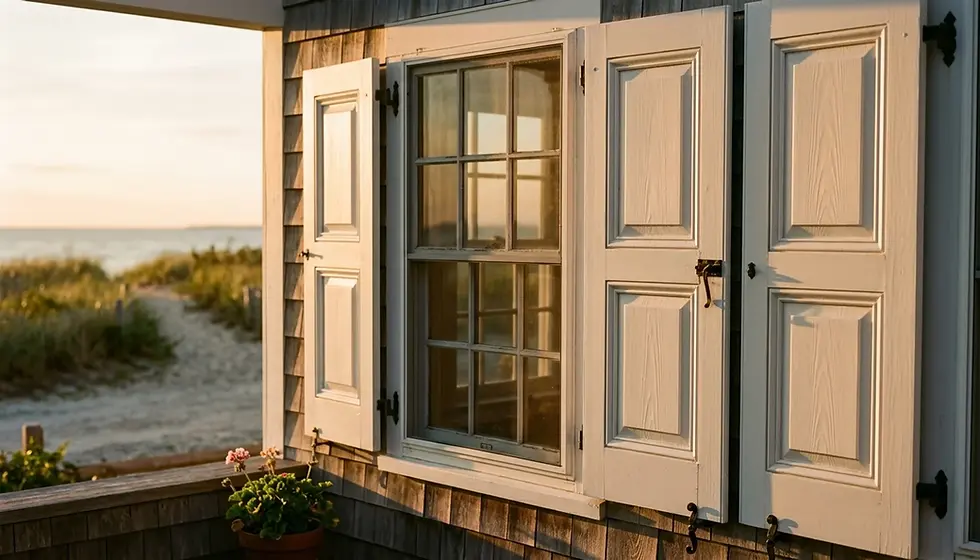
Exterior shutter types each suit different architectural styles. Louvered shutters fit traditional and colonial homes. Raised panel shutters suit formal or classic facades. Board-and-batten shutters pair well with farmhouse and cottage architecture. Bahama shutters are particularly relevant for coastal and tropical properties, offering both aesthetic appeal and documented storm protection, which adds measurable insurance and structural value in hurricane-prone regions like Maryland's Eastern Shore and Delaware's coastal communities.
Are Shutters Out of Style in 2026?
Shutters are not out of style in 2026. The North America blinds and shutters market is forecast to grow from USD 29.5 billion in 2026 to USD 59.8 billion by 2035, at a compound annual growth rate of 8.2%, according to Global Market Insights. Within that broader market, the plantation shutters segment was valued at USD 4.5 billion in 2021 and is projected to reach USD 7.1 billion by end of 2026, growing at 9.0% annually, per Transparency Market Research. Sustained double-digit growth does not describe a category in decline.
Design trends in 2026 favor clean lines, layered light control, and timeless materials over trendy seasonal decor. Plantation shutters fit all three criteria. White and off-white plantation shutters remain the dominant choice because they work with virtually every interior color scheme and do not date themselves the way patterned fabrics or bold blind colors do. Neutral shutters photograph well for listings and age gracefully, which is exactly what appraisers and buyers want to see.
Social media and home improvement content have further accelerated interest in premium window treatments. Buyers now approach property searches with reference images from design platforms, and plantation shutters appear consistently in aspirational interiors across those channels. The Home Improvement Research Institute noted in early 2026 that millennial and Gen Z buyers view shutters as integral to an interior renovation rather than a purely functional accessory, which is a meaningful shift in buyer psychology.
Exterior shutters follow similar trend lines, particularly in coastal and historically influenced markets. Bahama-style and louvered exterior shutters remain relevant on coastal properties from Bethany Beach to Ocean Pines because they serve a practical function (storm protection, shade) in addition to an aesthetic one. Purely decorative shutters, however, face growing scrutiny from sophisticated buyers who recognize when shutters are not functional. That distinction matters for value, and it is covered in detail below.
What Are the Downsides of Shutters?
Shutters have real downsides, and understanding them is critical to making a smart investment. The most significant risk is architectural mismatch: shutters installed on a home style they do not suit can actively reduce buyer confidence, particularly in the mid-to-luxury price tier where buyers are discerning about design coherence. A set of vinyl exterior shutters attached flat against a brick colonial home, with no functional hardware and proportions that do not align with the window dimensions, signals cost-cutting rather than quality investment.
When Shutters Do Not Add Value
Several specific scenarios reduce or eliminate the value benefit of shutters:
Cheap vinyl exterior shutters on premium homes: Vinyl shutters ($50 to $150 per pair) are lightweight and prone to fading, cracking, and warping under UV exposure. Buyers in the $400,000 and above price tier notice the difference between composite and vinyl immediately. In coastal markets like Rehoboth Beach and Ocean City, where salt air accelerates material degradation, vinyl shutters can look deteriorated within two to three years.
Purely decorative non-functional shutters: Exterior shutters that cannot physically close over the window, or that are sized too small to cover the opening, are a red flag for knowledgeable buyers. Sophisticated buyers discount them because they recognize them as cosmetic-only, with no storm protection, insulation, or privacy value.
Style mismatches: Board-and-batten shutters on a contemporary minimalist home, or highly ornate raised-panel shutters on a mid-century modern design, create visual dissonance. Appraisers do not penalize mismatched shutters explicitly, but buyers subtract from their mental valuation when details feel inconsistent.
Entry-level homes in tight buyer markets: In markets where buyers are primarily focused on price per square foot and will replace finishes after purchase anyway, premium shutters may not recover their full cost at resale. The 3 to 7% premium applies most reliably to mid-range and luxury homes where buyers are comparing finish quality across comparable listings.
There is also a maintenance reality to acknowledge. Plantation shutters that are opened and closed regularly require eventual hardware replacement, typically hinges, tilt rods, and staples, which adds ongoing cost. Proper care is straightforward: vacuum with a brush attachment, or wipe with a microfiber cloth dampened with warm water and mild soap. But avoid harsh chemicals and abrasive pads, which can damage painted or stained finishes over time.
Does Shutter Color and Finish Affect Home Value?
Shutter color and finish choices directly influence buyer perception and, by extension, the value shutters contribute to a home. This is one of the most overlooked dimensions of the shutters-and-home-value conversation, and no competitor article addresses it with specificity. The fundamental rule is contrast with purpose: exterior shutter colors that create intentional contrast against the home's facade (dark shutters on a light exterior, for example) register as deliberate and architecturally considered. Colors that blend into the siding with no visual distinction look like an afterthought.
Exterior Shutter Color: What Moves Buyers
Classic exterior combinations with documented curb appeal strength include black or charcoal shutters on white or gray homes (timeless, broadly appealing), navy or forest green on natural wood or cedar siding (coastal and craftsman styles), and deep red or burgundy on brick (traditional, particularly common on colonial and Georgian architecture). These combinations appear repeatedly in high-performing listing photography because they create focal points at the windows without competing with the roofline or landscaping.
Avoid colors that fade quickly in direct sun, particularly bright reds and purples in vinyl, which can shift to washed-out pinks within one or two seasons. Composite and wood shutters hold paint and stain significantly better over time, which is part of why material quality and color choice are connected decisions rather than independent ones.
Interior Plantation Shutter Finish: Matching for Maximum Value
Interior plantation shutters deliver the strongest buyer premium when they are consistent throughout the home. A full house treatment in a single, cohesive color or stain reads as a designed feature rather than a piecemeal upgrade. Norman offers custom color matching to molding, flooring, and cabinetry, which allows plantation shutters to feel architecturally integrated rather than installed after the fact. That integration is what appraisers and buyers respond to: the sense that the shutters belong to the home rather than simply being placed in it.
White and off-white remain the safest choices for resale because they align with the widest range of interior color palettes. Stained wood finishes appeal strongly in homes with exposed hardwood floors and wood trim, creating a material cohesion that photographs exceptionally well for listings.

How Do You Choose Shutters That Actually Increase Value?
Choosing shutters that increase home value requires matching four variables: shutter type to architectural style, material to climate conditions, color to facade palette, and budget to realistic ROI expectations. Getting all four right produces the documented 3 to 7% sale price premium. Getting any one wrong reduces or eliminates that return.
Step 1: Match Shutter Type to Your Home's Architecture
Start with the exterior style of your home. Louvered shutters with horizontal slats suit traditional, colonial, and cape cod designs. Raised panel shutters fit formal, Georgian, and classic Federal-style facades. Board-and-batten shutters belong on farmhouse, cottage, and craftsman homes. Bahama shutters are the correct choice for coastal, tropical, and Key West-influenced architecture. For interior use, plantation shutters with wide louvers (3.5 inch or 4.5 inch) read as high-end in most residential styles, while narrower louvers (2.5 inch) suit traditional interiors better.
Step 2: Select Material for Your Climate
In coastal markets including Lewes, Millsboro, Ocean City, and Bethany Beach, material selection is not optional: it is critical. Salt air corrodes aluminum and standard paint finishes. UV intensity fades vinyl within two to three seasons. The right material choices for coastal installations are composite (wood plus synthetic binders, resistant to moisture, warping, and insects) for exterior applications, and premium hardwood or engineered composite for interior plantation shutters. Norman's Woodlore composite line and the hardwood Normandy series are both designed to hold finish integrity under sustained moisture and UV exposure, which is exactly what Delmarva Peninsula conditions demand.
Step 3: Confirm Functionality, Not Just Appearance
Exterior shutters must be sized to actually cover their windows to deliver full value. Non-functional shutters that are too small or permanently fixed flush against the siding are a visual signal that the installation was cosmetic-only. Buyers who recognize this, and many mid-to-luxury buyers do, subtract from their valuation accordingly. Functional shutters with working hardware, even if they are rarely operated, carry a different psychological weight than decorative panels.
Step 4: Budget Realistically for Full-House Consistency
Partial shutter installations, three windows treated and five left bare, create inconsistency that undermines the finished-home appearance buyers are paying a premium for. Professional shutter installation typically costs between $50 and $100 per window depending on complexity, in addition to material costs. For interior plantation shutters, a full-home installation represents a meaningful upfront investment. But the documented sale price premium and faster time on market mean the math often works in your favor, particularly in homes priced above the entry-level tier.
If you are working within a budget, prioritize the rooms buyers spend the most time evaluating: the primary bedroom, main living area, and any room with a view. Our shutter consultation process at Home Blinds and Floors always starts with a room-by-room priority assessment, because a targeted installation in the right rooms often outperforms a budget-stretched full-house approach using lower-quality materials.
A Comparison of Shutter Types, Costs, and Value Impact
The table below summarizes the key differences between major shutter types across the variables that matter most for home value: cost, ROI potential, best architectural fit, and performance in coastal conditions. Use it as a starting reference, not a substitute for a professional consultation that accounts for your specific home and market.
Shutter Type | Material Options | Typical Cost Per Pair | Estimated ROI | Best Architectural Fit | Coastal Durability |
Louvered (Exterior) | Wood, Composite, Vinyl | $50 to $350 | 50 to 75% (composite/wood) | Colonial, Traditional, Cape Cod | High (composite); Low (vinyl) |
Raised Panel (Exterior) | Wood, Composite, Vinyl | $80 to $320 | 50 to 70% (composite/wood) | Georgian, Federal, Formal | High (composite); Low (vinyl) |
Board-and-Batten (Exterior) | Wood, Composite | $100 to $300 | 45 to 65% | Farmhouse, Cottage, Craftsman | Moderate to High (composite) |
Bahama (Exterior) | Aluminum, Composite | $150 to $400 | 50 to 75% in coastal markets | Coastal, Tropical, Beach House | Very High |
Plantation (Interior) | Hardwood, Composite | $150 to $350+ per panel | 3 to 7% sale price premium | Most residential styles | High (composite); Good (hardwood with proper finish) |
Frequently Asked Questions About Shutters and Home Value
How much value do shutters add to a home in dollar terms?
The value shutters add depends on home price tier, shutter quality, and market conditions. According to the Real Estate Institute of Australia's March 2026 data, plantation shutters are linked to an average 3 to 5% sale price premium over comparable homes with basic window coverings. A 2023 Comparative Market Analysis study found a 5 to 7% premium in competitive markets. On a $350,000 home, a 5% premium represents $17,500 in additional value. Exterior shutters carry an estimated ROI of 50 to 75%, meaning a $1,500 composite shutter installation could add $750 to $1,125 in perceived value.
Do plantation shutters increase home value more than exterior shutters?
Interior plantation shutters and exterior shutters contribute to home value through different channels, and both matter. Interior plantation shutters drive the documented 3 to 7% sale price premium because buyers perceive them as a permanent, high-quality feature during interior tours. Exterior shutters primarily improve curb appeal, which influences first impressions and time on market. In most cases, a coordinated approach using quality interior plantation shutters combined with architecturally appropriate exterior shutters produces the strongest combined value impact.
Are plantation shutters considered a capital improvement for tax purposes?
Many real estate professionals classify plantation shutters as a capital improvement rather than a cosmetic upgrade, which means they can contribute to a home's adjusted cost basis. This classification can reduce capital gains tax liability when you sell, because capital improvements increase your cost basis and reduce the taxable gain. You should consult a qualified tax professional or CPA to confirm how this applies to your specific situation, as classification can vary by installation type and local tax rules.
Do shutters add value in a buyer's market versus a seller's market?
Shutters deliver value differently depending on market conditions. In a seller's market, where buyers compete for limited inventory, shutters can accelerate a sale and support higher offers because buyers are comparing quality finishes across properties. In a buyer's market, where buyers have more options and negotiating power, well-matched shutters help a listing stand out rather than disappear into a crowded field. The key difference is that in a buyer's market, mismatched or low-quality shutters are more likely to be flagged as a negative than overlooked.
What color shutters increase home value the most?
No single color universally maximizes value, but the principle of intentional contrast with the home's facade performs consistently well. Black or deep charcoal shutters on white, gray, or cream exteriors create clean contrast that photographs well for listings and appeals to a broad buyer pool. Navy and forest green work strongly on natural wood siding and coastal-influenced homes. The most important factor is that the color reads as deliberate and coordinated with the overall exterior palette, not as a default or afterthought choice.
Do shutters increase home value in coastal markets like Rehoboth Beach or Ocean City?
Shutters carry additional value in coastal markets because they address functional needs that buyers in those markets specifically prioritize: storm protection, UV resistance, humidity tolerance, and salt air durability. Bahama-style exterior shutters are particularly valued in coastal Delaware and Maryland communities because they provide genuine storm protection in addition to aesthetic appeal. Interior plantation shutters in composite materials hold up to the humidity levels found in beach properties better than most alternative window treatments, which supports their perceived value among coastal buyers.
How long do shutters last compared to blinds or shades?
Quality plantation shutters last significantly longer than standard window treatments when properly maintained. Composite and hardwood shutters installed and cared for correctly can last 20 years or more, compared to 5 to 8 years for most blinds and 7 to 10 years for quality roller shades. Shutters opened and closed frequently will require eventual hardware replacements (hinges, tilt rods, staples), but the frame and panels themselves are highly durable. That longevity is part of the reason real estate professionals classify them as capital improvements rather than perishable accessories.
Are shutters worth the cost if I am planning to sell within one to two years?
Shutters can be worth installing before a near-term sale, particularly in the mid-to-luxury price tier where buyer expectations for finish quality are high. The 3 to 7% sale price premium documented in real estate market analysis can more than offset installation costs in many scenarios. However, the math depends on how much of the home still needs shutters, what material and style you choose, and whether your market rewards finish quality. A targeted installation in high-visibility rooms (primary bedroom, main living area) often delivers better near-term return than a rushed full-house installation using lower-quality materials.
The Bottom Line on Shutters and Home Value
Shutters do increase home value, and the evidence is specific enough to act on. The Real Estate Institute of Australia's 2026 data showing a 3 to 5% sale price premium, combined with the 2023 Comparative Market Analysis findings of 5 to 7% in competitive markets, provides a credible baseline for mid-range and luxury homes. The key is choosing shutters that fit your home's architecture, climate, and buyer expectations, not simply adding any shutter to any house and expecting a return.
Interior plantation shutters drive buyer perception of quality finishes. Exterior shutters, especially composite and wood options, drive curb appeal and time-on-market reductions. Energy efficiency benefits are real and documented: plantation shutters' R-value of 3 to 6 represents a meaningful improvement over bare windows, and buyers in 2026 increasingly factor operating costs into their offer calculations. Avoid cheap vinyl panels that look non-functional, resist the urge to treat only a few rooms when full-house consistency is what produces the premium, and match your shutter color to your facade with intention rather than convenience.
If you are weighing a shutter installation ahead of a sale or renovation, the most valuable next step is a professional consultation that accounts for your specific home, market, and budget. Generic estimates only get you so far. Your windows, your architecture, and your local buyer expectations all shape the outcome.

At Home Blinds and Floors, we serve homeowners across the Delmarva Peninsula, from Middletown and Centreville to Lewes, Rehoboth Beach, and Ocean City, with custom shutter installation designed specifically for coastal conditions. Our in-home consultations cover material selection, architectural fit, color coordination, and realistic cost-to-value analysis so you go into the project with clear expectations. If you want to understand what shutters would actually do for your home's value before committing, reach out to schedule a consultation. We have helped hundreds of Delmarva homeowners make this decision well, and we are glad to do the same for you.

Great insights, this really captures the nuance that shutters aren’t just about adding a fixed dollar value, but about elevating how a home is perceived. Since they’re considered permanent fixtures, they can contribute to appraisal value while also boosting curb appeal and buyer interest, which often leads to stronger offers and faster sales . It’s a smart reminder that in real estate, desirability and presentation can be just as powerful as measurable ROI.