.avif)
.avif)
.avif)
Best Window Treatments for Beach Homes That Resist Salt and Sun


The best window treatments for beach homes are those built from materials that resist salt air corrosion, withstand sustained UV exposure, and hold up against the humidity levels that routinely exceed 70% on coastlines like Maryland and Delaware's Eastern Shore. Standard off-the-shelf blinds fail fast in these conditions: aluminum corrodes, natural wood warps, and untreated fabric fades within a single summer season. Choosing the right product from the start saves you from replacing treatments every three to five years.
Salt air destroys standard hardware within two to three seasons, making corrosion-resistant components like stainless steel and UV-stabilized polymers non-negotiable for coastal installations.
Faux wood and composite shutters outlast real wood by years in coastal environments; Hunter Douglas Palm Beach Polysatin and Norman Woodlore Plus use polymer compounds that resist warping, mildew, and UV fading.
Solar shades are the top choice for preserving water views while blocking up to 99% of UV rays, depending on openness factor; tighter weaves (1-3% openness) offer more UV protection and privacy.
Vacation rental properties need different specifications than primary residences: cordless operation, durable mechanisms, and fade-resistant fabrics that hold up under heavy guest use.
Polyester cellular fabrics maintain color and operational integrity for 8 to 12 years in humid coastal environments, compared to 3 to 5 years for untreated natural fiber alternatives, according to industry performance benchmarks.
Motorized window treatments are the fastest-growing segment in the category, projected to grow at a CAGR of 9.8% from 2026 to 2030, and particularly practical for hard-to-reach windows in two-story beach houses.
Coastal homeowners on the Delmarva Peninsula face a specific combination of challenges: salt-laden bay breezes from the Chesapeake, direct Atlantic sun exposure, and seasonal humidity swings that push interior condensation onto window frames every spring. At Home Blinds and Floors, we work directly with homeowners from Rehoboth Beach and Bethany Beach to Ocean City and Ocean Pines, and we see the same pattern repeatedly: the homeowners who invest in purpose-built coastal materials spend less over a ten-year horizon than those who replace big-box treatments every few years.
This guide breaks down the seven best window treatment categories for beach homes, organized by what they do best. You will also find room-by-room recommendations, a hardware corrosion guide that most competitors skip entirely, and a cost-of-ownership comparison that shows why cheaper upfront often means more expensive long-term. Whether your property sits on a Delaware bay front or a Maryland oceanside lot, the recommendations below apply directly to your conditions.

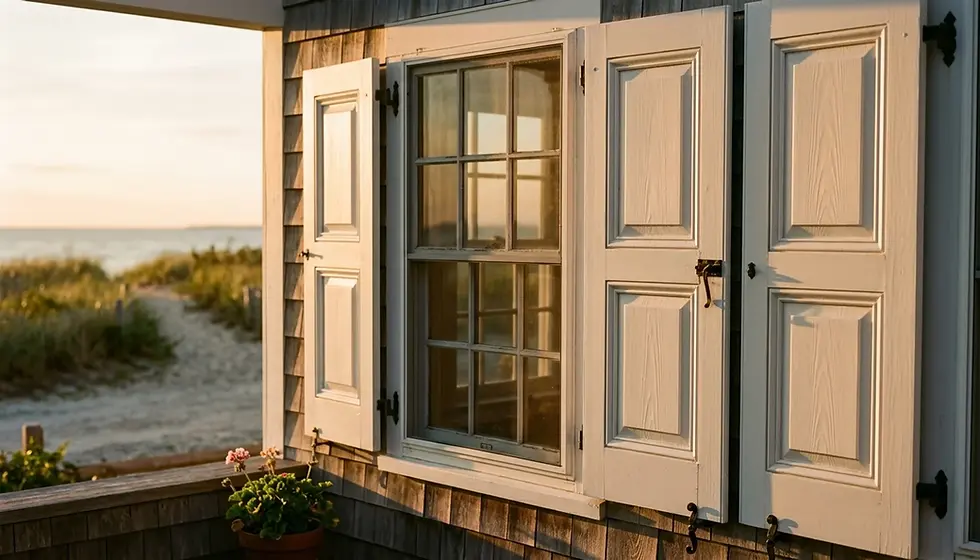
1. What Makes Faux Wood and Composite Shutters the Gold Standard for Coastal Homes?
Faux wood and composite shutters are the most durable window treatment category available for beach homes because their polymer-based construction is impervious to moisture absorption, salt air oxidation, and UV degradation that destroys real wood over time. Unlike natural wood, which absorbs humidity and eventually warps, cracks, or grows mildew, composite shutters maintain their shape and finish through years of coastal exposure.
The two leading products in this category serve as reliable benchmarks. Hunter Douglas Palm Beach Polysatin Shutters use a polysatin compound that specifically resists moisture, mildew, and UV rays, and the manufacturer guarantees they will not warp, crack, fade, chip, or peel. Norman USA's Woodlore Plus Shutters use an ABS copolymer construction with stainless steel hinges designed to prevent rust in salt-air environments. Those stainless steel hinges are a detail worth looking for; most budget composite shutters use steel or zinc hardware that corrodes within two to three seasons on an oceanfront property.
Composite shutters also offer one practical advantage that other window treatments cannot match: they provide meaningful insulation. Louvered panels trap air when closed, reducing heat gain through sun-facing windows during summer and reducing heat loss in winter. For a beach house with large west-facing windows taking direct afternoon Atlantic sun, that thermal benefit translates to measurable cooling cost reduction.
Best for: Primary residences, rental properties with high guest turnover, oceanfront homes with significant direct sun exposure. Our team at Home Blinds and Floors regularly installs composite shutters as the first recommendation for Delaware bay-front homes where salt spray is a daily reality.
Honest caveat: Composite shutters require a larger upfront investment than roller shades or blinds. Budget roughly $200 to $350 per window for professional installation, depending on window size and louver configuration. That cost pays back in longevity; you are unlikely to replace well-installed composite shutters for fifteen years or more.
2. How Do Solar Shades Protect Against UV While Preserving Ocean Views?
Solar shades are a light-filtering window treatment made from UV-stabilized woven mesh fabric that blocks ultraviolet radiation and reduces glare while maintaining visible sightlines to the exterior. For beach homes where an ocean or bay view is a primary feature, solar shades are the category that best reconciles UV protection with view preservation.
The critical specification to understand is openness factor, the percentage of the fabric that is open weave versus solid material. A 10% openness factor lets in more light and provides a clearer view but blocks less UV. A 1% or 3% openness factor blocks more UV and provides greater privacy, but the view becomes somewhat filtered. According to published product data from Blindsgalore's coastal collection, openness factor options for coastal solar shades range from 1% through 15%, giving you precise control over how much UV protection you trade for view clarity. Hunter Douglas Designer Screen Shades offer five varying opacity levels for the same reason.
For south and west-facing windows on Delmarva coastal properties, a 3% to 5% openness factor is the practical sweet spot. It blocks the majority of UV radiation, prevents interior furniture and flooring from fading, and still allows a usable view of the water. For screened porches or sunrooms where direct sun enters at a low angle, consider stepping down to 1% to 3%.
Solar shades with GREENGUARD Gold certification, such as the E Screen fabrics validated by the official Hunter Douglas E Screen GREENGUARD Gold Certificate, also carry indoor air quality certification, which matters for enclosed beach cottages with limited ventilation during shoulder seasons.
Best for: Living rooms and great rooms with water views, sunrooms, west-facing windows with afternoon sun exposure. Browse our window shades installation options to see the solar shade collections we carry for Delmarva homes.

3. Are Natural Woven Shades Worth the Risk in Salty, Humid Conditions?
Natural woven shades, made from bamboo, jute, sea grass, or rattan, are the window treatment category most associated with coastal and beach house aesthetics, but they carry the highest moisture vulnerability of any material group. Understanding when they work and when they fail is essential before you invest in them for a coastal property.
The honest performance picture: natural fibers are rated "Fair" for moisture resistance in coastal climates according to industry benchmarks, with a useful lifespan of 3 to 5 years without protective treatment. That does not mean you should avoid them entirely. It means placement and protection protocol matter enormously. Woven bamboo or sea grass shades installed in an interior room with good air circulation and no direct salt spray exposure can last well and look exceptional. Placed immediately behind oceanside windows that open regularly during summer, they deteriorate quickly.
Hunter Douglas Pirouette and Silhouette woven wood shades use hand-crafting techniques designed to minimize stretching, bowing, and breaking, which extends their coastal lifespan compared to lower-cost alternatives. If you want woven natural textures in a beach house, these are the products worth budgeting for rather than entry-level bamboo shades from a mass retailer.
Norman USA specifically warns against heavy drapes and opaque fabrics in coastal settings because they block airflow and trap moisture against the window frame, accelerating mildew growth on both the treatment and the surrounding trim. A woven shade allows more air movement than a solid roller shade, which is one reason it remains appropriate in the right coastal room despite its moisture sensitivity.
Best for: Interior bedrooms, dining rooms, and rooms without direct ocean-facing exposure. Avoid in bathrooms, screened porches, and any room where windows remain open during rain or heavy salt spray events.
4. Why Are Cellular and Honeycomb Shades an Underrated Choice for Beach House Bedrooms?
Cellular shades, also called honeycomb shades, are a window treatment category that uses a structured honeycomb fabric construction to trap air within individual cells, creating a built-in insulation layer that reduces heat transfer through windows. For beach house bedrooms where summer sun rises early and afternoon heat is intense, cellular shades deliver both meaningful energy efficiency and effective light control.
Norman USA's Portrait Honeycomb Shades directly address the coastal energy equation: the cellular structure prevents heat gain in summer and heat loss in winter, reducing the load on HVAC systems that already work hard against coastal temperature swings. In practical terms, you get a room that stays cooler longer in the morning before the AC kicks in.
The material matters as much as the structure. Polyester cellular fabrics are the correct specification for coastal properties. Per industry performance data, polyester cellular fabrics maintain color and operational integrity for 8 to 12 years in humid coastal environments, significantly longer than natural fiber alternatives. The honeycomb construction also prevents the fabric from lying flat against the glass, reducing the direct contact that accelerates salt-air degradation on window-adjacent materials.
Room-darkening cellular shades block 95 to 99% of light, making them the practical choice for beach house bedrooms where sunrise arrives early and guests or family members want to sleep past 6 a.m. That opacity range represents the industry standard for room-darkening performance. If you want a softer morning ambiance rather than full blackout, light-filtering cellular options maintain the insulation benefit with a gentler glow.
Best for: Bedrooms, nurseries, guest rooms in vacation rentals where sleep quality matters. Our cellular shades resource section covers single-cell versus double-cell options in detail for Delmarva homeowners.
5. What Are the Best Window Treatments for Sliding Glass Doors in Beach Houses?
Sliding glass door window treatments for beach homes refer to the category of panels, shades, or vertical systems designed specifically for wide glass doors that open onto decks, patios, or oceanside porches. Standard horizontal blinds do not function well on sliding doors because the slats catch and bend when the door moves, and wide horizontal spans sag over time in humid conditions.
Norman USA's SmartDrape Shades are specifically engineered for this application. The product allows occupants to pass through the doorway without opening the shade, eliminating the operational frustration that makes most sliding door treatments impractical. For a vacation rental property where guests unfamiliar with the mechanism will use the door dozens of times per week, that design advantage is directly relevant to long-term durability.
Vertical panel track systems represent the other strong option for wide coastal sliding doors. Unlike traditional vertical blinds with individual louvered slats that break and tangle, panel track systems use full-width fabric panels that slide smoothly on a top track. For coastal properties, specify panels in a performance fabric rather than natural linen, which will absorb moisture from the salt-air breeze when the door is open.
The hardware specification is as important as the fabric on sliding door applications. A sliding door sees hundreds of uses per season. Plastic track hardware degrades faster than powder-coated aluminum or stainless steel components in coastal humidity. Our installation team at Home Blinds and Floors specifies corrosion-resistant hardware as a standard practice for Ocean City and Rehoboth Beach properties for exactly this reason.
Best for: Ocean-facing decks, walkout patios, indoor-outdoor transitional spaces. For more detail on sliding door-specific options, our guide to best window treatments for sliding glass doors in Delmarva covers material and hardware specifications in depth.

6. How Do Outdoor and Exterior Shades Handle Salt Air, Rain, and Coastal Heat?
Outdoor shades and exterior roller shades are window treatment products mounted on the exterior of a building or on a porch/deck structure, designed to block heat and UV radiation before it ever reaches the glass. For beach homes with screened porches, elevated decks, or west-facing walls that absorb afternoon Atlantic sun, exterior shades can reduce the solar heat load on those surfaces by a significant margin before any interior window treatment is needed.
Coolaroo Outdoor Sun Shades represent the category standard for coastal exterior applications. The product uses mold-resistant, UV-stabilized materials explicitly rated to handle heat, rain, and sustained humidity, making Coolaroo one of the few outdoor shade brands designed with coastal conditions as a primary use case rather than an afterthought. For comparison, standard patio shades sold at mass retailers typically use polyester fabrics without UV stabilization; those fabrics degrade visibly within one or two seasons of direct coastal sun.
The installation approach matters for exterior shades in coastal wind environments. Overhead or side-mounted exterior shades on oceanfront porches need reinforced attachment hardware rated for wind load. A shade that flaps and tears in a nor'easter is not just a product failure; it is a potential debris hazard. Specify stainless steel mounting brackets and heavy-gauge grommets for any exterior shade application within a few blocks of the ocean or bay.
Coolaroo products are available in a range of openness factors comparable to interior solar shades, so you can calibrate view-to-privacy ratio the same way you would for an interior application.
Best for: Screened porches, elevated beach house decks, pergola structures, and west-facing exterior walls. Pair with interior solar shades for a layered approach that handles both heat gain and glare from different angles.
7. Should Vacation Rental Beach Properties Use Motorized Window Treatments?
Motorized window treatments for vacation rental beach homes are automated shade or blind systems operated by remote control, wall switch, smartphone app, or voice command, eliminating the mechanical cord and chain components that guests most commonly damage in short-term rental properties. For rental owners managing coastal properties from a distance, motorization also enables automated sunrise and sunset scheduling without requiring electrical modifications in most battery-powered systems.
The growth trajectory for this category is steep. According to Fortune Business Insights market data, the automatic window covering segment is projected to grow at a CAGR of 9.8% from 2026 to 2030, driven by smart home adoption and the practical appeal for vacation rental operators. As of 2026, motorized shades compatible with Alexa, Google Home, and Samsung SmartThings are widely available at accessible price points, not just luxury-tier installations.
Battery-powered motorized shades are particularly well suited to vacation rental beach homes because they require no electrical wiring modifications. In historic coastal cottages in Lewes or Milton, Delaware, where hardwired installations could require permit review, battery motors eliminate that complication entirely. Rechargeable motors are the most cost-effective over time; recharging via USB every six to twelve months is a manageable maintenance task even for absentee owners.
Cordless operation is also a safety specification, not just a convenience feature. Growing regulatory focus on cord strangulation risks, including Health Canada's 2019 corded window blind regulations, has accelerated consumer adoption of cordless and automated systems. For vacation rental properties where children of varying ages are guests, cordless operation is a sound liability decision regardless of local requirements.
For hard-to-reach windows on the upper floors of two-story beach houses, motorization moves from a convenience to a practical necessity. Our team at Home Blinds and Floors frequently recommends motorized solar shades for the second-floor ocean-facing windows on vacation rental properties in Ocean Pines and Bethany Beach where manual operation would require a ladder.
Best for: Vacation rental properties, two-story beach houses with high windows, owners who manage properties remotely, and any home with smart home integration goals. Visit our shades installation page for motorized options we install across the Delmarva Peninsula.
Which Window Treatment Materials Actually Resist Coastal Hardware Corrosion?
Hardware corrosion resistance refers to the ability of the metal and plastic components in a window treatment system, including brackets, screws, tilt rods, lift mechanisms, and track systems, to resist oxidation and structural degradation caused by salt-laden air and sustained high humidity. Most buyers focus on fabric or material selection and underestimate how quickly corroded hardware degrades an otherwise quality installation.
The material hierarchy for coastal hardware, from most to least resistant, runs as follows:
Hardware Material | Corrosion Resistance | Typical Coastal Lifespan | Best Application |
316 Marine Grade Stainless Steel | Excellent | 15+ years | Exterior mounts, oceanfront brackets |
304 Stainless Steel | Very Good | 10-15 years | Interior hardware, Norman Woodlore Plus hinges |
Powder-Coated Aluminum | Good | 8-12 years | Track systems, panel runners |
UV-Stabilized Polymer/Plastic | Good | 8-12 years | Tilt rods, endcaps, mounting brackets |
Standard Zinc-Plated Steel | Poor | 2-4 years | Avoid in salt-air environments |
Untreated Aluminum | Fair | 3-6 years | Avoid within 1 mile of ocean/bay |
The WRF Design Center identifies vinyl, aluminum, and faux wood as the three best material categories for coastal window treatments, but that recommendation applies to the slat or panel material, not to the mounting hardware. You can install composite shutters with the best polysatin compound available, and still have a failing installation in year three if the mounting brackets are zinc-plated steel rusting through their holes in the window frame.
When you review product specifications or request an installation quote, specifically ask what the bracket and hardware specification is. Premium brands like Hunter Douglas and Norman USA engineer hardware-level corrosion resistance into their coastal product lines; that is one practical reason their products justify a higher price point than comparable-looking mass-market options.
What Is the True Cost of Ownership for Coastal Window Treatments Over 10 Years?
Long-term cost of ownership for coastal window treatments is the total expenditure over a defined period that includes initial purchase price, installation cost, maintenance, and replacement frequency, factored against the specific degradation rates caused by salt air and UV exposure at a coastal property. Most buyers compare only the upfront price, which systematically undervalues premium coastal-grade products.
Consider a straightforward comparison across a 10-year window for a standard beach house with 12 windows:
Treatment Type | Upfront Cost (12 windows) | Expected Coastal Lifespan | Replacements in 10 Years | 10-Year Total (estimated) |
Big-box standard blinds | $400-$800 | 2-4 years (coastal) | 2-3 full replacements | $1,200-$2,400 |
Polyester roller shades (professional) | $1,500-$2,500 | 8-10 years | 0-1 partial replacement | $1,500-$3,500 |
Cellular shades (polyester, professional) | $2,000-$3,500 | 8-12 years | 0-1 partial replacement | $2,000-$4,500 |
Composite shutters (Hunter Douglas/Norman) | $3,500-$5,500 | 15+ years | 0 in 10 years | $3,500-$5,500 |
The pattern is clear: the cheapest upfront option is rarely the cheapest over a decade. Big-box standard blinds replaced two or three times in ten years can cost as much as professionally installed composite shutters that need no replacement in the same period, plus the added installation labor each time.
For vacation rental owners, the cost calculation includes one additional factor: guest-caused damage. Cordless and motorized systems significantly reduce mechanism damage from guests who do not follow operating instructions. A rental property with cord-and-pulley blinds will see more frequent mechanical failures than the same property with motorized or cordless cellular shades, and those repairs add up across a season of weekly turnover.

Room-by-Room Guide: Which Treatments Work Best Where in a Beach House?
Room-by-room window treatment selection for beach homes means matching each treatment type to the specific light control, privacy, moisture, and aesthetic requirements of each space, rather than applying a single material throughout. No competitor article covers this breakdown in meaningful detail, which is a significant gap given that a bedroom, bathroom, and kitchen on the same oceanfront property have completely different functional requirements.
Living Room and Great Room
Solar shades are the correct first choice for main living areas with water views. A 3% to 5% openness factor balances UV protection and view preservation. Layer with a sheer panel for evening privacy if the space is visible from a neighboring property or a shared beach walkway.
Bedrooms
Room-darkening cellular shades in polyester fabric deliver the insulation, sleep quality, and durability you need. Specify a standard inside mount to avoid the visible gap around the frame edges that undermines light blocking. For vacation rental bedrooms, motorized cellular shades eliminate cord damage and allow automated blackout scheduling.
Bathrooms
Composite shutters or faux wood blinds are the only practical choices in coastal bathrooms. Steam from showers combines with salt-air humidity to create the most aggressive moisture environment in a beach house. Natural fibers, cellular shades, and fabric roller shades will mildew within months in this room. Composite shutters wipe clean with a damp cloth and handle sustained moisture without warping. Our guide to faux wood versus real wood blinds for Delmarva homes covers this moisture-resistance comparison in detail.
Kitchen
Faux wood blinds or easy-clean roller shades work well in beach house kitchens. Avoid woven natural shades above a stove or sink where cooking steam and grease accumulate. A simple white or neutral roller shade in a polyester fabric is the most practical and cost-effective kitchen treatment for a rental property.
Screened Porch or Sunroom
Exterior-rated Coolaroo shades for the perimeter, or solar shades with a low openness factor for the interior glass walls of an enclosed sunroom. Hunter Douglas Designer Screen Shades are described specifically as effective in sunrooms for their UV protection performance. For more ideas tailored to this space, our sunroom solar shade guide for Delmarva covers the full selection process.
Sliding Glass Doors to the Deck
Panel track systems or Norman SmartDrape Shades. Specify performance fabric, not natural linen. Verify that the track hardware is powder-coated aluminum or stainless steel, not standard steel. For a full specification walkthrough, our article on vertical shades for sliding glass doors in Delmarva is worth reading before you purchase.
How Do Storm and Hurricane Conditions Factor Into Beach Home Window Treatment Choices?
Storm-rated window treatments for coastal homes refer to products designed to withstand high-wind conditions, wind-driven rain, and the pressure differential that occurs during tropical storms and nor'easters along the Atlantic coast. Most window treatments are not storm-rated; they are decorative and functional products that should be secured or removed before a significant storm event, not relied upon for structural protection.
True storm protection at the window level requires impact-resistant glass or dedicated storm shutters, which are a separate product category from decorative window treatments. If your beach home lacks impact-rated glazing, the most important storm preparation step is securing or removing interior window treatments before a named storm, so they are not damaged and do not become secondary projectiles if a window fails.
That said, exterior solar shades and Coolaroo-style outdoor shades should be retracted or tied down before any storm with sustained winds above 40 mph. Most exterior shade manufacturers publish specific wind speed limits in their installation documentation. For composite shutters, the polysatin and ABS copolymer constructions from Hunter Douglas and Norman USA provide better physical resistance to incidental rain infiltration than fabric treatments, but they are not a substitute for storm-rated glazing.
For Delaware and Maryland coastal properties in areas designated as wind-borne debris regions, consult your local building official about requirements before installing any exterior-mounted treatment. In some Maryland coastal counties, building permit review applies to certain exterior-mounted systems on new construction or major renovation. This is a practical step that many coastal buyers overlook until they need to file an insurance claim.
Frequently Asked Questions About Window Treatments for Beach Homes
What window treatment materials work best for resisting salt air in coastal homes?
The best materials for salt-air environments are composite polymer shutters (such as Hunter Douglas Palm Beach Polysatin or Norman Woodlore Plus ABS copolymer), polyester solar shades, and UV-stabilized faux wood blinds. These materials resist corrosion, warping, mildew, and UV fading where natural wood, standard aluminum, and untreated natural fabrics will degrade within two to five years. Hardware components should specify stainless steel or powder-coated aluminum brackets to prevent bracket-level corrosion even when the treatment material itself is coastal-grade.
How do I preserve my ocean view while still getting UV protection?
Solar shades with an openness factor of 3% to 5% are the best option for balancing UV protection and view preservation. A tighter weave (1%-3%) blocks more UV and provides more privacy but filters the view more noticeably. Hunter Douglas Designer Screen Shades offer five opacity levels for precise calibration. For maximum UV protection with an unobstructed view, composite shutters with open louvers allow you to tilt for light control while keeping the sightline clear when fully open.
Are window treatments for beach vacation rentals different from primary residences?
Yes, significantly. Vacation rental beach properties need cordless or motorized treatments to prevent guest-caused cord damage and to meet child safety best practices. Fabric durability and fade resistance are more critical because treatments receive heavy seasonal use without the careful maintenance a primary homeowner provides. Cellular shades and composite shutters both perform well in this context because their operation mechanisms are robust and their surfaces are easy to clean between guest stays. Motorized battery-powered systems also allow remote operation scheduling for absentee owners.
What is the openness factor for solar shades and why does it matter for beach homes?
Openness factor is the percentage of a solar shade's surface area that is open weave rather than solid material, expressed as a number from 1% to 15% or higher. For beach homes, openness factor controls how much UV radiation enters the room, how much privacy the shade provides, and how clearly you can see through the shade to a water view. A 3% openness factor blocks significantly more UV and provides more daytime privacy than a 10% factor, but reduces view clarity. Coastal solar shades are available in openness factors from 1% through 15%, according to product data from major suppliers.
How much should I budget for professional window treatment installation in a Delmarva beach home?
Budget ranges vary by treatment type and window count, but as a general guide, composite shutters typically run $200 to $350 per window professionally installed, polyester cellular shades range from $150 to $280 per window, and solar roller shades typically fall in the $100 to $200 per window range. These are professional installation ranges using quality coastal-grade materials; big-box treatments cost less upfront but require more frequent replacement in coastal conditions. Home Blinds and Floors provides free in-home consultations with detailed project quotes tailored to your specific window count and coastal exposure.
Can motorized shades work in a beach vacation home without wiring modifications?
Yes. Battery-powered and rechargeable motorized shades operate without any electrical wiring modifications, making them well-suited for historic coastal cottages or rental properties where hardwired installations would require permits. Rechargeable motors typically require recharging via USB every six to twelve months depending on use frequency. Battery-powered motors in less frequently used rooms can run for one to two seasons between changes. Many systems are compatible with Alexa, Google Home, and Samsung SmartThings for scheduled operation based on sunrise and sunset times.
How do I clean and maintain window treatments in a coastal home?
Composite shutters and faux wood blinds wipe clean with a damp cloth; avoid abrasive cleaners that strip the polymer coating. Polyester roller shades and solar shades can typically be spot-cleaned with a mild detergent solution and a soft cloth, or fully cleaned per the manufacturer's care instructions. Natural woven shades require more careful handling; spot-clean only and avoid saturating the natural fibers. For detailed care procedures, the official Hunter Douglas Cleaning, Maintenance and Operating Instructions document covers procedures for most major treatment categories. Inspect hardware annually for early-stage corrosion and address it before it compromises mounting integrity.
Choosing the Right Coastal Window Treatments: Your Next Steps
The best window treatments for beach homes share three traits regardless of category: materials engineered for moisture and UV resistance, hardware specified for salt-air corrosion resistance, and construction quality that justifies the price through longevity rather than asking you to replace treatments every few seasons. Composite polymer shutters sit at the top of the durability hierarchy. Solar shades solve the view-versus-protection equation better than any other product type. Cellular shades in polyester fabric deliver energy efficiency and light control in bedrooms with an 8 to 12 year performance window in coastal conditions.
The room-by-room approach matters more than most buyers realize. A bathroom and a living room on the same oceanfront property need fundamentally different specifications, and applying one material throughout is almost always a compromise that serves neither room optimally. Start with the highest-exposure rooms, typically south and west-facing windows and bathrooms, and prioritize coastal-grade materials there before optimizing for aesthetics in lower-exposure interior spaces.
In 2026, the range of coastal-ready window treatment options across price tiers is broader than it has ever been. Whether you are outfitting a primary residence in Rehoboth Beach or a vacation rental in Ocean City, there is a durable, view-preserving, UV-blocking solution that fits your budget and timeline. The key is knowing which specifications to require before you purchase.
Ready to find the right solution for your coastal property? Contact Home Blinds and Floors to schedule a free in-home consultation. Our team serves the full Delmarva Peninsula from Lewes and Bethany Beach to Ocean City and Salisbury, bringing samples directly to your home so you can see exactly how each treatment looks in your specific light conditions before committing.
At Home Blinds and Floors, we bring the showroom to your coastal home, so you see exactly how each treatment handles your light before you decide. Schedule your free consultation here and get product recommendations matched to your specific exposure, view, and budget.


Ocean views are great until afternoon glare cooks your living room. Standard blinds often block the breeze or get ruined by coastal humidity. If you are doing Luxury Home Remodeling along the coast, integrating recessed motorized shades directly into the ceiling framing looks much cleaner. It lets you keep those floor-to-ceiling glass views without turning your beach house into a greenhouse.