.avif)
.avif)
.avif)
Different Types of Blinds for Windows: The Full Guide

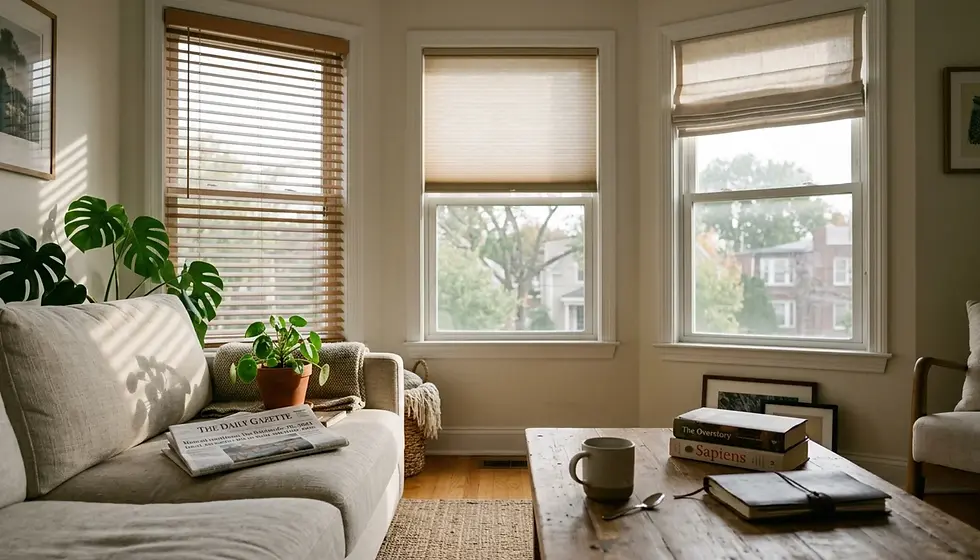
The different types of blinds for windows fall into eight main categories: wood, faux wood, metal (aluminum), mini, vertical, roller, cellular, and Roman blinds. Each type controls light and privacy differently, suits specific rooms and architectural styles, and carries a distinct price range. Knowing which category fits your space before you shop saves you from costly returns and installation mistakes.
Eight core blind types cover the full spectrum from traditional wood to motorized roller systems, each with distinct material, function, and aesthetic profiles.
Faux wood blinds resist warping and fading in humid environments, making them the practical choice for bathrooms, kitchens, and coastal homes on the Delmarva Peninsula.
Cellular (honeycomb) blinds provide the highest insulation value of any blind type, trapping air in their honeycomb structure to reduce heat transfer through glass.
Vertical blinds are the most practical solution for sliding glass doors and floor-to-ceiling windows, available with baton or cord-loop control systems.
Motorized options now exist across nearly every blind category in 2026, with voice-control and app compatibility increasingly standard rather than premium.
Child safety regulations from the Window Covering Manufacturers Association (WCMA) now require cordless or inaccessible cord systems on blinds sold for homes with young children.
Choosing the right window treatment is rarely as simple as picking a color. Room function, humidity levels, light exposure, your home's architectural style, and your household's safety needs all push you toward different solutions. At Home Blinds and Floors, we work with homeowners across the Delmarva Peninsula every week, from Rehoboth Beach beach houses dealing with salt-air corrosion to Easton, MD farmhouses needing energy efficiency upgrades. The patterns we see consistently are that people either overbuy (paying for motorization in a low-traffic guest room) or underbuy (installing aluminum blinds in a coastal kitchen where moisture warps them within two seasons).
This guide breaks down every major blind category with honest assessments of where each type excels, where it falls short, and what you should realistically expect to pay. We also cover the content gaps most buying guides skip entirely: energy efficiency, cleaning requirements, and child safety standards. By the end, you will have a clear framework for matching the right blind type to every window in your home.
What Are the Different Styles of Window Blinds?
Window blinds are a type of hard window covering made from horizontal or vertical slats, vanes, or panels that adjust to control light and privacy. Unlike soft window treatments such as curtains or fabric shades, blinds use rigid or semi-rigid materials including wood, aluminum, vinyl, and composite foam that tilt, raise, or slide to modify the amount of light entering a room. In 2026, the eight most widely installed blind styles are wood, faux wood, metal, mini, vertical, roller, cellular, and Roman blinds.
Before going deeper, one distinction worth making: blinds and shades are not the same thing. Blinds have individual slats or vanes that tilt independently. Shades are made from a single piece of fabric or material that raises and lowers as one unit. Roller shades and Roman shades technically belong to the shades category, but are so commonly grouped with blinds in everyday conversation that most guides, including this one, address them together. If you want to explore shades as their own product family, our dedicated shades page covers every option in detail.
Wood Blinds
Wood blinds feature real hardwood slats, typically 2 inches wide, and suit traditional, southern, mid-century modern, coastal, and transitional interior styles. They bring warmth and authenticity that no manufactured alternative fully replicates. The trade-off is sensitivity to moisture: real wood warps and swells in high-humidity environments, so these are best reserved for living rooms, dining rooms, and bedrooms in climate-controlled spaces. Avoid them in bathrooms, kitchens, or any coastal property without reliable dehumidification. When fitted with decorative tape, wood blinds can only tilt the slats rather than raise and lower the blind entirely, so factor that into your decision if full raise-and-lower function matters to you.
Faux Wood Blinds
Faux wood blinds are constructed from a composite foamwood material with 2-inch slats that mimic real wood grain without the moisture vulnerability. They resist warping and fading, which makes them the smarter choice for bathrooms, kitchens, laundry rooms, and any coastal home subject to salt-air humidity. Most manufacturers offer faux wood in 10 or more nature-inspired colors. In terms of operation, the standard cordless control uses the bottom bar to lift and lower the blind and a wand to tilt the slats. For a deeper comparison of these two materials specific to the Delmarva region, our post on faux wood vs. wood blinds for Delmarva homes lays out the full cost and durability picture.
Metal (Aluminum) Blinds
Metal blinds use aluminum slats, typically 2 inches wide, and suit modern, contemporary, industrial, and glam interiors. They are lightweight, easy to wipe clean, and relatively affordable, making them a practical choice for offices and high-traffic commercial spaces. Standard finishes range from neutral whites and grays to bolder options including matte black and champagne gold. Like wood blinds, the standard cordless model uses the bottom bar to lift and lower and a wand to tilt. Motorized versions add tilt control via remote, app, or smart home voice command, though motorized tilt on metal blinds removes the ability to raise and lower them, so confirm which function you prioritize before specifying motorization.
Mini Blinds
Mini blinds are a narrower version of metal blinds, using 1-inch aluminum slats instead of the standard 2-inch width. That reduced slat size is specifically engineered for sidelights, French doors, narrow bathroom windows, laundry room windows, and closet windows where a full-width blind would look bulky or block too much light. Importantly, mini blinds provide tilt function only; they do not lift or lower. If you need raise-and-lower capability in a small window, a 1-inch faux wood or standard metal blind is a better fit. Mini blinds are typically available in a smaller range of colors, often five metallic shades.

Vertical Blinds
Vertical blinds use vertical vanes or slats that slide along a track rather than stacking horizontally. They are the most practical solution for sliding glass doors and floor-to-ceiling windows because they draw open to the side rather than bunching at the top, keeping the view fully unobstructed when open. Two control types are standard: baton control and cord-loop control, the latter requiring a tension device installed at the wall. Vertical blinds are sometimes referred to as panel track blinds, though technically these two systems differ in slat width and mounting style. For sliding door applications specifically, our guide to sliding door treatments covers both vertical blinds and alternative panel systems side by side.
What Are the Best Types of Blinds to Get?
The best type of blind for a given window depends on four factors: the room's humidity level, the amount of direct sunlight the window receives, the privacy requirement, and your household's safety needs. No single blind type wins across all four factors, so the practical answer is almost always a mix of types across different rooms rather than one uniform solution throughout a home.

Here is a room-by-room breakdown of what consistently performs best, based on the patterns our team at Home Blinds and Floors sees in homes across Kent Island, Bethany Beach, Salisbury, and Annapolis:
Room | Best Blind Type | Why | Avoid |
Living Room | Wood or Faux Wood | Warmth, style flexibility, full raise-and-lower control | Mini blinds (too narrow aesthetically) |
Bedroom | Cellular or Roller with blackout lining | Maximum light block, energy efficiency, quiet operation | Metal blinds (light gaps around slats) |
Bathroom | Faux Wood or Mini Blinds | Moisture resistance, compact fit for smaller windows | Real wood (warps rapidly in humidity) |
Kitchen | Faux Wood or Roller | Easy to wipe clean, resists cooking steam and grease | Fabric Roman shades (absorb cooking odors) |
Sliding Door | Vertical Blinds or Panel Track | Side-draw opening keeps doorway clear | Horizontal blinds (stack too bulky at top) |
Home Office | Metal or Roller with light-filtering fabric | Glare control without full blackout, easy to clean | Cellular (more insulation than needed, higher cost) |
Coastal/Beach Home | Faux Wood or Composite Shutters | Salt-air resistance, UV-stable materials | Aluminum (corrodes), real wood (warps) |
For energy-conscious homeowners, cellular blinds are the standout performer regardless of room. Their honeycomb structure traps still air against the glass, reducing heat transfer in both winter and summer. Our detailed post on cellular shades explains single-cell versus double-cell construction and which situations justify the higher cost of double-cell units.
What Are the 12 Types of Window Coverings?
Window coverings as a category include both hard treatments (blinds and shutters) and soft treatments (shades, curtains, and drapes). The 12 most common types installed in residential and commercial properties in 2026 are: wood blinds, faux wood blinds, metal blinds, mini blinds, vertical blinds, roller shades, cellular shades, Roman shades, plantation shutters, panel track systems, curtains and drapes, and exterior shutters. Blinds specifically refer to the slat-based hard treatments; the remaining categories are technically shades, shutters, or fabric treatments.
Understanding where blinds end and shades begin matters practically, because the two categories are measured, mounted, and priced differently. Blinds require precise slat-width selection and headrail sizing. Shades require fabric opacity selection and often a clutch or motorized lift mechanism. Our blinds page and shutters page cover each category's installation requirements in full, including what measurements you need before requesting a quote.
Cellular Shades (Honeycomb Blinds)
Cellular shades are constructed from a continuous pleated fabric that forms honeycomb-shaped air pockets when extended. Those air pockets create a thermal barrier between the window glass and the room interior. Single-cell construction provides solid light filtering and moderate insulation; double-cell adds a second layer of honeycomb pockets for significantly better energy performance. For Delmarva homeowners managing high summer cooling loads or cold bay-facing windows in winter, double-cell cellular shades are worth the price premium. Our comparison of single vs. double cell shades for Delmarva homeowners walks through the cost-benefit calculation in detail.
Roller Shades
Roller shades consist of a single piece of fabric wound around a tube at the top of the window. They operate with a spring mechanism, a chain, or a motorized system. In 2026, roller blind fabrics have evolved considerably: thermal-backed and moisture-resistant options are now standard fare rather than premium upgrades. Day-and-night (zebra) roller blinds layer alternating sheer and opaque bands, allowing continuous adjustment between filtered light and privacy without switching treatments. For rooms with sliding glass doors, our post on the best vertical shades for sliding glass doors in Delmarva compares roller options against vertical alternatives directly.
Roman Shades
Roman shades fold into horizontal fabric pleats when raised, creating a layered, tailored look that suits traditional and transitional interiors particularly well. They are fabric-based, which means they absorb heat and light more softly than hard blinds but also absorb odors in cooking spaces. Motorized Roman shades have dropped significantly in price as of 2026, with quieter and smoother lift mechanisms now available at accessible price points. For kitchen applications, the better choice is almost always a wipeable roller or faux wood blind rather than fabric Romans.
Plantation Shutters
Plantation shutters are interior shutter panels mounted directly to the window frame with 2.5-inch to 4.5-inch adjustable louvers. They provide the strongest combination of light control, privacy, insulation, and long-term durability of any window covering category. Composite and faux-wood plantation shutters resist salt air and humidity, which is why they are one of the most requested treatments we install in Ocean City, MD and Rehoboth Beach coastal homes. Composite shutters typically run in the range of $250 to $550 installed per window depending on size and louver width, though exact pricing requires a measurement consultation. For a full breakdown of shutter styles and materials, visit our shutters service page.

How Do Price Ranges Compare Across Blind Types?
Price ranges for the different types of blinds for windows vary substantially based on material, operating system, and window size. Understanding the cost tier of each blind type before you start measuring saves you from scope creep once you are deep into a renovation budget. The figures below reflect typical installed costs for standard residential windows in the Delmarva market; very large windows, specialty shapes, or motorized upgrades add to these ranges.
Blind Type | Typical Installed Cost (per window) | Manual vs. Motorized | Durability Tier |
Mini Blinds (1-inch metal) | $40 to $120 | Manual only | Entry-level |
Metal (Aluminum) Blinds | $60 to $180 | Manual or motorized tilt | Entry to mid |
Faux Wood Blinds | $80 to $250 | Manual or motorized tilt | Mid-level |
Roller Shades | $90 to $300 | Manual or fully motorized | Mid-level |
Wood Blinds | $100 to $350 | Manual or motorized tilt | Mid to premium |
Cellular Shades | $120 to $400 | Manual, cordless, or motorized | Mid to premium |
Roman Shades | $150 to $450 | Manual or motorized | Mid to premium |
Vertical Blinds | $100 to $350 (full panel) | Manual baton or cord-loop | Mid-level |
Plantation Shutters | $250 to $550 | Manual with tilt rod | Premium |
For a locally specific cost breakdown covering the Delmarva market, our post on how much custom blinds cost on the Delmarva Peninsula provides detailed pricing context including what drives costs up or down in this region.
One factor most homeowners overlook: the difference between custom and stock sizing. Stock blinds from retail outlets appear cheaper at first glance but require window dimensions to match standard sizes precisely. When they do not fit perfectly, light gaps appear at the sides and operation suffers. Custom-measured blinds eliminate both problems. The long-term cost of replacing ill-fitting stock blinds every three to five years typically exceeds the upfront cost of professionally measured custom units installed once.
How Do You Clean and Maintain Each Type of Blind?
Cleaning requirements vary significantly across the different types of blinds for windows, and skipping regular maintenance shortens the lifespan of any treatment by years. The general rule is that hard-surface blinds (metal, faux wood, and wood) clean easily but require consistent dusting, while fabric-based treatments (cellular, Roman, and roller shades) need occasional deeper cleaning to avoid odor and allergen buildup.
Wood and Faux Wood Blinds
Dust wood and faux wood blinds weekly with a microfiber duster or a vacuum brush attachment, working slat by slat with the slats tilted closed. For spot cleaning, a barely damp cloth works on faux wood without risk. Never soak real wood slats; excess water causes swelling and warping. Annual deeper cleaning with a wood-safe cleaner extends the lifespan of real wood blinds considerably. In coastal homes where salt deposits settle on interior surfaces, monthly wipe-downs are more realistic than weekly dusting alone.
Metal (Aluminum) Blinds
Metal blinds are the easiest to clean of any blind type. Wipe them with a damp cloth or a mild soapy solution; aluminum is not sensitive to moisture. In a pinch, you can remove the entire blind and rinse it in a bathtub with warm water and dish soap, then hang to dry before rehanging. Avoid abrasive pads that scratch the finish. In commercial environments such as offices in Salisbury, MD or Middletown, DE where blinds accumulate fingerprints and dust quickly, metal blinds' wipe-clean surface is a genuine operational advantage.
Cellular and Roman Shades
Cellular shades require gentle vacuuming with a brush attachment along each pleat. Do not compress the cells manually; the honeycomb structure can lose its shape if crushed repeatedly. Roman shades can often be spot-cleaned with a damp cloth, but check the manufacturer's label before using any cleaning solution on the fabric. Heavily soiled fabric shades typically need professional cleaning, which adds to long-term ownership cost. Factor that into the total cost of ownership comparison against wipe-clean hard blinds.
What Do Child and Pet Safety Standards Require for Window Blinds?
Child safety requirements for window blinds are governed in the United States primarily by the Window Covering Manufacturers Association (WCMA) and informed by Consumer Product Safety Commission (CPSC) guidelines. As of 2026, corded window coverings sold at retail must comply with updated WCMA voluntary safety standards, and many states have moved toward mandatory requirements for childproofed cord systems in new construction and renovation projects. The practical implication for homeowners: if you have children under eight years old or pets in the home, cordless or motorized blinds are the safest and in some jurisdictions legally required choice.
Specifically, any cord that hangs in a loop or can form a loop presents a strangulation risk. Corded blinds with inner lift cords are also a documented hazard. The safest options are:
Cordless blinds: Operated by pushing the bottom rail up or pulling it down. Available across wood, faux wood, metal, and cellular categories.
Motorized blinds: No accessible cords whatsoever. Operated by remote, app, or voice command. Available on nearly every blind and shade type in 2026.
Tension-cord systems: Cord loops with a tensioning device anchored to the wall that prevents the cord from forming a free loop. Required on vertical blinds sold for residential use.
For vacation rental properties in Rehoboth Beach or Bethany Beach where guests bring children, cordless or motorized blinds also reduce liability and eliminate the most common source of guest damage complaints we hear about at Home Blinds and Floors: broken cords that guests pull too hard. Cordless mechanisms have no cords to break.

What Is the Energy Efficiency Impact of Different Blind Types?
Energy efficiency is one of the most meaningful but least discussed factors when comparing the different types of blinds for windows. The U.S. Department of Energy notes that heat gain and heat loss through windows can account for 25 to 30 percent of residential heating and cooling energy use, making window treatment choice a direct contributor to utility costs. Not all blind types address this equally.
Cellular (honeycomb) shades are the top performers for energy efficiency. Their air-trapping honeycomb structure creates a thermal buffer that measurably reduces heat transfer. Double-cell cellular shades perform significantly better than single-cell on north-facing or bay-exposed windows where cold air infiltration is the primary concern. For Delmarva homeowners dealing with both intense summer sun and cold bay-wind winters, double-cell cellular shades on bedrooms and living room windows represent a genuine long-term energy investment.
Roller shades with thermal backing are the second tier. Thermal-backed fabrics (increasingly standard in 2026) reduce solar heat gain in summer and retain interior warmth in winter, though they cannot match the air-pocket insulation of cellular construction. For kitchens and bathrooms where cellular shades are impractical, thermal roller shades are the next best option.
Wood and faux wood blinds provide moderate insulation when fully closed, primarily by blocking direct solar radiation rather than insulating the glass itself. Metal blinds provide essentially no insulation benefit; their primary function is light and privacy control, not thermal performance. If energy savings are a priority in your decision, rank your options in this order: double-cell cellular, single-cell cellular, thermal roller, faux wood or wood closed, metal or mini blinds.
How Do Motorized and Smart Home Blinds Work?
Motorized blinds refer to window treatments fitted with an electric motor in the headrail or tube that raises, lowers, or tilts the blind via remote control, a smartphone app, or a smart home hub such as Amazon Alexa, Google Home, or Apple HomeKit. In 2026, motorization is no longer a luxury-only feature: cordless motorized systems are available across wood, faux wood, metal, cellular, and roller categories at accessible price points, and the mechanisms have become quieter and more reliable than earlier generations.
There is one important technical constraint to understand before specifying motorized tilt on wood or metal blinds: motorized tilt removes the ability to raise and lower the blind. The motor replaces the tilt wand and controls only slat angle. If you want both motorized tilt and raise-and-lower capability, you need a fully motorized lift system rather than a tilt-only motor. Confirm this distinction with your installer before ordering, because it is a common source of post-installation disappointment.
For practical applications on the Delmarva Peninsula, motorization makes the most sense in three situations: hard-to-reach windows in beach houses with high transom windows, bedroom blackout blinds where you want to control light without getting out of bed, and commercial spaces in Lewes or Milton where large window banks would be impractical to operate manually. For standard-height residential windows in accessible rooms, manual cordless operation is simpler and more cost-effective.
Frequently Asked Questions About Types of Blinds for Windows
What is the difference between blinds and shades?
Blinds are made of individual rigid slats or vanes (wood, aluminum, or composite) that tilt, raise, or slide to control light. Shades are made from a single continuous piece of fabric or material that raises and lowers as one unit. Cellular, roller, and Roman treatments are technically shades, but the terms are often used interchangeably in everyday conversation and retail settings.
Which type of blind is best for a bedroom?
Cellular shades with a blackout or room-darkening fabric are the best choice for most bedrooms because they combine light blocking with thermal insulation. Roller shades with a blackout lining are a close second and easier to wipe clean. Wood blinds work well in bedrooms where full blackout is not required and aesthetic warmth is the priority, though they leave small light gaps along slat edges.
Are faux wood blinds worth it over real wood?
For most homes on the Delmarva Peninsula, yes. Faux wood (foamwood composite) resists warping, fading, and moisture damage that real wood cannot withstand in humid coastal conditions. Real wood is visually superior and worth the premium only in dry, climate-controlled rooms such as formal dining rooms or living rooms with stable humidity. In bathrooms, kitchens, or any coastal property without consistent dehumidification, faux wood outlasts real wood by years.
What blind type works best for sliding glass doors?
Vertical blinds are the most practical option for sliding glass doors because the vanes draw to the side rather than stacking at the top, keeping the full doorway clear when open. Panel track systems offer a similar side-draw function with wider fabric panels for a more contemporary look. Horizontal blinds are technically possible on sliding doors but create bulk at the top and obstruct part of the door when raised.
Do cordless blinds cost more than corded blinds?
Cordless blinds typically cost 10 to 25 percent more than their corded equivalents, depending on the blind type and brand. The higher upfront cost is justified by safety benefits (WCMA child safety compliance), cleaner appearance with no dangling cords, and reduced breakage risk in high-traffic households and rental properties. For homes with children under eight years old, cordless or motorized operation is the strongly recommended standard in 2026.
How long do window blinds last?
Quality blinds professionally installed with appropriate materials for the room typically last 10 to 20 years. Faux wood and composite blinds in coastal environments tend to last 12 to 15 years with basic maintenance. Aluminum mini blinds in high-use rooms may need replacement in 5 to 8 years due to slat bending and mechanism wear. Plantation shutters outlast all other categories, often remaining functional for 20 to 30 years with no more than occasional adjustment.
Can I install window blinds myself, or do I need a professional?
Standard horizontal blinds in typical window openings are manageable as a DIY project if you measure accurately and follow the manufacturer's mounting instructions. However, professional installation becomes worth the cost in several situations: non-standard window shapes, windows above staircases or in high positions, large window banks requiring consistent alignment, and any motorized system that requires wiring or hub integration. Measurement errors are the most common source of DIY installation failures, and custom blinds cannot be returned once cut to size.
What blind type is best for energy savings?
Double-cell cellular shades provide the best energy efficiency of any blind or shade type because their two-layer honeycomb structure traps a larger column of still air against the glass. The U.S. Department of Energy identifies windows as responsible for 25 to 30 percent of residential heating and cooling energy use, making treatment selection a meaningful factor in utility costs. After cellular shades, thermal-backed roller shades are the next most energy-efficient option, particularly for summer heat gain reduction.
Choosing the Right Blind Type: A Practical Summary
The different types of blinds for windows are not interchangeable. Each one is engineered for a specific combination of room conditions, aesthetic goals, and operational needs. The most important selection decisions come down to three things: the room's moisture level (which rules out real wood in bathrooms and coastal kitchens), the household's safety requirements (which make cordless or motorized operation the default for homes with young children), and the light control priority (which pushes bedrooms toward cellular or blackout roller and living rooms toward wood or faux wood with precise tilt control).
Budget-conscious homeowners should not automatically reach for the cheapest option. Metal mini blinds at $40 to $120 per window last five to eight years in high-use rooms. Custom faux wood blinds at $80 to $250 per window, installed correctly and maintained properly, last 12 to 15 years. The math on quality almost always favors the mid-tier investment when you factor in replacement costs and installation labor. Custom-measured professional installation, in particular, eliminates the light gaps and operational issues that make stock blinds frustrating within the first year.
In 2026, the overall trend across all blind categories is toward cleaner operation: cordless mechanisms, quieter motorized systems, and more durable materials that require less frequent replacement. Those trends all point toward investing slightly more upfront and replacing far less often.

If you are working through the different types of blinds for windows and want a professional to evaluate your specific rooms, light conditions, and budget before you commit, that is exactly what our in-home consultation process is designed for. Our team at Home Blinds and Floors serves homeowners and businesses across the Delmarva Peninsula, from Annapolis and Cambridge on the Maryland side to Rehoboth Beach, Lewes, and Millsboro in Delaware. We bring samples, take precise measurements, and give you a detailed quote before any order is placed. Schedule your free consultation with Home Blinds and Floors and get the right treatment for every window in your home.


Comments