.avif)
.avif)
.avif)
Panelled Window Shutters: What Nobody Tells You Before Buying


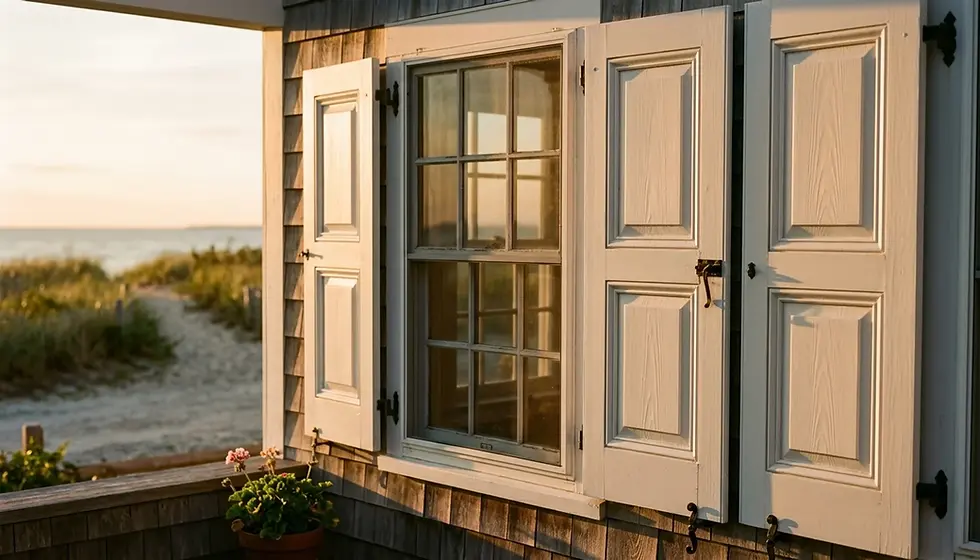
Panelled window shutters are solid-panel window coverings, available in raised, recessed, or flat configurations, that frame a window opening to add architectural definition and curb appeal. Unlike louvred shutters, panelled styles offer a fully solid face, making them a classic choice for colonial, federal, and craftsman-style homes across the Delmarva Peninsula and Eastern Shore.
Panelled window shutters come in three main profiles: raised panel, recessed (flat) panel, and board-and-batten, each suiting different architectural styles.
Most panelled shutters sold today are decorative and fixed in place, not functional or operable; buyers are rarely told this upfront.
Material choice matters more on the Delmarva coast: vinyl and composite panels resist salt air and humidity far better than untreated wood.
According to The Business Research Company, the global window shutters market is expected to reach $4.02 billion in 2026, growing at a CAGR of 6.5%.
Mullion placement (center, offset, double, or triple) directly affects how proportional your windows look from the street, yet most buyers never consider it.
Home Blinds and Floors provides in-home consultations across the Delmarva Peninsula to help homeowners choose the right shutter profile, material, and sizing before committing to installation.

If you are shopping for panelled window shutters in 2026, you have more options than ever: raised panels, flat panels, vinyl, composite, wood, and a range of mullion configurations that most retailers never explain. The decisions you make before installation determine whether your shutters look proportional, hold up to coastal weather, and actually serve the purpose you intended. This guide covers what the product pages leave out.
At Home Blinds and Floors, we work with homeowners across Rehoboth Beach, Lewes, Ocean City, Easton, and the broader Eastern Shore. One thing we see consistently: buyers fixate on color and panel style, then later wish someone had walked them through sizing, material durability, and the decorative-versus-functional question early in the process. This guide addresses exactly that.
What Is a Panel Shutter?
A panel shutter is a window covering that uses one or more solid rectangular panels, rather than angled louvres or horizontal slats, to fill the shutter frame. Panel shutters are traditionally mounted on either side of a window, either as operable units that swing closed or as fixed decorative pieces attached flat against the exterior or interior wall. The defining feature is the solid panel face, which gives the shutter its name and creates a clean, architectural look distinct from the slatted plantation style.
Panel shutters fall into three main profile types. Raised panel shutters feature a panel that projects outward from the surrounding frame stiles and rails, creating visible shadow lines and depth. Recessed or flat panel shutters sit flush inside the frame opening, producing a quieter, more contemporary appearance. Board-and-batten shutters use vertical planks held together by horizontal cross-members, offering a more rustic aesthetic popular on farmhouse and coastal cottage styles.
Specifically on the Delmarva Peninsula, raised panel shutters are the most requested profile. Federal and colonial architecture dominates older neighborhoods in Easton, Centreville, and Annapolis, and the raised panel's dimensional shadow lines complement those facades well. Flat panel designs are increasingly popular in newer construction around Bethany Beach and Ocean Pines, where cleaner lines suit modern coastal architecture.
For a broader look at exterior and interior shutter installation options across material types and styles, the shutters page covers the full range available through Home Blinds and Floors.

What Is the Most Popular Shutter Style?
The raised panel shutter is the most popular shutter style in North America, particularly for traditional and transitional homes. Its projecting panel creates depth and shadow that read well from the street, which is why raised panels are architecturally recommended for federal manor homes, traditional colonial properties, and craftsman cottages. Among panelled window shutters specifically, the raised profile consistently outsells flat and board-and-batten configurations in the residential market.
That said, flat panel shutters have closed the gap considerably in 2026. Growing demand for cleaner, more contemporary aesthetics on newer coastal builds has pushed flat panels into mainstream appeal. Homeowners in Milton, Millsboro, and the newer developments near Bethany Beach frequently choose flat panels because they complement modern window proportions without the visual complexity of a raised frame.
Board-and-batten remains a specialty choice, most appropriate for cottages, farmhouses, and beach bungalows where a relaxed, handcrafted character is the goal. This style sees higher demand in the more casual resort communities along Delaware's coast.
One trend worth noting: according to The Business Research Company's Window Shutters Global Market Report 2026, expansion of aesthetic customisation options is a top driver in the shutters market. Consumers increasingly want panel designs, paint finishes, and mullion configurations that reflect their specific home's character rather than off-the-shelf standard sizes. That demand for personalisation is exactly why working with a local installer matters more than ordering online.
Are Panelled Shutters Functional or Just Decorative? (The Truth Nobody Tells You)
Most panelled window shutters sold in 2026 are purely decorative and do not close over the window opening. This is the single most important fact buyers need to understand before purchasing, and it is almost never disclosed clearly on product pages. Decorative shutters are mounted flat against the wall beside the window, sized to look proportional but not actually sized to cover the glass. They provide no light control, no privacy, and no storm protection once installed.
Functional panelled shutters, by contrast, are sized to equal half the window's width so that both panels meet in the middle when closed. They require operable hardware: hinges that allow them to swing, and shutter dogs or holdbacks to keep them open against the wall. Functional shutters genuinely block light, add a layer of weather resistance, and on coastal properties can provide meaningful protection during heavy storms.
The practical distinction matters enormously for Delmarva homeowners. If you want shutters that can be closed ahead of a nor'easter or provide actual insulation value in winter, you need functional shutters with correct sizing and proper hardware. If your goal is purely visual, decorative panels serve the purpose at lower cost and simpler installation.
Ask this question directly before ordering: are these sized to close? If the product page lists a single width rather than a per-panel width equal to half your window opening, you are looking at decorative units. Home Blinds and Floors addresses this in every consultation because we see buyers realise the distinction only after installation, which is the worst time to find out.

How Do You Size Panelled Window Shutters Correctly?
Correct sizing for panelled window shutters depends on whether the shutters will be functional or decorative. For functional shutters, each panel should equal roughly half the window opening width, so that two panels close flush across the full width of the glass. For decorative shutters, proportion is the goal: industry practice recommends each panel span one-third to one-half of the window opening width, and the panel height should match the full window height including the frame, not just the glass area.
The most common sizing mistake is ordering panels that are too narrow relative to the window width. A narrow shutter beside a wide window looks visually detached, like an afterthought rather than an architectural feature. The result is one of the most frequent regrets we hear from homeowners who purchased shutters online without a site consultation.
For height, always measure from the top of the exterior casing to the bottom of the sill, not just the glass height. Windows with decorative headers or sill extensions need that additional height included or the shutter will appear truncated.
Composite shutters, specifically, use standardised structural dimensions: vertical stiles are typically 2.5 inches wide and 1.25 inches thick, with shutters under 12 inches wide using slightly narrower stiles. Rail widths at the top, optional center, and bottom generally run 2.5 inches each. Understanding these structural constraints helps you anticipate how a given panel configuration will look at scale on your specific window. For detailed sizing guidance tailored to your Delmarva home, a consultation with Home Blinds and Floors is the most reliable first step.
What Materials Are Panelled Shutters Made From, and Which Lasts Longest on the Coast?
Panelled window shutters are manufactured in four primary materials: wood, vinyl (PVC), composite, and metal. Each material has distinct performance characteristics, and material choice matters more on the Delmarva Peninsula than in most other markets, because salt air, high humidity, and intense summer UV exposure accelerate deterioration in ways that inland homeowners rarely contend with.
Wood Panelled Shutters
Wood offers the most authentic look and accepts paint with the best adhesion. Species matter: cedar and redwood perform better in coastal conditions than pine or poplar because their natural oils resist moisture absorption. The downside is maintenance. Wood shutters require repainting every three to five years in coastal environments, and any paint failure that exposes bare wood can lead to swelling, cracking, or rot within a single wet season. For homes in Ocean City, Rehoboth Beach, or any property within a few miles of tidal water, wood demands a serious maintenance commitment.
Vinyl (PVC) Panelled Shutters
Vinyl is the most widely purchased exterior shutter material because of its low upfront cost and zero painting requirement. Standard vinyl raised panel shutters start at roughly $45 to $60 per pair for fixed-size options, with custom sizes and additional mullions pushing per-pair pricing higher. Vinyl holds colour reasonably well for the first several years but becomes brittle with age in direct coastal sun, eventually cracking at mounting points. It cannot be repainted successfully, so colour changes require full replacement.
Composite Panelled Shutters
Composite shutters, typically produced from a blend of treated wood fiber, phenolic resins, zinc borate, and water repellent, represent the best balance of durability and authenticity for coastal Delmarva homes. The zinc borate component provides inherent resistance to moisture-related decay, and composite panels accept paint similarly to wood while resisting the warping and rot that end wood shutters prematurely in humid environments. One documented caution: composite panels stored or installed in direct sun without adequate air circulation before hanging can experience paint adhesion issues, so proper pre-installation staging matters. Composite shutters carry longer manufacturer warranties than vinyl alternatives, though warranty terms vary by manufacturer.
Metal Panelled Shutters
Aluminium and steel panel shutters are less common in residential applications but see demand in commercial settings and on properties where hurricane protection is a primary goal. Metal shutters are heavier, require hardware rated for the additional weight, and can develop surface corrosion without proper coating maintenance in salt-air environments. They are rarely the first choice for aesthetic applications but serve a clear functional purpose in storm-prone coastal areas.
If you want a deeper comparison of window treatment materials suited to Eastern Shore conditions, the faux wood vs. wood blinds guide for Delmarva homes covers related durability considerations that apply directly to shutter material selection as well.
What Are the Latest Trends in Window Shutters?
The window shutters market in 2026 is shaped by three converging trends: motorisation and smart home integration, sustainable materials, and expanded customisation. According to The Business Research Company, the global shutters market is forecast to grow from $4.02 billion in 2026 to $5.21 billion by 2030, with motorised and smart-integrated shutters identified as a primary growth driver. Homeowners increasingly want shutters that respond to schedules, voice commands, or app controls, particularly for hard-to-reach windows on upper floors or beach house great rooms with high ceilings.
Sustainability is a genuine purchasing driver in 2026, not just marketing language. Natural and recycled-material shutters have achieved up to 50% lower carbon footprints compared to conventional alternatives, according to published industry data. Composite materials that incorporate recycled wood fiber are gaining share specifically because they deliver environmental credentials alongside superior coastal durability.
On the design side, the shift toward panel configuration personalisation is notable. Buyers increasingly specify mullion placement (center, offset, double, or triple divisions within the panel) as a deliberate aesthetic decision rather than accepting a standard option. Arch-top panelled shutters are also growing in demand for homes with arched window openings, a style addressed further in the arched window treatments category on the Home Blinds and Floors blog.
Color customisation has expanded well beyond the traditional white, black, and green palette. Painted custom-colour vinyl shutters now give homeowners access to hundreds of colour matches, though painted composite and wood panels still offer the most reliable long-term finish adhesion for repaintable options.
How Does Mullion Placement Affect the Look of Your Windows?
Mullion placement in panelled window shutters refers to the horizontal rails that divide the panel face into two or more sections, and the position of those rails has a direct impact on how proportional your windows look from the street. This is a detail almost no retailer explains, yet it is one of the most visible design decisions you make. Getting it wrong means shutters that look mismatched or visually heavy relative to the window opening.
A center mullion divides the shutter panel into two equal halves. This works well on square or slightly rectangular windows where equal visual weight above and below the division reads naturally. But on taller, narrower windows, a center division can make the shutter look short and stumpy because the eye expects the upper panel to be smaller than the lower.
An offset mullion positions the dividing rail higher in the panel, creating a smaller upper section and a taller lower section. This configuration mimics traditional Georgian and federal proportions and is specifically well-suited to the taller double-hung windows common in colonial-era homes throughout Easton, Centreville, and Annapolis. The smaller-over-larger proportion reads as elegant rather than blocky.
Double and triple mullion configurations add additional horizontal divisions and are most appropriate for very tall shutters on large windows. Specifically, arch-top composite shutters use a 1-to-1 ratio for the arch height relative to the shutter width, so a 12-inch wide arch shutter includes a 12-inch arched top section in its overall height. Understanding this ratio prevents ordering errors that result in panels that do not fill the arch correctly.
The practical recommendation: match mullion placement to your window's height-to-width ratio and to the architectural period of your home. A Victorian cottage and a federal manor call for different proportions even when the window sizes are identical.
What Are the Downsides of Shutters?
Panelled window shutters have real drawbacks that deserve honest acknowledgment before you commit. Understanding the limitations helps you decide whether shutters are right for your specific situation or whether an alternative window treatment would serve you better.
First, cost is higher than most buyers anticipate for quality installations. Decorative vinyl panel pairs begin at modest price points, but custom-sized composite or wood panels with professional installation represent a meaningful investment per window, particularly on homes with many windows or non-standard opening dimensions.
Second, decorative shutters provide no functional value. If you install fixed decorative panels expecting light control, privacy, or storm protection, you will be disappointed. Interior shutters or plantation-style installations serve light and privacy needs that exterior decorative panels cannot.
Third, maintenance requirements are real and ongoing. Wood panels need repainting on a regular cycle, particularly in coastal conditions. Composite panels are lower maintenance but still require periodic cleaning and inspection of paint adhesion, especially if stored or staged incorrectly before installation. Vinyl requires no painting but cannot be updated as your home's colour palette changes without full replacement.
Fourth, improper sizing looks worse than no shutters at all. A panel that is too narrow, too short, or poorly proportioned to the window reads immediately as an afterthought, which actively diminishes curb appeal rather than enhancing it. This is the strongest argument for professional consultation and measurement before purchase.
Fifth, note that some composite shutter manufacturers void their warranty if shutters are hung on hinges rather than mounted flat, which eliminates the option to make fixed decorative shutters operable later. Always check warranty terms relative to your intended installation method before purchasing.
How Do Panelled Shutters Compare for Energy Efficiency?
Panelled window shutters, in their most common decorative exterior application, provide minimal direct energy efficiency benefit because they sit beside the window rather than over it. The energy performance conversation is more relevant to interior panelled shutters or to functional shutters that actually close over the glass.
Functional exterior panelled shutters that close do add a layer of wind barrier and reduce convective heat loss from glass surfaces in winter. On coastal Delmarva properties where winter winds off the bay and ocean are significant, this functional benefit is genuine, though it is difficult to quantify without site-specific testing.
For homeowners whose primary goal is energy efficiency, interior shutters, cellular shades, or insulating blinds outperform decorative exterior panels by a substantial margin. Cellular shades, for example, trap air in a honeycomb structure that creates a measurable insulation barrier at the glass surface. The cellular shades category covers this in detail, and it is worth reviewing if reducing heating and cooling costs is your primary motivation.
Louvred shutters, as a comparison point, allow airflow when open and offer a degree of solar shading when angled. Solid panel shutters, when closed, block airflow entirely, which can be an advantage in cold weather but a disadvantage in the warm months when cross-ventilation is desirable in beach properties.
The honest summary: for energy performance, pair exterior panelled shutters with interior window treatments rather than treating them as your primary insulation strategy. The shades installation service at Home Blinds and Floors is specifically designed to help homeowners layer treatments that address both aesthetics and energy goals together.
Feature | Raised Panel | Flat Panel | Board-and-Batten |
Architectural fit | Colonial, federal, traditional | Modern, transitional | Cottage, farmhouse, coastal casual |
Visual depth | High (shadow lines) | Low (flush face) | Medium (plank texture) |
Best material | Composite or wood | Vinyl or composite | Wood or composite |
Coastal durability | Good with composite | Good with composite or vinyl | Requires wood maintenance |
Customisation range | High (mullion options) | Medium (panel cutouts available) | Low (limited profiles) |
Typical price range (installed) | $250-$600+ per pair | $150-$450 per pair | $175-$500 per pair |
How Should You Maintain Panelled Window Shutters Over Time?
Long-term maintenance for panelled window shutters varies significantly by material, and this difference is rarely explained at the point of purchase. Most buyers learn their maintenance obligations only after the shutters are installed, which is why it belongs in any honest pre-purchase conversation.
Vinyl Panel Maintenance
Vinyl shutters require the least active maintenance: an annual wash with mild soap and water removes salt film, mildew, and oxidation. No painting is required. The limitation is that colour is fixed at manufacture; fading cannot be corrected, and surface scratches are permanent. Plan to replace rather than restore vinyl shutters when their appearance degrades, typically after 10 to 20 years depending on UV exposure.
Composite Panel Maintenance
Composite shutters accept paint and can be refreshed when colour fades or chips, which extends their usable life considerably. Clean annually with a soft brush and mild detergent. Inspect paint adhesion at the edges and around mounting hardware every two to three years; salt air and moisture intrusion at exposed wood fiber edges is the most common failure point. Touch up with exterior-grade paint before any exposed substrate has a chance to absorb moisture.
Wood Panel Maintenance
Wood shutters on coastal properties genuinely require repainting every three to five years, not as a suggestion but as a necessity. A single season of moisture exposure through failed paint can cause sufficient swelling and micro-cracking to allow rot to establish. Use a high-quality exterior primer and topcoat rated for humid environments. Cedar and redwood shutters tolerate the repaint cycle better than softer species because their grain structure is more stable through moisture fluctuations.
For any exterior shutter, check mounting hardware annually. Salt air corrodes standard steel screws and brackets over time. Stainless steel or coated fasteners are worth specifying at installation, particularly on properties within a mile of tidal water.
Frequently Asked Questions About Panelled Window Shutters
What is the difference between raised panel and flat panel shutters?
Raised panel shutters feature a panel face that projects outward from the surrounding frame, creating visible depth and shadow lines that add architectural dimension. Flat (recessed) panel shutters sit flush inside the frame for a cleaner, more contemporary look. Raised panels suit traditional colonial and federal homes; flat panels work better on modern or transitional architecture. Both are available in vinyl, composite, and wood materials.
Can panelled shutters be used on the interior of a home?
Yes. Interior panelled shutters mount inside the window frame or on the interior wall surface and provide genuine light control and privacy when they are sized to close across the opening. Interior panelled shutters are less common than plantation-style louvred shutters for interior applications, but they are an excellent choice for formal rooms where a clean, solid panel look complements the decor. Home Blinds and Floors installs both interior and exterior shutter configurations across the Delmarva Peninsula.
How long do panelled window shutters last in coastal conditions?
Durability depends heavily on material. Quality composite panelled shutters typically last 20 to 30 years in coastal environments with periodic maintenance. Vinyl shutters last 10 to 20 years before UV degradation becomes visually significant. Wood shutters can match or exceed composite longevity with consistent repainting every three to five years, but require more active upkeep. Stainless steel or coated mounting hardware extends the hardware lifespan to match the panel material in salt-air conditions.
Do panelled shutters add home value?
Well-proportioned, professionally installed shutters do improve curb appeal, which is a documented factor in buyer first impressions and appraised home value. The key qualifier is proportion: shutters that are correctly sized relative to the window opening read as intentional architectural detail. Shutters that are too narrow, too short, or mismatched to the home's style can work against curb appeal. Professional consultation and sizing before purchase is the most reliable way to ensure the investment adds rather than subtracts value.
What is the typical cost of panelled window shutters with installation?
Costs vary by material, size, and configuration. Standard vinyl raised panel pairs begin at roughly $45 to $95 per pair for fixed or custom sizes, before installation labour. Composite and wood panels with professional installation typically run $250 to $600 or more per window pair depending on custom sizing, mullion complexity, and finish requirements. For accurate pricing on your specific windows, an in-home consultation that accounts for window dimensions, material selection, and the number of openings is the most reliable path to a real quote.
Can panelled shutters be painted a custom colour?
Composite and wood panelled shutters can be painted in virtually any exterior colour using standard exterior-grade paint, giving you full control over colour matching to your home's palette. Vinyl shutters are manufactured in a fixed colour and cannot be successfully repainted: the paint adhesion on smooth vinyl is poor and will peel within one to two seasons. If colour flexibility over time is important to you, composite or wood is the correct material choice. Some manufacturers offer painted custom-colour vinyl as a factory finish, which performs better than field-applied paint on vinyl but still cannot be updated later.
Are there eco-friendly panelled shutter options available in 2026?
Yes. Composite shutters that incorporate recycled wood fiber and natural binders represent the most widely available eco-friendly option in 2026. Industry data shows that natural and recycled-material shutters can achieve up to 50% lower carbon footprints than conventional alternatives. Additionally, the market is seeing growing demand for FSC-certified wood shutters from sustainably managed forests. If sustainability is a purchasing priority, ask specifically about recycled content percentages and certifications when comparing options.
How do I know if my windows need custom-sized shutters versus standard sizes?
Standard-size shutters fit a limited range of common window dimensions and are designed primarily for decorative application. If your windows fall outside standard width or height increments, or if you want shutters that are correctly proportioned to your specific opening rather than just approximately close, custom sizing is worth the additional cost. Homes with non-standard window heights, arched tops, or windows wider than 20 inches almost always require custom panels to achieve a proportional result. A site measurement confirms which category your windows fall into.
Ready to Choose the Right Panelled Shutters for Your Home?
Panelled window shutters are a strong architectural investment when the profile, material, sizing, and mullion configuration are matched deliberately to your home's style and your local conditions. On the Delmarva Peninsula and Eastern Shore, material selection and correct proportioning matter more than anywhere else: salt air and coastal humidity are unforgiving, and a shutter that looks right but is made from the wrong material will disappoint within a few seasons.
The questions this guide covers, specifically the decorative-versus-functional distinction, the sizing pitfalls, the mullion proportion logic, and the maintenance realities by material, are the ones that determine whether your shutter investment looks intentional or accidental five years from now. Start with those questions, not with the colour chart.
Home Blinds and Floors serves homeowners across Rehoboth Beach, Lewes, Bethany Beach, Ocean City, Easton, Salisbury, Annapolis, Kent Island, and every community in between. Our in-home consultations cover measurement, material selection, proportion guidance, and installation, so you make a confident decision before anything is ordered. Get started with Home Blinds and Floors and schedule your complimentary consultation today.


Comments