.avif)
.avif)
.avif)
Custom Shades for Middletown, DE Homes: A Room-by-Room Guide


Custom shades for Middletown, DE homes refers to window treatments professionally measured, fabricated, and installed to fit the exact window dimensions and architectural characteristics of each room, rather than relying on stock sizes that rarely align with the non-standard window openings common in newer tract-built construction throughout communities like Whitehall, The Estates at St. Anne's, and similar planned developments across New Castle County. Unlike off-the-shelf options, custom shades account for your specific light exposure, HOA color restrictions, mount type, and room function before a single measurement is taken.
Middletown, DE's newer construction communities often feature non-standard window sizes that require custom fabrication rather than stock shades from big-box retailers.
HOA restrictions in planned communities like Whitehall limit visible window treatment colors from the street, making custom options the most reliable path to compliance.
Room function drives shade selection: bedrooms need blackout performance, kitchens need glare control without losing natural light, and living rooms need layered privacy solutions.
Inside-mount vs. outside-mount decisions matter significantly in tract-built homes where shallow window boxes are common and can limit fabric and hardware choices.
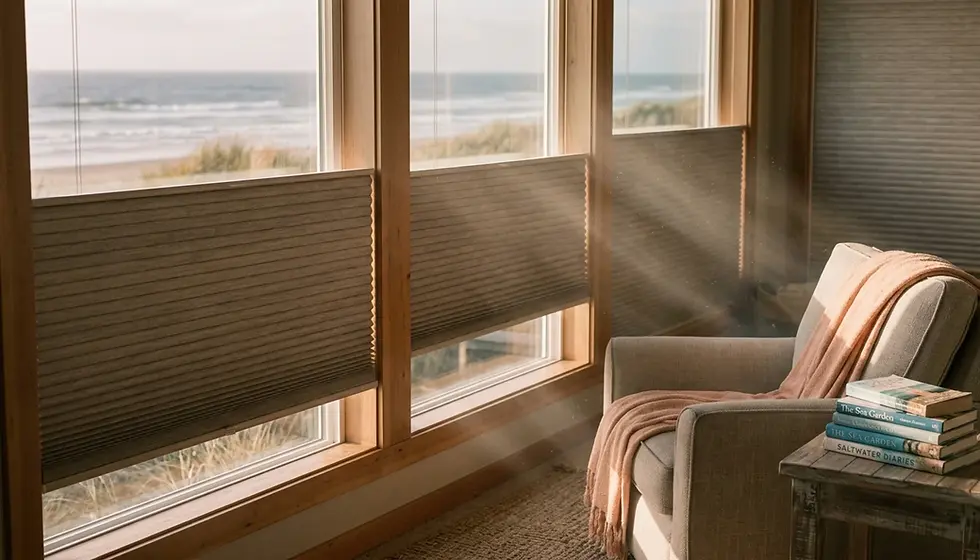
Double-cell cellular shades can reduce window heat loss by up to 40% compared to bare windows, a meaningful advantage during Middletown's humid summers and cold winters.
Home Blinds and Floors offers in-home consultations across the Delmarva Peninsula, including Middletown, bringing samples directly to your home for accurate measurement and side-by-side fabric comparisons.
Why Does Middletown, DE Architecture Demand a Custom Approach?
Middletown, DE home architecture refers primarily to newer tract-built construction from the early 2000s through the present, characterized by open-concept floor plans, tall two-story foyer windows, wide sliding glass doors to rear patios, and window configurations that vary significantly between builders and subdivisions. Specifically, communities like Whitehall and The Estates at St. Anne's feature window opening depths as shallow as 2.5 inches in some casement frames, which eliminates most standard inside-mount options outright. This is not a theoretical concern: at Home Blinds and Floors, we encounter shallow-box windows regularly when consulting in Middletown, and they change the hardware and fabric options available to the homeowner entirely.
First, consider the scale. Many Middletown homes built after 2005 include two-story great room windows that reach 96 inches or taller. Stock roller shades max out at 72 to 84 inches in most retail formats. A custom fabrication, by contrast, can be built to any height the window demands, with motorized operation that makes manual lowering of an 8-foot shade practical rather than frustrating.
Additionally, the east-west orientation of streets in many Middletown subdivisions means that west-facing living rooms take the full force of late-afternoon summer sun. Delaware's humid continental climate produces high UV intensity from May through September, and standard fabric shades without UV treatment can degrade within three to five years in direct western exposure. Quality UV-treated fabrics, by contrast, typically last 10 to 15 years even in direct sun. That lifespan difference alone justifies the custom investment.
For a deeper look at how these coastal and peninsula climate factors affect fabric choices across the Delmarva region, the custom shades resource library at Home Blinds and Floors covers material selection in detail.

What Are the HOA Compliance Rules for Window Treatments in Middletown Communities?
HOA compliance for window treatments in Middletown, DE planned communities typically refers to covenants that restrict the visible exterior color of window coverings to white, off-white, or neutral tones when viewed from the street. While specific covenant language varies by community and development year, this requirement appears in a significant share of the subdivisions developed along Route 1 and Route 299 corridors in New Castle County. Violating it can trigger formal HOA notices and required removal, which means replacing shades you just installed.
The practical implication for shade selection is straightforward: you need a fabric with a white or neutral backing regardless of the interior-facing color or pattern you choose. Many homeowners select a warm linen or soft gray on the room-facing side while specifying a white liner that satisfies the exterior appearance requirement. Custom fabrication makes this possible. A standard stock shade in a charcoal fabric, by contrast, will show that dark color from the street and likely conflict with your HOA's standards.
Before ordering, pull your community's Declaration of Covenants, Conditions, and Restrictions (CC&Rs) and specifically read the sections covering "window coverings," "window treatments," or "exterior appearance." Some HOAs in Middletown's newer developments also restrict reflective solar screen fabrics on front-facing windows, as the mirror-like appearance conflicts with neighborhood aesthetic guidelines. Solar screens remain fully acceptable on rear and side exposures in most cases.
Our team at Home Blinds and Floors regularly reviews CC&R requirements with Middletown homeowners during in-home consultations, and we can help you identify fabrics and liner combinations that satisfy both your design preferences and your HOA's exterior standards simultaneously.
Inside Mount vs. Outside Mount: Which Works for Middletown's Tract-Built Windows?
Inside-mount installation refers to fitting the shade hardware entirely within the window frame opening, producing a clean, built-in appearance. Outside-mount installation refers to attaching the headrail to the wall or trim above and outside the window opening, covering a larger area. For Middletown, DE homes built between roughly 2000 and the present, the inside-mount vs. outside-mount decision often comes down to a single measurement: the depth of the window box.
Most roller shades require a minimum inside-mount depth of 2.75 to 3.5 inches depending on the headrail style. Cellular shades typically require 2 to 2.5 inches. Many vinyl windows installed in Middletown's tract-built communities have frame depths at or near these minimums, particularly in bathrooms and secondary bedrooms where builders use standard-depth casement configurations. When the depth falls short, an inside mount creates a headrail that protrudes forward past the window frame, which looks awkward and can interfere with window operation.
Outside mounting solves this problem completely. By mounting the hardware above the window opening, you also gain the ability to make the window appear taller and wider than it actually is, a popular choice in the two-story foyer windows common in Middletown colonials and center-hall designs. The trade-off is that outside mounts require solid wall material above the window to anchor the brackets, and some Middletown homes have window placements that run close to ceiling lines, leaving limited clearance.
For sliding glass doors in rear additions, which appear frequently in Middletown's townhome and single-family designs, outside-mount vertical shades or panel track systems are almost always the correct choice. The guide to vertical shades for sliding glass doors covers the specific hardware considerations for these large openings in detail.

Room-by-Room Guide: Which Custom Shades Fit Each Space?
Custom shade selection by room refers to matching shade type, fabric opacity, and operating mechanism to the specific function and light requirements of each space in the home. A single shade category is rarely the right answer across all rooms. Bedrooms have fundamentally different needs than kitchens, and a living room facing a busy street in Middletown requires layered privacy solutions that neither space needs individually.
Bedrooms: Prioritize Blackout Performance
Bedrooms in Middletown homes, particularly those with east-facing windows in newer two-story construction, benefit most from blackout cellular shades or blackout roller shades. True blackout performance requires both a blackout-rated fabric and side channels or a cassette headrail that blocks light gaps at the edges. A shade fabric rated as "room darkening" typically blocks 95 to 99% of light but allows a visible glow around the edges; a full blackout system eliminates that glow by enclosing the fabric edges within a recessed track.
Double-cell cellular shades in a blackout configuration are our most requested bedroom product for Middletown homeowners. According to data from the Home Blinds and Floors regional guide, double-cell cellular shades reduce window heat loss by up to 40% compared to bare windows, which directly affects bedroom comfort year-round in Delaware's seasonal climate.
Kitchens: Control Glare Without Losing Natural Light
Kitchen windows in Middletown homes typically face rear yards and receive strong southern or western exposure during cooking hours. The goal is glare reduction without complete light blocking, which makes solar shades the most practical solution. Solar shades use an open-weave fabric that cuts UV and visible glare while maintaining an outward view. Openness factor ratings range from 1% (maximum UV block, minimal view) to 14% (high view, less UV control). For most Middletown kitchens, a 3% to 5% openness factor balances glare control with the view homeowners want.
Top-down bottom-up shades are an alternative worth considering for kitchens positioned close to neighboring homes, a common scenario in Middletown's denser townhome communities. This configuration lets you lower the top of the shade from the ceiling while keeping the lower portion raised, allowing light through the upper window while blocking sightlines at counter height.
Living Rooms: Layer Privacy and Light Control
Living rooms in Middletown's front-facing street exposure benefit from a layered approach: a sheer shade for daytime privacy paired with a heavier room-darkening option for evenings. Hunter Douglas's Silhouette and Pirouette lines accomplish this in a single product by combining a sheer vane system with an opaque backing. For homeowners who prefer separate layers, a sheer roller shade mounted inside pairs with a blackout panel on the outside mount above, providing full flexibility throughout the day.
For living rooms with large, multi-panel window configurations, motorized operation removes the frustration of coordinating multiple shade positions manually. Motorized shade options from brands including Hunter Douglas, Norman, and Graber are compatible with Amazon Alexa, Google Home, and Apple HomeKit, which aligns well with the tech-forward homeowners increasingly common in Middletown's newer developments.
Home Offices: Reduce Screen Glare Without Blocking Daylight
Home offices in Middletown homes, a category that grew significantly after 2020 as remote work normalized, need precise directional light control. A solar shade at a 3% openness factor placed on a south or west window cuts glare on monitors without reducing the ambient daylight that makes extended screen work tolerable. Roller shades with a semi-sheer fabric in the 5% to 10% openness range work well for north-facing offices where direct glare is less of a concern but diffuse light control still adds comfort.
Bathrooms: Moisture Resistance First
Bathroom windows in Middletown's two-story colonial layouts are typically smaller casement or awning windows with shallow frames. Outside-mount waterproof roller shades using a PVC-coated or moisture-resistant fabric are the safest choice. Cellular shades, despite their energy efficiency advantages, are not recommended for bathrooms with poor ventilation because fabric honeycomb cells can trap moisture and develop mildew. Faux wood blinds, another popular option reviewed in the faux wood vs. wood blinds guide, also perform well in humid bathroom environments.
How Do Middletown's Climate Conditions Affect Shade Material Selection?
Middletown, DE climate conditions refer to the area's humid continental weather pattern, characterized by hot, humid summers with average July temperatures in the upper 80s Fahrenheit, cold winters with occasional snow and ice, and a spring-to-fall period with high UV index readings that exceed coastal areas further south due to Middletown's slightly more inland position. These conditions directly influence which shade materials hold up over time and which degrade prematurely.
Specifically, Middletown's summer humidity creates a condensation risk on interior window surfaces during air-conditioned months, particularly in west-facing rooms where hot exterior glass meets cold interior air. Fabric shades that pool against the glass rather than hanging clear of the surface can wick moisture and develop permanent watermarks. Cellular shades with a cassette headrail and proper cord tension hang away from the glass and avoid this problem. Standard cordless roller shades, particularly in lighter fabrics, can press against the glass and show moisture damage within a few seasons.
The UV intensity during Middletown summers is significant enough that standard polyester fabrics without UV treatment can show visible fading within three to five years on south and west exposures, according to regional performance data from the Home Blinds and Floors Delmarva guide. Investing in UV-stabilized fabric at the time of purchase adds roughly 10 to 20% to the fabric cost but extends the service life to 10 to 15 years, which is a better value in almost every scenario.
For homeowners considering energy efficiency as a primary driver, the numbers are meaningful. According to the Home Blinds and Floors regional cost data, cellular shades reduce heating and cooling costs by an estimated $15 to $40 per window annually in Delmarva's climate. Across a typical Middletown home with 20 to 25 windows, that compounds to a meaningful annual saving. Single vs. double-cell options are compared in detail in the single vs. double-cell cellular shades guide for homeowners who want to calculate the payback period before committing.
What Do Custom Shades Cost for a Middletown, DE Home?
Custom shades pricing in Middletown, DE refers to the per-window cost of fabrication, hardware, and professional installation, which varies based on shade type, fabric grade, operating system, and window size. The table below summarizes typical price ranges based on the Home Blinds and Floors Delmarva regional pricing guide for 2026.
Shade Type | Typical Cost Per Window | Best Room Application | Lifespan (with UV treatment) |
Solar Roller Shade | $80 to $160 | Kitchen, home office | 10 to 15 years |
Single-Cell Cellular Shade | $80 to $160 | Living room, bathroom | 12 to 18 years |
Double-Cell Cellular Shade | $120 to $220 | Bedroom, great room | 12 to 18 years |
Roman Shade | $150 to $300 | Dining room, primary bedroom | 10 to 15 years (fabric dependent) |
Motorized Roller Shade | $250 to $450 | Great room, two-story windows | 10 to 15 years |
For context, basic aluminum blinds begin around $35 to $50 per window for standard sizes, but quality faux wood blinds range from $75 to $120 per window. Custom shades carry a higher upfront cost, but quality cellular and roller shades typically last 12 to 18 years compared to three to five years for lower-grade stock options, according to industry benchmarks from the IBISWorld U.S. Blind and Shade Manufacturing Industry Report (March 2026).
The North America blinds and shutters market is projected to grow from $29.5 billion in 2026 to $59.8 billion by 2035, according to Global Market Insights (December 2026), with strong demand for motorized and smart-home-compatible products driving the upper price segments. That growth reflects a fundamental shift: homeowners increasingly treat window treatments as a long-term design investment rather than a commodity replacement purchase.
For a broader regional cost breakdown including blind categories, the custom blinds cost guide for the Delmarva Peninsula provides additional detail on what factors drive installation pricing across different home types.

How Do You Choose the Right Custom Shades: A Step-by-Step Process
Selecting custom shades for a Middletown, DE home is a structured process that moves from room function and light requirements through HOA compliance, mount type, fabric selection, and finally operating mechanism. Following the steps in order prevents the most common mistake: choosing a fabric or style before confirming the window box depth and HOA constraints that may limit your options.
Step 1: Identify Each Room's Primary Function
Before looking at any fabric samples, write down what each room needs from its window treatments. Blackout for sleep? Glare control for a monitor? Street privacy without losing daylight? Each function points toward a different shade category, and clarifying this before you see samples prevents the common error of choosing a shade you love aesthetically that fails practically within its first season.
Step 2: Measure Window Box Depth and Note the Window Type
Using a tape measure, record the inside-mount depth at three points across the top of the window opening: left corner, center, and right corner. If any measurement falls below 2.5 inches, flag that window for outside-mount consideration. Also note whether the window is single-hung, casement, awning, or sliding, because casement windows that swing inward are incompatible with inside-mount shades that hang in the opening path.
Step 3: Review Your HOA's CC&R for Window Treatment Restrictions
Pull your community's Declaration of Covenants, Conditions, and Restrictions and search for language covering window coverings, window treatments, or exterior appearance. Note any color restrictions and whether reflective fabrics are excluded on street-facing elevations. Bring this information to your consultation so your installer can identify compliant fabric and liner combinations from the start.
Step 4: Select Fabric Opacity by Room
Match your room function from Step 1 to a fabric opacity category. Blackout or room-darkening (0% to 1% openness) for bedrooms. Light-filtering (10% to 20% opacity) for living areas where some natural glow is desirable. Solar screen (3% to 10% openness factor) for kitchens and home offices. Sheer (30% to 50% opacity) for decorative layers where privacy is not a primary concern.
Step 5: Choose Your Operating Mechanism
Manual cordless lift works well for standard windows under 72 inches in height and is the most budget-friendly option. Motorized operation with a battery-powered or hardwired motor makes sense for windows above 72 inches, grouped window banks where coordinated operation matters, or homeowners who want smart home integration. Hunter Douglas, Norman, and Graber motorized shade systems at Home Blinds and Floors are compatible with Amazon Alexa, Google Home, and Apple HomeKit as of 2026.
Step 6: Schedule an In-Home Consultation for Final Measurements
Professional measurement is the most important step. Even a quarter-inch error in width creates a visible gap on an inside-mount installation or a misaligned headrail on an outside mount. A trained installer measures each window at multiple points, accounts for any out-of-square openings common in Middletown's newer construction, and confirms mount type suitability before the order is placed. Home Blinds and Floors provides in-home consultations across the Delmarva Peninsula, including Middletown, bringing product samples directly to your home so you can evaluate fabric colors in your actual lighting conditions.
Frequently Asked Questions About Custom Shades in Middletown, DE
Can I install custom shades myself in a Middletown, DE home?
You can install basic cordless roller shades yourself if the windows are standard size and the window box depth is sufficient for inside mounting. However, for non-standard window sizes common in Middletown's tract-built communities, two-story windows, motorized systems, or windows requiring outside-mount hardware into specific wall materials, professional installation produces significantly better results. Incorrect measurements on a custom order cannot be corrected without reordering the shade entirely.
Do Middletown, DE HOAs restrict the type of window shades I can install?
Many Middletown planned communities include HOA covenants that restrict the exterior-visible color of window treatments to white or neutral tones. Some also prohibit reflective solar screen fabrics on front-facing elevations. You should review your community's CC&Rs before ordering to confirm whether a white or neutral liner is required on your specific elevation. A professional consultation can help you identify fabrics that meet both your interior design preferences and HOA requirements.
What is the best shade type for a bedroom in a Middletown, DE home?
Double-cell cellular shades in a blackout or room-darkening configuration are the most effective choice for bedrooms in Middletown homes. They combine blackout performance with up to 40% reduction in window heat loss compared to bare glass, which directly improves sleep comfort during both Delaware's hot summers and cold winters. For full blackout performance, specify side channels or a cassette headrail that blocks edge light gaps.
How much do custom shades typically cost per window in the Delmarva region?
According to the Home Blinds and Floors Delmarva regional pricing guide, custom cellular shades typically cost $80 to $220 per window depending on cell configuration, while motorized roller shades range from $250 to $450 per window. Basic aluminum blinds start around $35 to $50 per window for standard sizes, but custom shades typically last two to three times longer, making them a better long-term value for most homeowners.
Are motorized custom shades compatible with smart home systems?
Yes. Motorized shade systems from Hunter Douglas, Norman, and Graber, all carried by Home Blinds and Floors, are compatible with Amazon Alexa, Google Home, and Apple HomeKit as of 2026. Both battery-powered and hardwired motor options are available. Battery-powered motors eliminate the need for in-wall wiring and are practical for retrofit installations in homes without pre-run electrical to window positions.
How long does the custom shade ordering and installation process take?
The typical timeline from in-home consultation to completed installation runs two to four weeks for most custom shade orders, depending on the fabric and product line selected. The consultation and measurement visit typically takes 60 to 90 minutes for a whole-home project. Installation of a full home's shades typically runs four to eight hours depending on the number of windows and whether motorized systems require additional setup and programming.
What fabric should I choose for kitchen windows in Middletown to reduce summer glare?
Solar shades with a 3% to 5% openness factor are the most practical choice for Middletown kitchens with south or west exposure. This range cuts UV and visible glare during peak afternoon sun while maintaining an outward view, unlike blackout fabrics that eliminate daylight entirely. For kitchens close to neighboring homes, top-down bottom-up shades add the ability to allow overhead light while keeping lower window sections private during daytime hours.
Getting Custom Shades Right in Middletown, DE
Custom shades for Middletown, DE homes require matching window treatment choices to the specific architectural constraints, climate exposures, HOA requirements, and room functions present in each property. The newer construction communities throughout New Castle County present unique challenges: shallow window boxes that limit inside-mount options, tall two-story openings that demand motorized operation, west-facing rooms that require UV-stabilized fabric, and HOA covenants that restrict exterior-visible colors. None of those constraints are insurmountable, but each one needs to be addressed before you select a fabric.
The room-by-room approach outlined here, starting with function and ending with operating mechanism, is the most reliable way to avoid the most expensive mistake in window treatment projects: ordering the wrong product for the space. A beautiful Roman shade is the wrong answer for a west-facing bathroom. A sheer roller shade is the wrong answer for a street-facing bedroom. Getting the sequence right produces results that hold up for 12 to 15 years rather than requiring replacement in three to five.
In 2026, with the North America blinds and shutters market growing at 8.2% annually according to Global Market Insights, the range of quality custom options available to Middletown homeowners has never been broader. The investment pays off in energy savings, longer product life, and the consistent visual quality that defines a well-finished home interior.

If you're ready to work through the room-by-room process for your own home, the team at Home Blinds and Floors brings samples directly to your Middletown home, takes precise measurements, and reviews your HOA requirements before recommending a single product. You can review what past clients across the Delmarva Peninsula have experienced at the Home Blinds and Floors reviews page, and explore the full range of available window shade products at the shades service page. Accurate measurements and the right fabric from the start make every subsequent year of ownership easier.


Comments