.avif)
.avif)
.avif)
Affordable Plantation Blinds: A Real Buyer's Guide for 2026


Affordable plantation blinds are custom-fitted window shutters made from vinyl, poly composite, or faux wood materials that deliver the classic louvered look at a fraction of real hardwood pricing. In 2026, you can realistically budget $150 to $400 per window installed for poly or vinyl options, compared to $400 to $1,200 for real wood. That gap is where smart buyers save thousands on a whole-home project without sacrificing the clean, architectural look plantation shutters are known for.
Vinyl and poly composite shutters typically run $150 to $400 per window installed, versus $400 to $1,200 for real hardwood options.
Material choice accounts for 60 to 70% of price variance in any plantation shutter installation, making it the single biggest lever for budget buyers.
The North America plantation shutters market is projected to reach USD 7.1 billion by end of 2026, growing at a 9.0% CAGR since 2022, driven partly by rising demand for energy-efficient home upgrades (Transparency Market Research).
Plantation shutters carry an R-value of 3 to 6, compared to 1.5 to 4 for standard blinds, making them a legitimate energy-saving investment over time.
The U.S. Consumer Products Safety Commission reports that a child between ages 7 months and 8 years dies each month from window cord strangulation, making cordless shutters a safety priority for families.
At Home Blinds and Floors, we've helped hundreds of homeowners across the Delmarva Peninsula find quality shutter solutions that fit both their windows and their budgets.
What Is the Average Cost for Plantation Blinds?
Plantation blind cost refers to the total price per window for materials plus professional installation, and that figure varies considerably by material, louver size, and window dimensions. According to pricing data from Blinds West TN, the average installed cost for plantation shutters ranges from $250 to $800 per window. A standard 36 x 60 inch window typically lands between $300 and $680 installed. A larger 48 x 72 inch window can reach $480 to $1,080. For a whole home, most installations run between $1,450 and $3,360 total.
Breaking this down by material makes the picture clearer. Vinyl shutters are the entry point, running $150 to $350 per window installed. Composite shutters, which offer better durability and warp resistance, fall in the $250 to $550 range. Real wood shutters, specifically basswood and painted hardwood, start at $400 and can climb past $1,200 per window.
Louver size also moves the needle. Choosing 4.5-inch louvers over standard 3.5-inch ones adds a 10 to 15% price premium, according to industry benchmarks. If you're watching every dollar, stick with 3.5-inch louvers on smaller windows and reserve the larger size for main living areas where the visual payoff is obvious.
At Home Blinds and Floors, we regularly walk clients through per-window cost estimates during free in-home consultations, because the numbers on a website rarely account for custom sizing, frame style choices, or the specific window configurations common in Delmarva coastal homes.

What Is a Cheaper Option to Plantation Shutters?
Cheaper alternatives to plantation shutters include faux wood blinds, cellular shades, and roller shades, all of which can deliver meaningful light control and privacy at a lower per-window cost. Faux wood blinds, for example, often run $30 to $100 per window for the product itself, with installation adding to that total. Roller blinds held the largest product-type share in the North America market in 2026, generating USD 7.6 billion in revenue (Global Market Insights), which tells you how popular budget-conscious alternatives have become.
Here is a practical comparison of your main options at the affordable end of the market:
Window Treatment | Typical Product Cost | Lifespan | Moisture Resistance | Best For |
Vinyl Plantation Shutters | $150 to $350/window installed | 15 to 25 years | Excellent | Bathrooms, coastal homes, high-humidity rooms |
Poly Composite Shutters | $250 to $550/window installed | 25+ years | Superior | Whole-home installs in humid climates |
Faux Wood Blinds | $30 to $120/window (product only) | 5 to 10 years | Good | Budget-first buyers, rentals, secondary rooms |
Cellular Shades | $40 to $150/window (product only) | 7 to 12 years | Moderate | Energy efficiency priority, bedrooms |
Roller Shades | $25 to $100/window (product only) | 5 to 8 years | Varies by fabric | Minimalist interiors, offices, rentals |
For buyers who want the plantation shutter aesthetic without full custom pricing, online retailers like Direct Buy Blinds' poly shutter category offer poly shutters starting around $207 per window with current promotions. SelectBlinds' plantation shutter catalog starts at $297.99 for their Eco Guard model, with up to 55% off first purchases.
But skip straight faux wood blinds if your home gets significant sun or humidity. They look similar to shutters in photos, yet they warp faster and rarely last a full decade in coastal environments. For rooms like bathrooms or sunrooms along the Delaware coast, poly composite shutters are worth the extra investment even in a budget build-out. Our team at Home Blinds and Floors has seen faux wood blinds fail in under three years in salt-air conditions, which erases any upfront savings quickly.
If energy efficiency is your primary driver rather than aesthetics, cellular shades are genuinely worth considering as a cost-effective alternative. Their honeycomb structure traps air and provides meaningful insulation, especially in rooms that get intense afternoon sun.
Why Are People Getting Rid of Plantation Shutters?
Homeowners removing plantation shutters most commonly cite three reasons: changing interior design preferences toward softer window treatments, the high replacement cost when shutters warp or crack, and the shift toward motorized smart-home systems that older shutter hardware cannot accommodate. This trend is worth understanding if you're buying, because it also reveals exactly what to look for in a long-lasting affordable option.
Warping is the biggest functional complaint. Real wood shutters are particularly vulnerable in humid environments. According to the U.S. Department of Energy, approximately 30% of a home's heating energy is lost through windows, and about 76% of sunlight falling on standard windows enters as heat. That solar load, combined with coastal humidity on the Delmarva Peninsula, is genuinely hard on wood. Composite shutters address this directly, offering superior warp resistance compared to natural wood at a price point of roughly $15 to $30 per square foot (Transparency Market Research).
Design fatigue is real too. Plantation shutters dominated coastal interiors for years, and some homeowners now prefer the cleaner look of roller shades or linen drapes. That said, plantation shutters remain a strong resale asset in most markets. Real estate agents consistently cite them as an appealing feature for buyers seeking turnkey homes.
Motorization incompatibility is an increasingly practical concern. Smart home platforms including Amazon Alexa, Google Home, and Apple HomeKit have pushed homeowners toward motorized shade systems. Traditional shutter panels don't integrate with these platforms, which makes them feel outdated in tech-forward homes. If smart home integration matters to you, our motorized shades page outlines options that work seamlessly with existing automation systems.
The people removing shutters aren't necessarily making the wrong call. But most who replace shutters with cheap blinds later regret the trade-off in durability. The smarter move is choosing the right material from the start.

What Is the Most Affordable Way to Do Blinds for Every Window?
The most affordable whole-home blind strategy combines material selection, strategic placement, and a phased installation approach to stretch your budget without compromising quality where it matters most. For most homes on the Delmarva Peninsula or in coastal Delaware communities like Rehoboth Beach, Bethany Beach, and Lewes, the practical answer is poly composite shutters in living areas and master bedrooms, and faux wood blinds or cellular shades in secondary bedrooms and utility spaces.
Here is a realistic budget planning framework for a three-bedroom coastal home with approximately 15 windows:
Room Zone | Recommended Treatment | Windows | Estimated Cost Range |
Living Room / Dining Room | Poly Composite Shutters | 4 to 6 | $1,000 to $3,300 |
Master Bedroom | Poly Composite Shutters | 2 to 3 | $500 to $1,650 |
Secondary Bedrooms | Faux Wood Blinds or Cellular Shades | 4 to 5 | $200 to $600 |
Bathrooms | Vinyl Shutters | 1 to 2 | $150 to $700 |
Kitchen / Utility | Faux Wood Blinds or Roller Shades | 2 to 3 | $80 to $360 |
The medium price range segment held the largest share of the North America blinds and shutters market in 2026, accounting for 36.9% of total market revenue (Global Market Insights). That figure confirms what we consistently observe: most homeowners aren't going budget-basement or luxury, they're prioritizing value in high-visibility rooms and economizing elsewhere.
Online ordering through retailers like Direct Buy Blinds or SelectBlinds can lower material costs further, but you take on measurement risk. Ordering a custom shutter to the wrong width wastes the entire product cost. Professional in-home measurement, like what the Home Blinds and Floors team provides across Salisbury, Easton, Ocean City, and the broader Eastern Shore, eliminates that risk and often pays for itself in avoided remakes.
For buyers focused on longevity, our guide to faux wood vs. wood blinds for Delmarva homes breaks down exactly which material holds up longest in each application.
How Do You Measure Windows Correctly for Custom Plantation Blinds?
Measuring windows correctly for custom plantation blinds means taking inside-mount or outside-mount dimensions at three points across the width and three points down the height, then using the smallest measurement to avoid fit failures. This step is where first-time DIY buyers most commonly lose money. A shutter panel ordered even a quarter-inch too wide will not close properly, and custom products are generally non-returnable.
For an inside mount, measure the width at the top, middle, and bottom of the window opening. Record the narrowest measurement. Measure the height on the left, center, and right sides. Record the shortest. Most manufacturers deduct a small clearance automatically, but confirm this before ordering.
For an outside mount, you control the overlap. A standard recommendation is to add 1.5 to 2 inches on each side beyond the window frame and 2 to 3 inches above. This allows full coverage and better light blockage.
Arched windows and angled sills require additional care. Direct Buy Blinds, for example, sends a confirmation drawing for all arched shutter orders before production begins, which is a smart safeguard you should look for in any custom order. SelectBlinds and similar online retailers also provide detailed measuring guides specific to their shutter systems.
If you're managing a multi-room project across communities like Centreville, Grasonville, or Kent Island, professional measurement makes a meaningful difference. One remade shutter panel at $300 to $500 often costs more than the consultation itself. Our team at Home Blinds and Floors measures every window before any order is placed, which is why we rarely see remakes on projects across our service area.
For sliding glass doors and non-standard openings, the measurement considerations are different. Our article on window treatments for sliding glass doors in Delmarva covers those specific scenarios in detail.
Which Affordable Plantation Blind Material Saves the Most Money Long-Term?
Poly composite shutters, priced at approximately $15 to $30 per square foot, represent the strongest long-term value among affordable plantation blind materials because of their 25-plus year lifespan and superior resistance to warping, fading, and moisture damage in humid climates (Transparency Market Research). Real wood costs more upfront and degrades faster in salt-air or high-humidity environments. Vinyl is the cheapest option but tends to feel less substantial and shows wear sooner than composite.
Consider the ten-year math. A set of faux wood blinds at $80 per window may last six to eight years in a typical interior, meaning you'll replace them once or twice in a decade. A poly composite shutter at $350 per window installed may last 25 years with minimal maintenance. Over 20 years, the shutter wins on total cost in most scenarios.
The insulation advantage compounds this further. Wooden shutters reduce heat loss by approximately 51%, and composite shutters perform even better at around 60%, compared to 28% for roller blinds and 14% for curtains. Given that the U.S. Department of Energy estimates 30% of a home's heating energy is lost through windows, the energy savings from quality shutters can meaningfully offset their higher upfront cost over time.
Child safety adds another long-term cost consideration. Corded window coverings carry ongoing liability in family homes. The U.S. Consumer Products Safety Commission has documented the strangulation risk associated with window cords, and the Window Covering Manufacturers Association has proposed rules requiring cords to be cordless, inaccessible, or 8 inches or shorter in any use position. Cordless shutters eliminate this risk entirely and avoid the cost of retrofitting later. You can explore cordless shade options if you need a budget-friendly cordless solution for family spaces.

Where Can You Buy Affordable Plantation Blinds: Online vs. Local Retailers?
Affordable plantation blinds are available through three main channels: online-only retailers, big-box home improvement stores, and local window treatment specialists. Each channel offers a different trade-off between price, customization depth, and installation support.
Online Retailers
Online retailers like Direct Buy Blinds and SelectBlinds offer the widest selection at the lowest list prices. Direct Buy Blinds has been selling custom window treatments online for over 20 years and currently runs sitewide promotions including 30% off with free shipping. Their Premium Poly Shutter starts at $207.20 after coupon in 11 available colors. SelectBlinds' Classic Faux Wood Shutter carries a 4.8-star rating across 221 customer reviews at $437.94, making it one of the better-reviewed options in the mid-range category. The trade-off is that you measure yourself, you install yourself, and returns on custom products are typically not accepted.
Big-Box Stores
Home Depot, Costco, and similar retailers stock a limited range of semi-custom and stock-size shutters. Selection is narrower than online, prices are competitive on standard sizes, and you can see materials in person before buying. The weakness is that staff expertise on custom fitting is limited, and true custom sizing usually requires ordering through a catalog rather than off the shelf.
Local Window Treatment Specialists
Local specialists like Home Blinds and Floors provide in-home measurement, professional installation, and access to professional-grade product lines from brands including Hunter Douglas, Norman, and Graber. The upfront cost is typically higher than online self-install, but the accuracy, finish quality, and warranty support differ significantly. For homeowners in Middletown, DE, Milton, DE, Ocean Pines, MD, or anywhere across the Eastern Shore, working with a local specialist means someone who understands how coastal humidity, salt air, and seasonal temperature swings affect window treatments specifically in these markets.
You can review our plantation shutters installation service to see what a professional consultation and installation covers in your area.
Practical Steps to Get the Best Price on Plantation Shutters in 2026
Decide on material first. Poly composite is the practical sweet spot for coastal and humid-climate homes. Vinyl works for bathrooms. Real wood is worth the premium only in dry, temperature-controlled rooms where aesthetics justify the cost.
Measure accurately before requesting quotes. Use the three-point method described above. If you're not confident, pay for professional measurement. One wrong panel costs more than the consultation.
Compare online retailers for material costs. Check Direct Buy Blinds and SelectBlinds for current promotions. Discounts of 30 to 55% are common in 2026 and can bring custom poly shutters into a very accessible price range.
Phase your project if budget is tight. Install shutters in high-visibility rooms first. Use cellular shades or faux wood blinds as temporary treatments in secondary rooms while you save for the next phase.
Choose 3.5-inch louvers over 4.5-inch for budget projects. The larger size adds 10 to 15% in cost without a proportional gain in light control performance for most window sizes.
Ask about cordless options. Cordless shutters eliminate safety risk for families and require no cord-replacement maintenance over time, which reduces long-term ownership cost.
Request a free in-home consultation before committing. A professional can identify fitting challenges, recommend the right frame style for your window architecture, and give you a project cost that accounts for your specific windows rather than generic averages.
For a detailed breakdown of what custom window treatments actually cost across the Delmarva region, our article on custom blinds costs on the Delmarva Peninsula walks through pricing by window type and material in clear detail.
Frequently Asked Questions About Affordable Plantation Blinds
What is the average cost for plantation blinds installed?
The average installed cost for plantation blinds ranges from $250 to $800 per window, depending on material and size. Vinyl shutters are the most affordable at $150 to $350 per window installed. Composite shutters run $250 to $550. Real wood shutters range from $400 to $1,200. A whole-home installation for a standard house typically falls between $1,450 and $3,360 (Blinds West TN pricing data).
Are faux wood shutters a good cheaper alternative to real plantation shutters?
Faux wood shutters and blinds cost significantly less than real wood shutters but generally last five to ten years in typical interior conditions. For humid or coastal environments like the Delmarva Peninsula, poly composite shutters are a better affordable option because they resist warping and moisture damage far better than faux wood, despite costing more upfront.
How do I measure my windows for custom plantation blinds?
Measure width at the top, middle, and bottom of the window opening, then record the narrowest measurement. Measure height on the left, center, and right, then record the shortest. For outside mounts, add 1.5 to 2 inches on each side of the frame. Always confirm whether the manufacturer applies a clearance deduction automatically before submitting your measurements.
Do plantation shutters actually reduce energy bills?
Yes. Plantation shutters carry an R-value of 3 to 6, compared to 1.5 to 4 for standard blinds. Composite shutters reduce heat loss by approximately 60%, and wooden shutters by around 51%, compared to 28% for roller blinds (Transparency Market Research). Given that the U.S. Department of Energy estimates 30% of a home's heating energy escapes through windows, quality shutters deliver measurable savings over their lifespan.
Why are some homeowners replacing their plantation shutters?
The most common reasons include warping from humidity exposure, design preferences shifting toward softer window treatments like linen shades or roller blinds, and the incompatibility of traditional shutter panels with smart home automation systems (Amazon Alexa, Google Home, Apple HomeKit). Choosing warp-resistant composite or poly materials from the start addresses the durability concern directly.
Are cordless plantation shutters worth the extra cost for families with children?
Yes, cordless shutters are strongly recommended for family homes. The U.S. Consumer Products Safety Commission reports that a child between ages 7 months and 8 years dies each month from window cord strangulation. Plantation shutters are inherently cordless by design, which is one reason they are considered among the safest window treatment options for children's rooms and family living areas.
What window treatment materials work best in coastal environments like Rehoboth Beach or Ocean City?
Poly composite and vinyl materials perform best in coastal environments because they resist salt air corrosion, humidity-driven warping, and UV fading better than real wood or standard faux wood. Composite shutters, priced at approximately $15 to $30 per square foot, carry a 25-plus year lifespan in humid climates, making them the most cost-effective long-term choice for coastal homes on the Delmarva Peninsula.
The Right Plantation Blind Choice Comes Down to One Decision
Affordable plantation blinds are genuinely available in 2026, and the range of quality at the budget end of the market has never been wider. The North America blinds and shutters market is projected to reach USD 59.8 billion by 2035 (Global Market Insights), which means more competition, more options, and more pressure on manufacturers to deliver quality at accessible price points. That is good news for buyers.
The single most important decision you'll make is material. Choose poly composite for anything exposed to humidity, sun, or salt air. Use vinyl for bathrooms. Reserve real wood for controlled interior environments where the premium feels justified. Everything else, louver size, color, frame style, and phasing strategy, flows from that first call.
If you're anywhere on the Delmarva Peninsula, from Annapolis and Kent Island down to Rehoboth Beach and Ocean City, working with a local specialist who understands coastal building conditions makes the process significantly less complicated. Online retailers offer real savings on materials, but they can't account for the site-specific factors that determine whether your shutters look perfect and last 25 years, or look slightly off and need replacing in a decade.
Start by exploring your custom blinds options to understand the full range of what's available, and consider booking a free in-home consultation with the Home Blinds and Floors team to get accurate per-window pricing for your specific project. You can also browse reviews from homeowners across the Eastern Shore who've navigated exactly the same decision. The right window treatment is out there at a price that makes sense. It just takes a few targeted questions to find it.

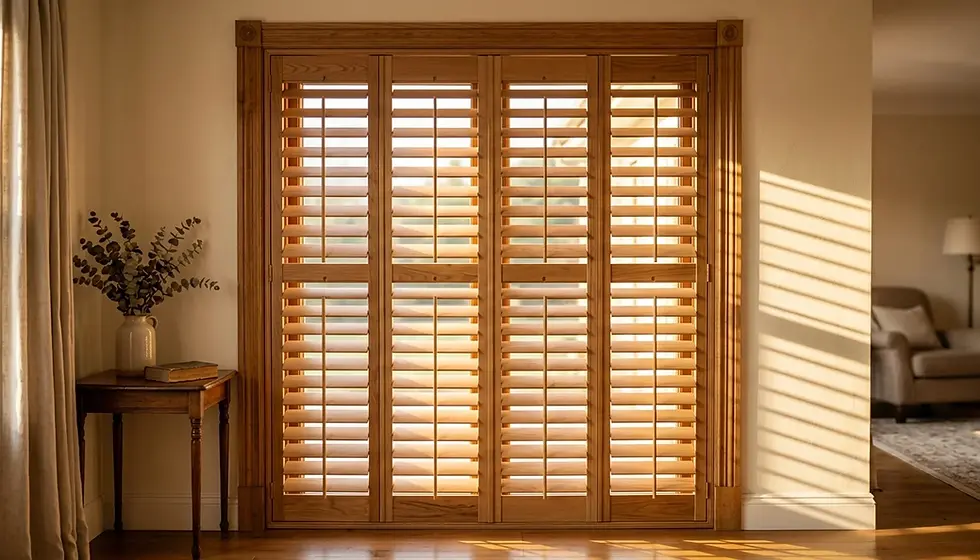
If you want to see what a well-executed plantation shutter installation looks like in a real coastal home, this is it. The floor-to-ceiling honeycomb blinds in this bedroom from a Home Blinds and Floors project show exactly what you get when material and measurement come together correctly. Contact Home Blinds and Floors to schedule your free in-home consultation and get a quote built around your specific windows, your style, and your budget.

Comments