.avif)
.avif)
.avif)
Roman Shades and Curtains Together: What Nobody Tells You

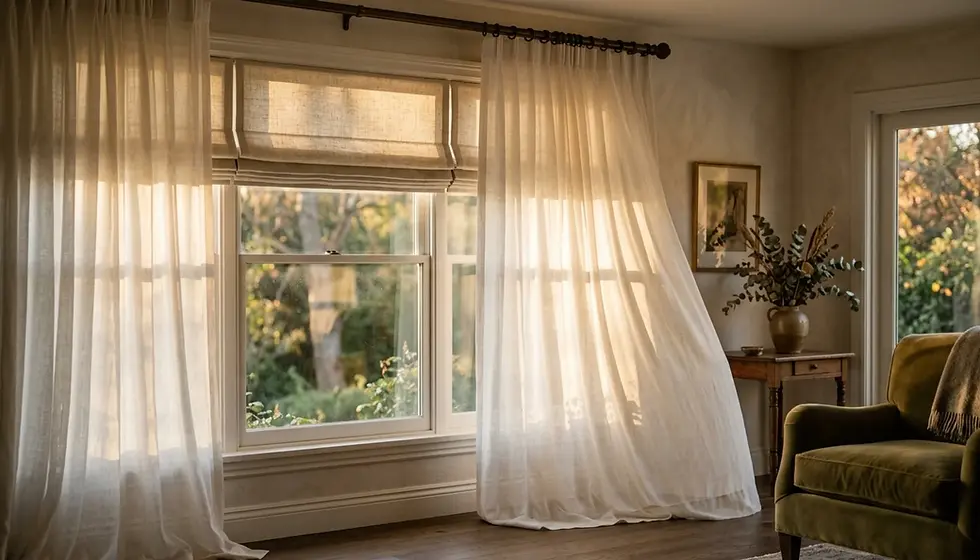
Pairing roman shades and curtains together is one of the most functional layering techniques in interior design. The roman shade handles precise light control and privacy close to the glass, while the curtain panel adds insulation, softness, and a finishing frame around the window. Used correctly, the combination outperforms either treatment alone.
Roman shades and curtains work together when the shade is inside-mounted inside the window frame and the curtain rod is outside-mounted above and beyond the frame, ensuring neither treatment interferes with the other.
The most common layering mistake is mounting both the shade and the curtain rod at the same height, which causes the curtain to block the shade from raising fully.
If you can only invest in quality for one layer, prioritize the roman shade: it does the functional work of light control and privacy, while curtains can be sourced affordably in a complementary fabric.
Cordless and motorized roman shades now represent over 55% of new installations in 2026, according to industry analysis, partly due to child safety regulations and growing smart home adoption.
Windows with no free wall space on either side are poor candidates for layering: curtain panels stack on the glass and block light even when fully open.
The global roman shades market was valued at $2.1 billion in 2026 and is projected to reach $3.5 billion by 2033, reflecting a broad consumer shift toward layered, design-forward window treatments.
Can You Do Roman Shades and Curtains Together?
Roman shades and curtains can absolutely be used together on the same window, and the combination is one of the most recommended pairings by professional interior designers. The key is treating each layer as having a distinct job: the roman shade manages the functional work of light filtering, privacy, and insulation close to the glass, while the curtain panel frames the window, adds texture, and provides a decorative finish. When each layer has a clear role, the result feels intentional rather than cluttered.
At Home Blinds and Floors, we see this combination requested regularly across homes on the Delmarva Peninsula, particularly in coastal properties where intense summer sun demands serious light control but homeowners also want the soft, finished look that curtain panels provide. The layered approach handles both concerns at once.
The critical hardware detail most articles skip: mount the roman shade inside the window frame (an inside mount) and mount the curtain rod outside the frame, extending at least 4 to 6 inches beyond the casing on each side. This separation ensures the curtain rod clears the shade's mounting hardware, and the panels stack completely off the glass when open. TWOPAGES, which carries over 200 color varieties across their roman shade line, specifically recommends this inside-plus-outside mount configuration for a harmonious layered result.
One practical caveat worth stating directly: this pairing does not work well on every window. Small windows, shallow frames, and windows with no free wall space on the sides are all situations where adding a curtain layer creates more problems than it solves. The section below on when layering does not work covers this in detail.

Should You Have Curtains With Roman Blinds?
Whether to pair curtains with roman blinds depends on four factors: the window's physical dimensions, the room's light control needs, the wall space available beside the frame, and your budget. For most living rooms and bedrooms with standard-sized windows and at least 6 inches of free wall on each side, adding curtains to roman shades delivers measurable benefits in insulation, light bleed reduction, and visual warmth. For smaller or more confined windows, a single well-chosen roman shade is the better call.
When the Combination Works Best
Layering delivers the most value in three situations. First, bedrooms where you want genuine darkness: inside-mounted roman shades, even in blackout fabric, typically allow a thin line of light around their edges. A floor-length curtain panel in a blackout or room-darkening fabric closes that gap completely. Second, living rooms facing west or south on coastal properties where afternoon sun is punishing: the roman shade filters glare while the curtain adds a second insulating layer that reduces heat gain. Third, dining rooms and entryways where the design goal is visual drama, not just function.
When to Skip the Curtains
Windows narrower than 30 inches rarely benefit from curtain panels. The stacked fabric when panels are open covers a disproportionate share of the glass, reducing the light and air you are trying to let in. Windows with no side wall clearance have the same problem: the curtain stack has nowhere to go except onto the glass itself. Spiffy Spools, one of the more candid voices in the custom window treatment space, explicitly addresses this issue in their layering guide, noting that sill-length drapes fail entirely on windows with no free wall below them. For those windows, floor-length panels hung well above the frame are the better solution, or simply a well-chosen roman shade alone.
What Is the Downside of Roman Blinds?
Roman blinds have several genuine limitations that curtains can partially offset, which is one of the practical arguments for layering them. Understanding the weaknesses of roman shades helps you make a smarter decision about whether to add a curtain layer and what kind.
Edge Light Bleed
Inside-mounted roman shades placed close to the glass are effective at blocking direct sunlight through the center of the window, but they consistently allow light to enter around the edges where the shade does not fully seal against the frame. This is a known limitation of the inside-mount configuration. A curtain panel hung outside the frame and extending 4 to 6 inches past the casing on each side eliminates this edge light bleed almost entirely. If your goal is a genuinely dark bedroom, the curtain is not decorative: it is functional.
Fabric Accumulation When Raised
When a roman shade raises, the fabric folds stack at the top of the window. A relaxed roman shade, with its characteristic scalloped bottom, needs manual assistance forming those folds and works best on windows that are not operated frequently. Flat roman shades, which currently represent approximately 34% of market revenue according to MarketIntelo, manage this more cleanly because their horizontal fold lines are crisp and predictable. If you raise and lower your shade daily, a flat or plain fold style will hold up better over years of use.
Projection and Depth Requirements
Outside-mounted roman shades project forward from the wall to clear the window casing and any hardware below. When you add a curtain rod in front of that, the rod needs enough projection to clear the raised shade. A standard curtain rod bracket projects 3 to 5 inches from the wall. If your shade hardware already projects 2 inches, you need a rod bracket with at least 4 inches of projection to avoid contact. This clearance calculation is something our team at Home Blinds and Floors walks through during every in-home consultation because it is easy to underestimate, and wrong hardware creates a layering arrangement that cannot function independently.

What Does Martha Stewart Use Instead of Curtains?
Martha Stewart has frequently featured roman shades as a preferred alternative to traditional curtain panels, particularly in kitchens, bathrooms, and smaller rooms where floor-length drapes would feel heavy or impractical. Roman shades offer a clean, tailored look that fits tightly within or around the window frame without the floor-sweeping bulk of drapery. In Stewart's published home interiors, natural linen and cotton roman shades appear regularly, consistent with the broader market trend: cotton and linen fabrics collectively account for over 45% of roman shades fabric segment revenue, according to MarketIntelo, reflecting a strong consumer preference for natural materials.
The design logic behind choosing roman shades over curtains comes down to proportion and control. In rooms with lower ceilings or windows close to cabinetry or countertops, a flat roman shade gives you clean light control without visual noise. In rooms with taller ceilings and more architectural presence, the combination of roman shades and curtains together creates the layered depth that a roman shade alone cannot achieve. Both approaches have their place. The question is which proportion and function your specific room calls for.
For homeowners on the Eastern Shore who want the clean Stewart-aesthetic in a coastal context, a natural linen roman shade inside-mounted on a kitchen window is a practical starting point. It filters the intense bay-side light without darkening the room, and it holds up better than delicate drapery in a high-humidity kitchen environment.
How Do You Physically Mount Both Treatments Without Interference?
Mounting roman shades and curtains together without the two treatments interfering requires specific clearance measurements that no competitor article currently spells out in full. Getting this wrong means your curtain panels snag on the shade's lift cord, your rod prevents the shade from raising completely, or your brackets sit too close to the window to allow the shade to function at all.
The Step-by-Step Hardware Sequence
Mount the roman shade first. For an inside mount, the shade hardware sits flush inside the window frame. For an outside mount, the headrail mounts above the frame, typically 2 to 4 inches above the casing. Measure the shade's projection from the wall once installed: this is your baseline clearance number.
Add at least 2 inches of clearance. Your curtain rod brackets must project from the wall by at least 2 inches more than the shade's projection. If the shade projects 2.5 inches, your rod bracket needs a minimum of 4.5 inches of projection. Standard off-the-shelf brackets range from 3 to 5 inches; for layered installations, select brackets on the longer end or choose adjustable-projection brackets.
Position the rod above the shade hardware. The curtain rod should sit at least 4 inches above the top of the shade's headrail, or at ceiling height if you want to visually elongate the window. Mounting the rod at the same height as the shade headrail is the single most common layering mistake we see: the curtain panel then covers the shade's operating mechanism and prevents clean operation.
Extend the rod beyond the frame. The rod should extend 4 to 6 inches past the window casing on each side. This allows the curtain panels to stack entirely off the glass when open, preserving full light access through both the window and the roman shade.
Test clearance before finalizing. With both treatments installed but before securing final hardware positions, raise the roman shade fully and draw the curtain panels open. Check that no fabric contacts the lift mechanism and that the raised shade does not push the curtain rod forward.
Inside Mount Versus Outside Mount: The Practical Trade-Off
Inside-mounted roman shades help resist heat gain because they sit close to the glass, but they can show light gaps at the edges. Outside-mounted shades eliminate edge light bleed but project further from the wall, requiring a longer curtain rod bracket. For shallow window frames that cannot accommodate an inside mount at all, outside mounting is required. In those cases, select a curtain rod bracket with 5 to 6 inches of projection to ensure the rod clears the shade comfortably.
What Are the Most Common Layering Mistakes to Avoid?
Layering roman shades and curtains together introduces several specific failure modes that individually seem minor but collectively produce a window treatment that looks expensive and functions poorly. The following mistakes are the ones our consultants at Home Blinds and Floors see most frequently in homes where the homeowner installed both layers independently without measuring for compatibility.
Mistake | Why It Fails | The Fix |
Mounting shade and rod at the same height | Curtain covers shade mechanism; shade cannot raise cleanly | Position rod at least 4 inches above shade headrail |
Choosing curtains that are too short | Sill-length or apron-length panels look unfinished and shrink the room visually | Use floor-length panels hung from high on the wall |
Mismatched scale between shade and curtain | A very ornate patterned shade paired with heavily textured curtains creates visual chaos | Keep one layer patterned, keep the other a solid or subtle texture |
Insufficient rod bracket projection | Curtain panel catches on shade hardware; rod bows forward under fabric weight | Select brackets with at least 2 inches more projection than the shade's outward depth |
Layering on a window with no side wall clearance | Curtain stack covers the glass even when panels are open | Use a single well-chosen shade; skip the curtain layer entirely |
Choosing conflicting textures | Heavy linen shade with heavy velvet curtain reads as cluttered and dark | Pair heavy shades with sheer curtains, or lightweight shades with substantive panels |
Scale is the mistake that most articles overlook. A roman shade with a bold geometric pattern needs a curtain in a solid or very subtle texture. The shade commands attention; the curtain should support it, not compete. Interior designers at firms like Shelley Morris Interiors and Kate Marker Interiors consistently apply this principle: one pattern, one solid, one layered result that reads as intentional.
How Should You Choose Fabric, Color, and Fold Style for This Pairing?
Choosing fabrics for roman shades and curtains together means selecting two materials that perform different functional roles while reading as a coordinated set. The roman shade should be chosen for its light control properties first, then its aesthetic. The curtain panel should be chosen for its drape, weight, and how it complements the shade's texture without mimicking it exactly.
The Three Pairing Strategies That Work
Spiffy Spools, a custom window treatment company that has published some of the most detailed layering guidance available, identifies three fabric pairing approaches that consistently produce successful results. The first pairs two solid-colored treatments in complementary tones: a warm linen shade with a cool white or cream curtain, for example. The second pairs a solid shade with a patterned curtain or vice versa. The third, and most popular according to Spiffy Spools, pairs a sheer roman shade in the back position with an opaque drapery panel in the front. This configuration gives maximum versatility: sheer shade down with curtain open for diffused privacy, both down for full blackout, both raised for maximum light.
For color coordination, The Spruce guide to accent colors in home decor is a practical reference for understanding how to select a curtain color that pulls from the room's existing palette without matching the shade exactly. Matching exactly creates a flat, one-dimensional effect. A slight tonal shift, or a contrast pulled from a rug or upholstery piece, gives the layered treatment visual depth.
Roman Shade Fold Styles and How They Affect Pairings
Four fold styles define most of the roman shade market. Flat fold shades have crisp horizontal pleats and a smooth panel-like appearance when down: they pair well with both tailored linen curtains and more relaxed cotton panels. Plain fold shades show soft horizontal lines without sharp creases: a versatile middle ground that works with most curtain styles. Relaxed fold shades have a characteristic curved bottom and casual drape: they look best paired with equally relaxed, unstructured curtain panels rather than crisp, structured drapery. Top-down-bottom-up shades allow independent movement of the upper and lower edges, giving you privacy at the bottom while maintaining a view at the top. For a visual walkthrough of how each style looks in practice, this Roman shade fold styles comparison video from YouTube covers the differences clearly before you commit to a purchase.

Does the Combination Affect Your Home's Resale Value or Rental Appeal?
Layered roman shades and curtains do influence how a home presents during sale or rental, and no competitor article in this space currently addresses this question directly. Real estate staging professionals consistently note that window treatments are among the highest-return-per-dollar finishing decisions a homeowner can make before listing, because they affect both the visual scale of a room in photographs and the perceived quality of the home during a walkthrough.
A window with a well-chosen roman shade and coordinated floor-length curtains reads as finished and intentional in listing photography. A window with a roman shade alone, or with mismatched treatments, reads as incomplete. For vacation rental properties specifically, which represent a meaningful segment of the market on the Delmarva Peninsula, the visual quality of window treatments directly affects booking conversion on platforms where photography is the primary decision-making tool.
According to the Forbes and Yelp 2026 Summer Design Trends Report, searches for drape and curtain installation are up 139% in 2026, and searches for Roman shades are up 70% as part of the broader Curtain Core home design trend. Buyers and renters in 2026 are paying closer attention to window treatments than they have in recent years, which makes a thoughtfully layered window a genuine competitive advantage in both sale and rental contexts.
The practical recommendation: if you are preparing a home for sale or rental, invest in treatments that can be installed by a professional, fit the window precisely, and use fabrics that photograph well. Custom-fitted roman shades from brands like quality shade collections installed by a local professional will always outperform off-the-shelf alternatives in both function and photography. Our team regularly advises clients in Rehoboth Beach and Ocean City who are preparing rental properties on exactly this balance between investment level and return.
If You Can Only Invest in Quality for One Layer, Which Should It Be?
If budget forces a choice between investing in a quality roman shade or a quality curtain, prioritize the roman shade. This is the recommendation our consultants at Home Blinds and Floors consistently give, and the reasoning is straightforward: the shade does the functional work. It controls light, provides privacy, and insulates the glass. The curtain's role in a layered installation is primarily structural and decorative: it frames the window, adds softness, and eliminates edge light bleed.
A quality roman shade in a durable fabric, properly measured and professionally installed, will operate cleanly for 10 to 15 years. A budget curtain panel in a complementary solid fabric can serve the decorative function well at a fraction of the cost. The reverse approach, a budget shade with expensive curtains, typically produces a layered treatment where the shade fails functionally within a few years and the curtain cannot compensate for it.
On the Delmarva Peninsula, coastal conditions add another variable. Intense UV exposure from bay and ocean-facing windows accelerates fabric degradation. Investing in a shade made from UV-stabilized or tightly woven fabric, such as the cotton and linen blends that account for over 45% of roman shades fabric segment revenue globally, gives you a functional foundation that holds up in coastal conditions. Curtain panels in those same rooms can be in lighter, less expensive fabrics because they are not taking the direct UV load.
For budget-conscious homeowners considering this layered approach, explore the range of custom shade options available before assuming the combination is out of reach. A precisely fitted roman shade does not have to be the most expensive option in the product line to function well: it has to be the right fabric, the right mechanism, and the right mount for your specific window.
How Do You Clean and Maintain Two Overlapping Fabric Layers?
Maintaining roman shades and curtains together requires a specific cleaning sequence that no competitor article currently addresses. Cleaning them in the wrong order, or without removing one layer temporarily, risks transferring dust from the curtain onto a freshly cleaned shade, or snagging delicate shade fabric on curtain hardware during removal.
The Correct Maintenance Sequence
Start with the curtain panels. Remove them from the rod and launder or dry clean according to the fabric's care label. While the curtains are off the rod, vacuum the roman shade from top to bottom using a soft brush attachment, working with the grain of the fabric. For flat or plain fold shades in cotton or linen, spot-clean any stains with a damp cloth and mild detergent. Allow the shade to dry completely before rehanging the curtain panels.
Two-layer installations accumulate dust faster than single treatments because the layers create a pocket of still air between the shade and the curtain where particles settle. In coastal homes on the Delmarva Peninsula, salt particulate in the air adds to this accumulation. A light vacuum pass on the curtain panels every four to six weeks, and a full removal-and-wash cycle twice per year, is a practical maintenance schedule for most households.
For motorized roman shades, Hunter Douglas's official Cleaning, Maintenance and Operating Instructions document is the authoritative reference for care procedures that do not void warranty coverage. Motorized mechanisms require particular care around moisture: never spray cleaning solutions directly onto the shade fabric on a motorized unit, as liquid can wick into the motor housing.
Cordless roman shades, which now represent a majority of new installations, are slightly easier to maintain than corded versions because there is no lift cord to tangle with the curtain fabric during cleaning. This is one of the practical, non-obvious reasons that cordless options have gained preference beyond child safety compliance alone.
Frequently Asked Questions About Roman Shades and Curtains
Can roman shades and curtains be used on the same window?
Yes, roman shades and curtains can be used on the same window. The standard approach is to inside-mount the roman shade within the window frame and outside-mount the curtain rod above and beyond the frame, so neither treatment interferes with the other's operation. This configuration allows each layer to function independently.
What is the correct rod bracket projection when layering over a roman shade?
Your curtain rod bracket needs at least 2 inches more projection than the roman shade's outward depth from the wall. For most inside-mounted roman shades, the shade projects roughly 2 to 2.5 inches, meaning a rod bracket with 4 to 5 inches of projection is appropriate. For outside-mounted shades, measure the shade's projection after installation before selecting brackets.
Should the curtain rod be mounted at the same height as the roman shade?
No. Mounting the curtain rod at the same height as the roman shade's headrail is one of the most common layering mistakes. The rod should sit at least 4 inches above the top of the shade hardware, and ideally near ceiling height to visually elongate the window. This prevents the curtain panel from covering the shade's operating mechanism.
What fabric pairing works best for roman shades and curtains together?
The most versatile pairing is a sheer or semi-sheer roman shade in the back position combined with an opaque or room-darkening curtain panel in front. This gives you multiple light control configurations: shade down with curtain open for diffused privacy, both layers down for full blackout, and both raised for maximum light. Flat fold shades in linen or cotton pair well with most curtain styles.
Do roman shades work in small rooms or on small windows with curtains?
Roman shades work well in small rooms, but adding curtain panels to small windows is often counterproductive. Windows narrower than approximately 30 inches lose a disproportionate share of their glass area to curtain stack when the panels are open. For small windows, a single well-chosen roman shade is typically the better design decision than a layered treatment.
How do roman shades affect energy efficiency when paired with curtains?
Layering roman shades with curtains improves energy efficiency compared to either treatment alone. Inside-mounted roman shades positioned close to the glass reduce direct heat gain, while a curtain panel creates an additional air buffer between the glass and the room. Cellular shades, when used in place of roman shades, provide the highest insulation value due to their honeycomb structure, but flat roman shades in tightly woven fabric still offer meaningful reduction in heat gain compared to a bare window.
Are motorized roman shades compatible with a layered curtain installation?
Yes, motorized roman shades are compatible with layered curtain installations and are increasingly common in 2026, with cordless and motorized options representing over 55% of new installations according to industry data. The main practical consideration is ensuring the curtain rod bracket has enough projection to clear the motorized shade's headrail, which is slightly deeper than a manual headrail due to the motor housing.
What is the best roman shade fold style to use with curtains?
Flat fold and plain fold roman shades are the most versatile pairing partners for curtains because their clean horizontal lines complement both tailored and casual curtain panels. Relaxed fold shades, with their curved scalloped bottoms, work best paired with equally casual, unstructured curtain fabric rather than crisp tailored drapery. Top-down-bottom-up shades add functional flexibility but require more precise rod placement to avoid blocking the upper operating edge.
Making the Right Decision for Your Windows in 2026
Combining roman shades and curtains delivers real functional and aesthetic benefits, but only when the hardware clearances are correct, the window dimensions support the extra layer, and each treatment is chosen with the other in mind. The combination works best on standard to large windows with free wall space on the sides, in rooms where light control and insulation are both priorities, and when the shade is inside-mounted and the rod is outside-mounted with adequate projection clearance.
The 2026 Curtain Core trend reflects a genuine shift in how homeowners approach window treatments: not as an afterthought but as a primary design element. Searches for curtain installation are up 139% and for roman shades up 70% this year, according to the Forbes and Yelp 2026 Summer Design Trends Report. That level of consumer interest suggests that homeowners are investing more thought and budget into this decision than in previous years, which makes getting the technical details right more important than ever.
If you are weighing this combination for your own home and want to work through the specific measurements, fabric options, and mounting hardware before committing, that is exactly the conversation our consultants are set up to have. Explore the full range of custom window shades and custom window treatment options available through Home Blinds and Floors, or contact our team to schedule a free in-home consultation across the Delmarva Peninsula, from Middletown and Easton to Rehoboth Beach, Lewes, and Ocean City.
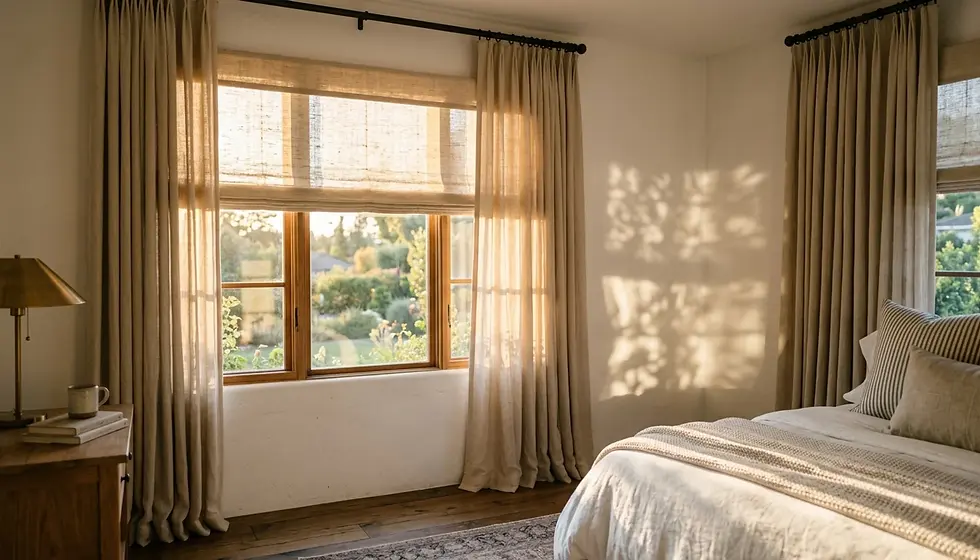
The layered look in that image, with roman shades handling the light close to the glass and curtain panels framing the full window height, is achievable in any room when the measurements and mounting sequence are right. If you want that result in your home without the guesswork, Home Blinds and Floors brings the measuring tools, the product knowledge, and the installation experience to your door. Request your free consultation here.

Comments