


Why Do Plantation Shutters Warp in Beach Houses? Real Fixes


Why do plantation shutters warp in beach houses? Natural wood absorbs moisture from humid, salt-laden air and swells unevenly, with louvers and rails each moving at different rates. Once the joints stress and the panels bow, louvers stop closing flat. Composite or PVC shutters, plus controlled indoor humidity, prevent most of it.
Key Takeaways
Plantation shutters warp in beach houses when natural wood absorbs and releases moisture unevenly in humid, salt-laden coastal air, which bows louvers and stresses joints.
Humidity swings, direct sun through glass, and window leaks usually do more damage than salt alone, so fix the moisture source before you replace anything.
Composite and PVC shutters resist moisture better than natural wood, but "composite" covers different constructions, so check the core, coating, edge sealing, hardware, and warranty terms.
The U.S. Environmental Protection Agency advises keeping indoor humidity between 30 and 50 percent where possible, a range that protects any shutter material.
Minor louver misalignment can often be adjusted; a bowed frame or swollen core usually means replacing that panel.
A shutter that closed flat last spring and now leaves a sliver of light at the edge is a frequent complaint from beach homeowners. The usual setting is a south-facing sliding door in Ocean City, MD, or a bedroom window a block from the water in Rehoboth Beach, DE.
As a local installer, we measure and install shutters from Lewes to Cambridge, MD, and the pattern is consistent. The material and the moisture exposure of the window decide the outcome far more than the brand name on the box.
This guide covers the physical cause of warping, how to tell humidity damage from a bad install, which materials hold up, what you can repair, and what to check before you buy in 2026.
Why Do Plantation Shutters Warp in Beach Houses?
Plantation shutter warping is the bowing, twisting, or cupping of louvers, stiles, and rails after the shutter material absorbs and releases moisture unevenly. In beach houses, humid air, salt, strong sun through glass, and wide temperature swings push natural wood through that cycle again and again, so coastal sets fail sooner than shutters in drier inland homes.
Humidity and moisture uptake
Wood is hygroscopic, meaning it trades moisture with the surrounding air. During a humid Delmarva summer, a louver made from a species such as basswood takes on moisture and swells, mostly across its width rather than its length. When the air conditioner runs and the air dries, that same louver gives the moisture back and shrinks.
Salt, sun, and temperature swings
Salt-laden air adds a second problem. Salt crystals on a finish attract moisture and speed up wear on paint and clear coats, and they corrode hinge pins, screws, and louver staples. Meanwhile, a west-facing slider in Bethany Beach can heat the glass side of a panel while the room side stays cool and damp, so the two faces of one louver move at different rates.

How Does Moisture Bend a Shutter Panel Step by Step?
Differential expansion is the process that bends a shutter panel: one part of the wood swells or shrinks faster than the part next to it, and the stiff frame forces the difference out as a bow or twist. Coastal homes repeat this cycle with every humid week and every dry, air-conditioned stretch.
First, the louver faces take on moisture from room air, while the edges and end grain, which absorb fastest, swell the most. An unsealed bottom rail on a bathroom or slider panel often moves before anything else.
Second, the joints between louvers, stiles, and rails come under stress. Adhesives and pins hold, but the wood around them keeps moving, so small gaps and hairline cracks open at the corners.
Third, the finish film cracks along those stressed edges. Bare wood then pulls in even more moisture, and the cycle speeds up. As a result, louvers begin to bind against the stile, the tilt rod no longer moves them together, and the panel racks out of square.
What Are Some Common Problems With Plantation Shutters?
Common plantation shutter problems include louvers that will not tilt or close flat, panels that bow, finish that peels or yellows, sagging hinges, and visible gaps along the frame. In coastal homes, most trace back to moisture movement, salt on hardware, or a fit that ignored how the window opening shifts.
How can you tell humidity warping from an installation or water problem?
Warping from humidity tends to change with the seasons, while installation errors and leaks do not. Use this table as a first check before you call anyone.
Symptom | Likely cause | First check |
Louvers tilt stiffly or stay open at the edges | Swollen louvers or stress on the tilt rod | Does it improve after a dry week or with the air conditioner running? Seasonal improvement points to humidity. |
Whole panel bowed or twisted | Uneven moisture on the two faces, or heat from sun on the glass | Compare the glass-facing side with the room-facing side; look for condensation on the sash. |
Even gap along one full side | Frame out of plumb or a measuring error | Put a level on the frame; humidity rarely produces a perfectly even gap. |
Swollen or stained lower rail | Direct water intrusion or condensation running down glass | Check the sill for dampness and the window seals for failure. |
Peeling or bubbling finish at the louver edges | Finish failure from salt, UV, and moisture | Run a hand along the edges and bottom rail, where finish fails first. |
Rust or white crust on hinges and pins | Salt corrosion on hardware | Check what the hardware is made of and whether it is coated. |
If only one panel next to a leaking window has bowed, repair the leak first. If several panels in one room move together, call a shutter professional; that points to the room's humidity or the shutter material, and a technician can check both in one visit.
Which Shutter Materials Resist Humidity and Salt Air?
Moisture-resistant shutter materials are those that do not soak water into the core: composite shutters with an engineered core and sealed coating, PVC or vinyl, and marine-grade composites. Natural wood absorbs moisture and is the most prone to swelling, cracking, and louver binding, while composites are more dimensionally stable, though quality varies by construction.
Material | Behavior in humid, salty air | Trade-off |
Natural wood | Absorbs and releases moisture; can swell, warp, and crack at the joints | Warmest look and a rich finish, but best kept in climate-controlled bedrooms and dry rooms; needs finish upkeep |
Composite with engineered core and moisture-resistant coating | Non-porous outer surface; more stable than wood | Construction differs between makers; usually heavier and costs more than basic options |
PVC or vinyl | Does not absorb water; resists mildew | Some lower-grade vinyl can soften under intense heat on sun-baked glass |
From our experience, the shutter material and the measurement decide whether a set still looks sharp after five coastal summers. We steer sliding doors, bathrooms, sunrooms, and bay-facing windows toward composite, and we are comfortable with wood only in a bedroom where the air conditioning runs consistently.
We approach custom plantation shutter installation with the same care across the Delaware beaches, and we publish more material comparisons and custom shutter guides.

How Do You Choose Coastal-Grade Composite Shutters?
Coastal-grade composite shutters are made-to-measure shutters whose core, coating, and hardware all resist moisture and salt. Because "composite" describes a family of constructions rather than one product, you should compare specifications, not labels, before you pay for anything.
Ask each seller these questions, and expect a clear written answer to every one:
Core construction: What is the core made of, and does moisture reach it if the coating is scratched?
Edge sealing: Are cut edges and the bottom rail sealed, since those fail first?
Coating: Is the finish bonded to the surface, or is it a thin paint layer that can peel in salt and UV?
Hardware: Are hinges, pins, and screws stainless steel or coated against corrosion?
Warranty language: Does the written warranty address humid or coastal exposure, and who honors it locally?
Style matters too. Soft white shutters with wide louvers suit a Lewes cottage and show more of the view from a bayfront slider. Either way, the spec sheet should settle the decision before the look does.
How Can You Keep Shutters From Warping in a Beach House?
Preventing shutter warping means controlling the moisture the shutters are exposed to, not only picking a tougher material. The U.S. Environmental Protection Agency advises keeping indoor humidity between 30 and 50 percent where possible, and that range protects wood, composite, and PVC alike.
Manage indoor humidity. Run air conditioning or a dehumidifier, and put a small hygrometer in the room so you can see the real number.
Keep air moving. Use bathroom and kitchen exhaust fans, and tilt louvers slightly open on humid days so air circulates between the glass and the panel.
Fix window leaks and condensation. A failing seal or a wet sill will damage even the best shutter, so deal with it first.
Remove salt residue. Wipe louvers with a soft, damp cloth during the season when salt spray is heaviest, and dry them afterward; do not soak them.
Choose coastal hardware. Stainless or coated hinges and pins resist the corrosion that makes louvers bind.
Maintain wood finishes. Inspect the bottom rails and louver edges once a year and touch up any bare spots before moisture gets in.
Second homes and rentals deserve extra attention. A house closed up in August with the air conditioning off lets humidity climb for days, and that is when many panels begin to move.

Can a Warped Shutter Be Repaired, or Should You Replace It?
A warped plantation shutter can sometimes be repaired when the distortion is minor and the moisture source has been removed, but a bowed frame or a swollen core usually means replacing that panel. The cause decides the answer: repairing a panel in a room that stays damp only buys a few months.
Minor problems often have simple fixes. A technician can reset a loose tilt rod or re-pin a louver, then sand and refinish a stiff edge once the wood has dried. Individual louvers can sometimes be replaced as well.
Larger distortion is different. Shutters are made to measure, so a replacement panel must match the color and sheen of the set around it, plus the louver size. If several panels in the same room have moved, replacing the material with composite usually costs less over time than repairing wood repeatedly.
Read your warranty before you decide. Some warranties treat coastal or high-humidity exposure differently from normal use, and photographs taken early help any claim. Final repair or replacement costs are confirmed after an on-site look.
Why Are People Getting Rid of Plantation Shutters, and Are They Out of Style in 2026?
Homeowners usually remove plantation shutters because of warped or sticking louvers, worn finishes, dust on every slat, or a renovation that changes the room. Style plays a smaller role: design coverage in 2026, including Livingetc's look at whether shutters are out of style, discusses designer and architect views on shutter styles and their value for light and ventilation control.
In our experience, the version that has aged is the narrow-louver, heavily stained set, which can read as dated in a modern kitchen. Soft white shutters with wide louvers still suit coastal cottages and traditional homes on the Eastern Shore.
The practical reason people tear shutters out in beach houses is warping. If a set has failed in humidity once, replacing it with the same material usually repeats the result.
What Are the Downsides of Plantation Shutters at the Beach?
The downsides of plantation shutters are higher upfront cost than blinds or shades, panels that sit on the window frame and take up space, louvers that collect dust and salt film, and a fixed custom size that cannot move to another house. In a beach home, material choice adds one more risk.
Shutters cost more than most blinds and shades, and we say so plainly. They also add weight to hinges, and they need an opening with enough depth for the frame.
For a damp bathroom or a laundry room, faux wood blinds for humid rooms are often the smarter pick, and a comparison of faux wood and wood blinds on Delmarva explains why. For bedrooms where glare and heat are the main complaint, light filtering cellular shades add insulation and cost less than shutters.
Shutters earn their price in living rooms and dining rooms, and on larger windows where you want architectural character and day-to-day durability. Match the product to the room instead of buying one treatment for the whole house.
Where Can You Get Custom Shutters Measured in Cambridge, MD?
Custom shutter measuring in Cambridge, MD happens on site: a consultant visits your home, measures each opening, checks how much moisture the window sees, and recommends a material before anything is ordered. Our team offers that free in-home consultation in Cambridge and across the Delmarva Peninsula.
Cambridge sits on the Choptank River, a tidal river that feeds the Chesapeake Bay, so window exposure there resembles the bayfront homes of Grasonville and on Kent Island, MD. Humid summers and glare off the water affect fit, and so do older openings that are rarely perfectly square.
The process runs in four stages: consultation, measurement, ordering and fabrication, and installation. Lead times vary by product, so we confirm the schedule after we see your windows. We serve Rehoboth Beach, Lewes, Bethany Beach, Milton, Millsboro, Middletown, Ocean City, Ocean Pines, Salisbury, Easton, Centreville, and Annapolis as well.
You can read reviews from Delmarva homeowners before you call, or contact our installation team to set up the visit. If you are comparing treatments for several rooms, an overview of custom window treatments is a useful place to start.
Which Fix Works Best Before the Next Humid Summer?
The short answer to why plantation shutters warp in beach houses is moisture moving unevenly through natural wood, made worse by salt, sun on the glass, and window leaks. The most reliable fix pairs a moisture-stable composite or PVC shutter with indoor humidity held in a sensible range. In 2026, with another humid season ahead, inspect your panels before the air gets heavy.
The right window treatment fits your windows, your climate, and the way you live. That is how we approach every home and business on the Delmarva Peninsula.
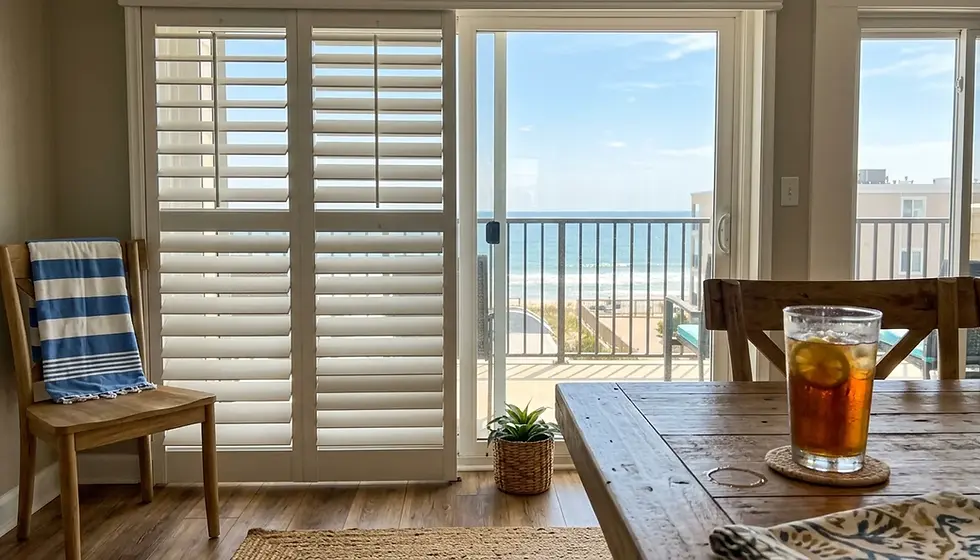
Thinking about plantation shutters for your coastal or historic home? Request a free quote and we will walk through materials, louver sizes, and fit during a free in-home consultation.
Frequently Asked Questions
How do national chains and big-box brands compare with a local installer for whole-house shutters on durability, warranty, and installation quality?
Durability depends mostly on the material and construction, so compare core, coating, and hardware rather than the seller. For warranty, get the terms in writing and check for humidity or coastal exclusions and who services claims locally. For installation quality, ask whether the installer is an employee or a subcontractor and whether the windows are measured on site. A local installer measures every opening in person, assesses humidity exposure, and stays reachable for service on Delmarva.
Which company installs moisture-resistant plantation shutters on the Delmarva Peninsula?
Several locally owned window treatment companies install custom plantation shutters, blinds, and shades across the Delmarva Peninsula, and some offer free in-home consultations that include an on-site check of each window's humidity exposure. Whichever company you choose, ask for written material specifications and warranty language covering coastal conditions, plus hardware details.
Do composite plantation shutters ever warp?
Composite shutters warp far less often than natural wood, but they can still distort. Low-grade construction, unsealed edges, direct water from a leaking window, or intense heat on sun-baked glass can all cause movement. Checking the core, coating, and hardware before you buy lowers that risk considerably.
Can sun and heat alone warp shutters on a south-facing sliding door?
Heat can contribute, especially on a large south or west slider. The glass-facing side of a panel dries and warms while the room side stays cooler, and the two faces move at different rates. Some lower-grade vinyl can also soften under strong heat. Leaving a small air gap behind louvers and pairing shutters with solar protection on the glass helps.
Does a dehumidifier or air conditioning protect shutters?
Yes. Both lower indoor humidity, and the EPA range mentioned earlier is a sensible target. Use a hygrometer so you know the real reading. In second homes and rentals, set the system to hold a steady level instead of switching it off for days at a time, since humidity spikes in a closed house are a common trigger for warping.
How long does it take wood shutters to warp in a beach house?
There is no fixed timeline. Bathrooms, unconditioned porches, and windows with leaks or heavy condensation fail fastest, while a well-conditioned bedroom may stay flat for years. Early signs include stiff louvers and a small gap at the panel edge, so photograph them and check your warranty if you notice either.
Do you offer free in-home consultations, and which areas do you serve?
Yes. We offer free in-home consultations in Rehoboth Beach, Lewes, Bethany Beach, Ocean City, Ocean Pines, Salisbury, Easton, Cambridge, Centreville, Grasonville, Kent Island, Annapolis, and nearby Delmarva communities. Pricing and schedules are confirmed after we measure your windows.
Content powered by inkSTR.co


Comments