.avif)
.avif)
.avif)
9 Best Sun Blinds for Coastal and Delmarva Homes
- Johann Reardon

- Jun 27
- 17 min read

Sun blinds are window treatments specifically engineered to reduce solar heat gain, filter or block UV radiation, and control glare without sealing out natural light entirely. They differ from standard blinds in both fabric construction and purpose: where a typical blind manages privacy, sun blinds are optimized for thermal and UV performance. For homeowners on the Delmarva Peninsula, where ocean-facing rooms receive hard morning sun and bay-side windows catch long afternoon exposure, choosing the right sun blind is a practical decision with measurable impact on comfort, furniture longevity, and energy costs.
Sun blinds block UV rays, reduce heat, and protect furniture. Explore the 9 best options for Delmarva homes, with material tips and cost guidance for 2026.
Solar shade fabrics are rated by openness levels from 0% to 14%, where lower percentages block more light but maintain greater UV protection.
According to the Facts and Factors Blinds and Shades Market Report, the global blinds and shades market is projected to grow from USD 15.65 billion in 2026 to USD 27.18 billion by 2034, driven largely by demand for sun-control products.
Motorized sun blinds are adopted by approximately 44% of buyers in North America, according to 2026 industry data, making automation the fastest-growing segment in window coverings.
In a coastal environment like the Delmarva Peninsula, solar shades and composite-material blinds outperform standard fabric treatments because they resist salt air, humidity, and intense seasonal UV exposure.
Home Blinds and Floors provides free in-home consultations across Rehoboth Beach, Bethany Beach, Lewes, Ocean City, Annapolis, and surrounding Delmarva communities, with professional installation of custom-fitted sun blinds and shades.
If you have watched hardwood floors fade to a dull gray near a south-facing window, or noticed that your living room furniture looks five years older on the ocean side than the interior wall side, you have already experienced what uncontrolled sun exposure does in a Delmarva home. The right sun blind solves that problem without turning your room into a dark cave. This guide covers nine of the best options available in 2026, what they cost, how long they last, and how to choose based on your specific room conditions.
The Home Blinds and Floors team installs window treatments across the Delmarva Peninsula, from Annapolis and Kent Island down through Easton, Salisbury, and Rehoboth Beach to Ocean City. We see the same sun-related damage patterns repeatedly, particularly in properties within a mile of the water, and this guide reflects what actually works in those conditions rather than what sounds good in a product catalog.
What Are Sun Blinds and How Do They Work?
Sun blinds refer to a category of window covering designed to intercept solar radiation before it converts to heat and UV damage inside a room. Solar shade fabrics work by using a woven mesh or perforated construction that absorbs and reflects solar energy rather than simply blocking all light. The key performance metric is the openness factor, expressed as a percentage from 0 to 14. A 3% openness fabric transmits very little visible light and blocks the most heat and UV. A 10% openness fabric allows significantly more light through while still reducing solar heat gain. Specifically, solar shades can filter out up to roughly 90% of sunlight at the tighter weave levels, and many high-quality fabrics block up to 99% of UV rays even at more open weaves.
Interior sun blinds are the most common residential choice. They mount inside or outside the window frame and roll, fold, or slat to allow adjustment throughout the day. Exterior solar shades go one step further by intercepting solar energy before it even contacts the glass, which is particularly effective: external blind systems can block up to 97% of solar heat energy and reduce interior room temperatures by up to 18 degrees Celsius, according to published performance data from exterior blind manufacturers. For Delmarva homeowners managing summer heat loads in oceanfront or bay-facing rooms, that temperature reduction translates directly into lower air conditioning costs and a more comfortable interior.
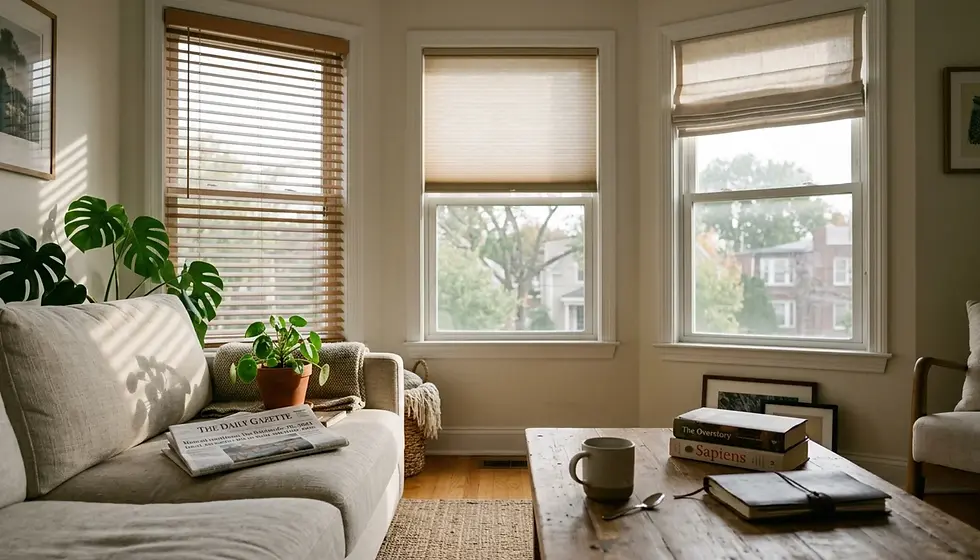

What Are the Best Blinds to Block Out the Sun?
The best sun blinds combine strong UV and heat performance with materials suited to your specific room and climate. For coastal Delmarva homes, that means prioritizing moisture-resistant fabrics, corrosion-resistant hardware, and weave densities matched to your window's solar orientation. Below are the nine options we recommend most often, ordered by their versatility and performance in the Delaware and Maryland coastal environment.
1. Solar Roller Shades
Solar roller shades are the workhorse of the sun blind category and the most requested option across our consultations in Rehoboth Beach and Bethany Beach. They use a single sheet of woven mesh fabric that rolls onto a tube mounted above the window. The openness factor you choose determines the balance between view preservation and heat control: a 3% fabric gives you strong solar protection with a slightly tinted outward view, while a 5% fabric is the most popular middle ground for living rooms and coastal great rooms. The hardware is minimal, the cleaning process is straightforward (a damp cloth handles most coastal dust and salt deposits), and motorized versions integrate cleanly with Alexa, Google Home, and Apple HomeKit. For large ocean-facing windows in Lewes or Bethany Beach, motorized solar rollers are worth the upgrade because manual operation on an oversized shade is awkward and the cords wear faster in high-use settings.
2. Cellular (Honeycomb) Shades
Cellular shades are the strongest insulating option in the sun blind family. Their honeycomb construction traps air between the fabric layers, which resists heat transfer in summer and cold infiltration in winter. Double-cell versions perform noticeably better than single-cell in rooms with significant temperature swings, which is common in beach cottages that sit empty during winter and then face intense summer sun. For a detailed comparison of single-cell versus double-cell performance for Delmarva homes, see our guide to single vs. double cell shades. Cellular shades pair well with blackout liners for bedrooms and can be ordered in top-down-bottom-up configurations, which works particularly well in narrow bathrooms where you want light from above but privacy at eye level.
3. Composite Faux Wood Blinds
Composite faux wood blinds are the practical choice for coastal homes where real wood warps within a few seasons. The composite material resists humidity, salt air, and direct UV exposure far better than natural wood, while maintaining a warm, traditional slat aesthetic. You close the slats fully to block direct afternoon sun or tilt them at an angle to reduce glare while keeping a view of the water. In high-humidity rooms like bathrooms, laundry areas, and coastal mudrooms, composite blinds are the right call. For a room-by-room comparison, our faux wood vs. real wood blinds guide covers performance expectations in each Delmarva microclimate in detail.
4. Motorized Blackout Roller Shades
Motorized blackout roller shades serve a different function than solar shades: they eliminate all light transmission rather than filtering it. These are the right choice for bedrooms, media rooms, and home offices where total darkness or full glare elimination is the goal. In Rehoboth Beach vacation rentals, blackout motorized shades in guest bedrooms are one of the most consistent guest experience improvements we see, because sleeping in a room that gets strong morning sun from the east is uncomfortable without them. The motorized mechanism removes cord hazards, which matters both for child safety and for rental properties where cord damage is a recurring maintenance issue. North America saw approximately 44% of window covering buyers opt for motorized solutions in 2026, according to WiifiTalents 2026 Window Blinds Industry Statistics, and blackout motorized rollers are a significant driver of that figure.
5. Sheer Solar Shades (Light-Filtering)
Sheer solar shades use a more open weave, typically 10% to 14% openness, that softens and diffuses incoming light without darkening the room. They are best suited for north- and east-facing rooms where direct sun is not the primary problem but glare and UV protection still matter. In a bay-facing living room in Lewes or Milton, where afternoon light is soft and diffused rather than harsh, a sheer solar shade preserves the water view beautifully while still blocking UV damage to floors and upholstery. They are not the right choice for south- or west-facing rooms with full afternoon sun exposure, where a tighter 3% to 5% weave is needed. For those applications, see the solar roller shade option above.
6. Exterior Solar Shades and Canvas Sunblinds
Exterior solar shades and canvas sunblinds mount on the outside of the window frame and intercept solar energy before it contacts the glass. This exterior interception is the most thermally effective approach because it prevents heat from entering the building envelope entirely rather than managing it after it has already radiated through the glass. Canvas sunblinds specifically are valued for their durability in outdoor coastal conditions, their ability to be retracted when not needed, and their aesthetic contribution to a home's exterior. Cleaning canvas sunblinds involves a mild solution of water and a small amount of salt per litre with a dash of clove oil, applied with a soft cloth. For Delmarva homes with south-facing covered porches, pergolas, or screened outdoor rooms, exterior canvas shading is a practical upgrade that also adds property value. Our outdoor view enhancements category covers additional exterior shading options in more detail.

7. Zebra (Dual-Layer) Shades
Zebra shades, sometimes called dual-layer or transitional shades, alternate between solid fabric bands and sheer mesh bands. By adjusting the position of the shade, you align the solid bands to block direct sun or shift to the mesh bands for soft filtered light. The effect is genuinely flexible: you get near-blackout performance when aligned for blocking and a light-diffusing solar effect when shifted to the open position. For coastal living rooms that function differently in the morning sun versus the late afternoon glare, zebra shades offer an unusual degree of control in a clean, contemporary aesthetic. They are more visually interesting than a standard roller shade and work well in open-plan beach cottages where the window treatment becomes part of the room's design statement.
8. Roman Solar Shades
Roman solar shades combine the structured, tailored look of a Roman fold with solar mesh fabric. They stack into flat horizontal pleats when raised and present a smooth solar mesh surface when lowered. In formal dining rooms, home offices, and master bedrooms where the design aesthetic calls for something more refined than a roller shade, Roman solar shades bridge the gap between performance and elegance. The fabric options available in solar mesh for Roman shades are broader than many people expect, including textured weaves and neutral coastal tones that complement board-and-batten and shiplap interiors common in Eastern Shore homes. The trade-off is that Roman shades are harder to clean than roller shades because of the fabric stacking mechanism, and they are not the best choice for high-humidity rooms.
9. Plantation Shutters with Composite Louvers
Plantation shutters with composite louvers function differently than fabric sun blinds but serve many of the same purposes. Adjustable louvers let you angle sunlight away from floors and furniture while keeping the room bright. Composite shutters resist the warping, bowing, and paint peeling that afflict wood shutters in coastal environments, making them a long-term investment rather than a recurring replacement cost. For ocean-facing rooms in Rehoboth Beach, Bethany Beach, and Ocean City where the visual architecture of the window treatment matters as much as its performance, composite plantation shutters are often the most elegant solution. Our shutters page and our dedicated custom shutters resources cover material options and installation details for coastal applications.
If you are weighing solar shades against plantation shutters for a specific room in a coastal home, a free in-home consultation with Home Blinds and Floors is the fastest way to reach the right answer. We bring samples, evaluate your room's actual sun exposure at different times of day, and make a specific recommendation rather than a catalog presentation. Visit homeblindsandfloors.com to schedule yours.
Sun Blinds Plantation Shutters Introduced
How Much Do Solar Blinds Cost?
Solar blind costs vary significantly by product type, motorization, fabric quality, and window size. The ranges below reflect typical installed pricing across the Delmarva Peninsula in 2026 and are provided as orientation figures. A free in-home consultation with Home Blinds and Floors will produce an accurate quote for your specific windows.
Sun Blind Type | Typical Installed Cost (per window) | Best For | Coastal Durability |
Solar Roller Shade (manual) | $150: $350 | Living rooms, offices, sunrooms | Excellent with moisture-resistant fabric |
Solar Roller Shade (motorized) | $400: $850 | Large windows, smart home integration | Excellent; cord-free reduces wear |
Cellular / Honeycomb Shades | $200: $500 | Bedrooms, high-insulation rooms | Good; avoid direct water exposure |
Composite Faux Wood Blinds | $150: $400 | Bathrooms, coastal rooms, rentals | Excellent; moisture-resistant core |
Zebra / Dual-Layer Shades | $200: $450 | Living rooms, open-plan spaces | Good with quality fabric selection |
Exterior Solar / Canvas Sunblinds | $400: $900 | Porches, pergolas, south-facing rooms | Excellent; designed for outdoor conditions |
Composite Plantation Shutters | $250: $600 | Formal rooms, coastal homes | Excellent; engineered for salt air |
Retrofit installations, meaning replacements in existing homes rather than new construction, account for over 57% of blinds and shades revenue according to industry data, which means most buyers are replacing something that already failed rather than starting fresh. If you are replacing warped wood blinds or faded fabric shades in a coastal home, the material upgrade to composite or solar mesh will nearly always extend the product's useful life significantly and reduce the frequency of that replacement cycle.
For a full breakdown of custom window treatment pricing across the Delmarva Peninsula, see our detailed custom blinds cost guide.
How Long Do Sun Blinds Usually Last?
Sun blinds last between 7 and 15 years under typical residential use, depending on material quality, coastal exposure, and maintenance. Solar roller shades made from high-quality woven mesh fabrics, when kept clean and retracted during severe weather, routinely reach 10 to 12 years before the fabric shows noticeable degradation. Some manufacturers offer 10-year guarantees on fabric and hardware components for their premium sunscreen blind lines, which is a reliable indicator of expected service life when the product is properly maintained.
In coastal Delmarva conditions, the variables that shorten blind lifespan most aggressively are salt air corrosion on metal hardware, UV breakdown of lower-quality fabrics, and humidity cycling that causes warping in materials not engineered for moisture exposure. Composite and vinyl materials outlast natural wood by several seasons in these conditions. A faux wood blind in an Ocean City bathroom might last 12 to 15 years; a real wood blind in the same location might start showing stress in three to five years.
Motorized systems add a hardware lifespan variable. The motors in quality motorized blinds typically last 8 to 12 years with normal use. Battery-powered motors require battery replacement every one to two years depending on use frequency. Hardwired or rechargeable motors avoid that maintenance cycle and are worth specifying in new construction or full renovation projects.
Regular cleaning extends fabric life meaningfully. For solar mesh fabrics, a gentle wipe-down with a damp cloth removes salt deposits and dust before they abrade the weave. For exterior canvas sunblinds, a periodic wash with a mild solution keeps mold and mildew from establishing in the fabric fibers, which is a genuine concern in the humid Delmarva summer.
What Is the Cheapest Way to Block Sun from Windows?
The cheapest functional approach to blocking sun from windows is a manual solar roller shade with a 3% to 5% openness fabric, installed at standard window sizes. At the entry level of the custom treatment market, manual solar rollers represent the best value-to-performance ratio: they block meaningful UV and heat, they look clean and intentional rather than improvised, and they last significantly longer than off-the-shelf alternatives from big-box stores because the fabric is heavier and the hardware is rated for daily use.
Truly budget-driven approaches like reflective window film or heavy curtains do block some sun, but they come with trade-offs worth understanding. Reflective film can void window manufacturer warranties and is difficult to remove cleanly. Heavy blackout curtains block all light rather than filtering it, and in a coastal home where the view is part of the value, eliminating that view to save money on coverings is a poor trade.
For homeowners across Millsboro, Milton, or Middletown who need to treat multiple windows on a defined budget, the most cost-effective strategy is to prioritize south- and west-facing rooms first, since those receive the most direct afternoon sun, and address north- and east-facing rooms in a second phase. Home Blinds and Floors works with budget-conscious homeowners across the Delmarva Peninsula to sequence projects sensibly and apply cost-effective materials where they perform best. Our window blinds page covers the full range of options available across price points.
Sun Blinds vs. Conventional Blinds: Which Performs Better by Climate?
Sun blinds and conventional blinds serve different primary purposes, and the right choice depends heavily on your climate and the specific function of the room. Conventional blinds, such as aluminum mini blinds or standard fabric roller shades, are designed primarily for privacy and basic light management. Sun blinds, specifically solar shades and composite shutters with UV-blocking properties, are engineered for thermal and UV performance as their core function.
In a temperate coastal climate like the Delmarva Peninsula, where summer UV index regularly reaches 8 to 10 and humidity is consistently high from May through September, solar shades outperform conventional blinds on every relevant metric: UV protection, heat reduction, moisture resistance, and furniture preservation. The openness factor gives you precise control over the light-versus-protection trade-off that conventional blinds cannot match.
In drier inland climates with less intense sun and lower humidity, conventional faux wood blinds perform adequately and cost less than solar mesh alternatives. The moisture resistance advantage of solar shade fabrics matters less in those environments. But for Rehoboth Beach, Ocean City, Easton waterfront properties, and bay-facing homes across Kent Island, the solar shade category is clearly the stronger performer.
The global blinds and shades market reached an estimated USD 15.65 billion in 2026 and is projected to reach USD 27.18 billion by 2034 at a 6.3% CAGR, according to the Facts and Factors Blinds and Shades Market Report. Functional sun-control products are driving a significant portion of that growth, with smart and motorized systems expanding rapidly. In 2026, the penetration rate of functional sunshade products in the United States and Europe reached 70%, reflecting how broadly solar performance has become a baseline expectation rather than a premium add-on.


How to Choose the Right Sun Blinds for Your Home
Choosing the right sun blind requires matching four variables: your window's solar orientation, the room's function, the coastal exposure level of your home, and your budget. Here is a practical framework for working through that decision.
Identify the solar orientation of each window. South-facing and west-facing windows receive the most direct sun and need the tightest weave, typically 3% openness, for meaningful heat control. East-facing windows get morning sun only and work well with 5% to 10% openness. North-facing windows rarely need solar shades at all; standard cellular or light-filtering shades are sufficient.
Match the opacity to the room's function. Bedrooms benefit from blackout or near-blackout options. Living rooms and dining rooms generally perform best with 5% openness solar rollers that preserve the view while controlling heat. Media rooms need total blackout. Sunrooms and porches are strong candidates for exterior canvas sunblinds or exterior solar rollers that intercept heat before it enters the space.
Choose materials rated for your coastal exposure. For homes within a mile of the water in Rehoboth Beach, Bethany Beach, Lewes, or Ocean City, specify moisture-resistant fabrics and corrosion-resistant hardware. Aluminum and stainless components outlast standard steel brackets in salt air. Composite and vinyl louvers outlast wood on the coast.
Decide on motorization before measuring. Motorized systems require different mounting hardware than manual systems. If you add motorization after the fact, it usually means re-ordering new brackets and possibly a new headrail. Deciding upfront saves money and avoids reinstallation. For windows over 72 inches wide or in rooms above the ground floor, motorization is strongly recommended over manual operation.
Get an in-home measurement before ordering. This is where DIY approaches consistently fail. Solar shades need precise inside measurements to seat correctly against the window frame and prevent light gaps at the edges. A gap of even a quarter inch on each side allows significant solar heat to bypass the fabric entirely. Home Blinds and Floors handles measurement as part of the free consultation, so you never order the wrong size.
For sliding glass doors and patio door applications, vertical solar shades and panel track systems are worth considering. Our guide to window treatments for sliding glass doors in Delmarva covers those options specifically. For sunrooms, our solar shades for sunrooms guide addresses the unique light challenges of all-glass enclosures in detail.
Frequently Asked Questions About Sun Blinds
What is the difference between solar shades and blackout blinds?
Solar shades use a woven mesh fabric with an openness factor of 3% to 14%, designed to filter UV rays and reduce solar heat gain while preserving a degree of outward visibility. Blackout blinds use a solid, opaque fabric or material that blocks all or nearly all light transmission. Solar shades are the right choice for rooms where you want sun protection without losing the view. Blackout blinds are the right choice for bedrooms, media rooms, or any space where complete darkness is the goal. Many homeowners in Delmarva beach homes use solar shades in living areas and blackout options in bedrooms to serve both needs.
How do openness levels work in solar shade fabrics?
The openness factor in solar shades is a percentage representing how much of the fabric surface is open weave versus solid material. A 3% openness fabric has very small gaps in the weave, blocking more light and heat while offering a slightly filtered outward view. A 10% openness fabric has larger gaps, letting in more light and providing a clearer view but less UV and thermal protection. For south- and west-facing windows on the Delmarva coast, 3% to 5% openness is the practical range. For east- and north-facing rooms where glare control rather than heat blocking is the goal, 7% to 10% works well.
Are motorized sun blinds compatible with smart home systems?
Yes. Motorized solar shades and sun blinds are available in versions compatible with Alexa, Google Home, Apple HomeKit, Lutron Caseta, and Control4 platforms. Battery-powered motors offer wireless installation without wiring changes, while hardwired motors provide more reliable long-term performance. Home Blinds and Floors installs motorized window treatments across the Delmarva Peninsula, including smart home-integrated systems for properties in Annapolis, Kent Island, Rehoboth Beach, and surrounding communities. The free in-home consultation includes a review of your existing smart home setup to confirm compatibility before ordering.
Which sun blind materials hold up best in coastal conditions near the water?
In salt air environments like Rehoboth Beach, Bethany Beach, Lewes, and Ocean City, the materials that perform best are composite and vinyl louvers for shutters and blinds, marine-grade or moisture-resistant solar mesh fabrics for roller shades, and powder-coated aluminum or stainless steel hardware. Natural wood warps and cracks within a few seasons in high-humidity coastal conditions. Standard painted steel brackets corrode faster than expected near the waterfront. Specifying moisture-rated components adds minimal cost at the time of installation and avoids the frustration of replacing treatments every three to five years.
How do I clean solar shade fabric and canvas sunblinds?
For interior solar mesh roller shades, a damp cloth or sponge wiped across the fabric surface removes most dust and salt deposits. Avoid soaking the fabric or using harsh solvents, which can break down the coating on UV-blocking fabrics. For exterior canvas sunblinds, a mild cleaning solution, typically a small amount of salt per litre of water with a dash of clove oil applied with a soft cloth, is effective for removing mold and mildew growth that can develop in humid coastal conditions. Rinse thoroughly with clean water after cleaning and allow the canvas to dry fully before retracting to prevent mold from forming in the stored fabric.
How much do solar shades cost to install on the Delmarva Peninsula?
Manual solar roller shades typically run from $150 to $350 per window installed, while motorized versions range from $400 to $850 per window depending on fabric, motor type, and window size. Composite plantation shutters with UV-controlling louvers generally fall in the $250 to $600 range per window installed. These are orientation figures for 2026; actual pricing depends on window dimensions, product tier, and project scope. Home Blinds and Floors provides free in-home consultations with accurate quotes before any commitment, so you will know the full cost before ordering. Request yours at homeblindsandfloors.com.
Are sun blinds effective for protecting furniture and flooring from UV damage?
Yes. Solar shades at 3% to 5% openness block a substantial portion of UV radiation, which is the primary cause of fading and degradation in hardwood floors, upholstered furniture, and area rugs. Even at 10% openness, solar mesh fabrics block a significant share of UV rays compared to unprotected glass. For homes with wood floors, exposed timber furniture, or light-colored upholstery in sun-facing rooms, solar shades are one of the most cost-effective preservation investments available. The alternative, replacing faded flooring or reupholstering furniture, consistently costs far more than the window treatments that would have prevented the damage.
Does Home Blinds and Floors serve commercial properties as well as residential homes?
Yes. Home Blinds and Floors installs solar shades, sun blinds, and full window treatment solutions for commercial properties across the Delmarva Peninsula, including offices, medical facilities, retail spaces, and hospitality properties. Commercial applications often require glare control for screens and workstations, privacy management during business hours, and durable products rated for high-use environments. Multi-window commercial projects are handled with coordinated measurement, ordering, and installation to minimize disruption. Contact Home Blinds and Floors at homeblindsandfloors.com to request a commercial consultation.
The Right Sun Blind Starts with the Right Fit
Sun blinds are one of those home improvements that pay for themselves quietly: lower cooling costs through the summer, furniture that does not fade prematurely, rooms that stay comfortable even when the afternoon sun is at its most aggressive. The nine options covered in this guide range from entry-level solar rollers to motorized exterior systems, and the right choice for your home depends on your window orientation, room function, and proximity to the coast.
For homeowners across the Delmarva Peninsula, choosing a solar shade or sun blind without accounting for coastal conditions is the most common mistake we see. Salt air, humidity, and intense UV exposure disqualify many otherwise good products within a few seasons. The materials and hardware that hold up at the Delaware beaches are specific, and getting that selection right from the start is the difference between a window treatment that lasts 12 years and one that needs replacing in four.
Home Blinds and Floors serves homeowners and businesses from Annapolis and Kent Island through Easton, Salisbury, and Centreville down to Rehoboth Beach, Bethany Beach, and Ocean City, with free in-home consultations, custom fabrication, and professional installation. If your windows are ready for an upgrade in 2026, the consultation process starts with a visit to your home, samples in hand, at no cost and no obligation.
Ready to find the right sun blind for your space? Schedule your free in-home consultation with Home Blinds and Floors and get a custom recommendation backed by years of Delmarva installation experience.
Content powered by inkSTR.co


Comments