.avif)
.avif)
.avif)
What Are Standard Size Window Blinds? A Room-by-Room Guide

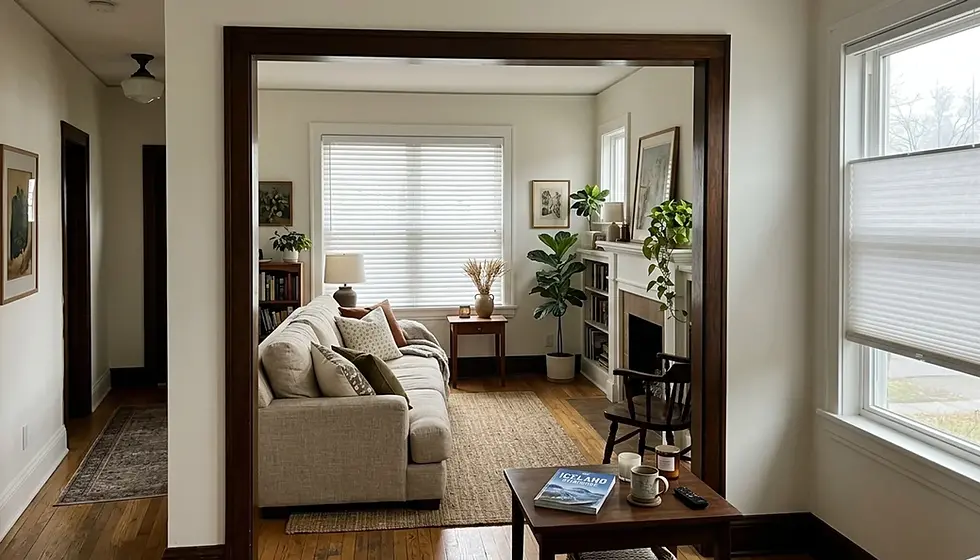
Standard size window blinds refer to pre-determined width-and-height combinations that align with the most common residential window dimensions built in American homes. Bathroom and kitchen windows typically call for blinds in the 24 to 36-inch width range, bedroom windows fall between 36 and 48 inches wide, and living room windows often require blinds 48 to 72 inches wide. Knowing your room type gets you 80% of the way to the right blind size before you ever pick up a measuring tape.
TL;DR: Key Takeaways
Standard blind sizes run from 24x24 inches (small bathroom) up to 72x84 inches (large great room), organized by room type and window style.
Inside mount blinds require a minimum frame depth of 1/2 inch for cellular shades, 1-1/8 inches for roller shades, and 2 inches for faux wood blinds.
Outside mount blinds should overlap 2 to 3 inches on each side of the window frame and mount 3 to 6 inches above the opening to block light gaps.
The U.S. blinds and shades market is estimated to reach USD 5.03 billion in 2026, according to Market Data Forecast, signaling strong consumer demand for new window treatments.
When a window falls outside standard dimensions by even 1/4 inch, a custom-sized blind from a professional installer like Home Blinds and Floors will fit and perform far better than a trimmed stock blind.
Older construction homes built before 1980 frequently have non-standard rough opening sizes, meaning standard stock blinds often produce frustrating light gaps around the frame.
If you have spent any time staring at a wall of blind boxes in a home improvement store, you already know how confusing the sizing can get. The industry uses "standard" loosely. A stock blind labeled 36 inches wide may be factory-cut to 35-1/2 inches to clear a typical inside mount frame, while a custom order at exactly 36 inches is made to fill that same frame with no gap. Understanding what "standard" actually means at each step of the purchase process will save you from costly re-orders and poorly fitting window treatments.
At Home Blinds and Floors, we serve homeowners across the Delmarva Peninsula from Rehoboth Beach and Lewes in Delaware down to Ocean City, Salisbury, and Annapolis in Maryland. Across hundreds of consultations, the single most common source of buyer frustration is ordering what a box store calls a "standard" blind, only to discover it does not fit the actual window. This guide explains exactly what standard sizes exist, what sizes work by room, and when custom fabrication is the smarter investment.

What Are Standard Sizes for Window Blinds?
Standard sizes for window blinds are the width-and-height combinations that correspond to the most common residential window openings built across American housing stock. Width typically runs in 6-inch increments from 24 inches to 72 inches. Height typically runs in 6-inch increments from 24 inches to 84 inches. These dimensions cover the majority of windows found in homes built after 1980, though older construction often deviates significantly from these benchmarks.
The table below organizes standard blind sizes by room type, using the window dimensions most frequently encountered in residential installations across single-family homes on the Delmarva Peninsula and throughout the Mid-Atlantic region.
Room Type | Typical Window Width | Typical Window Height | Common Window Style |
Bathroom / Kitchen | 24 to 36 inches | 24 to 36 inches | Single-hung, awning |
Bedroom | 36 to 48 inches | 48 to 60 inches | Double-hung, casement |
Living Room | 48 to 60 inches | 48 to 84 inches | Picture, double-hung, sliding |
Great Room / Modern Open Plan | 60 to 72 inches | 60 to 84 inches | Picture, floor-to-ceiling, bay |
Dining Room | 36 to 48 inches | 48 to 60 inches | Double-hung, casement |
One important distinction: window manufacturers specify the rough opening (the framed hole in the wall), while blind manufacturers specify the finished width of the blind itself. A 36-inch rough opening typically produces a 35 to 35-1/2-inch usable inside mount space. Stock blinds account for this trim-down, but the allowance varies by manufacturer, which is why measuring your actual frame rather than assuming the label is always the right call.
How Building Codes Shape What "Standard" Means
The International Residential Code (IRC) sets minimum egress window requirements for bedrooms: a minimum net clear opening of 5.7 square feet, at least 24 inches in height and 20 inches in width. In practice, most builders install bedroom windows considerably larger than the egress minimum to meet buyer expectations and natural light goals. These IRC minimums explain why you rarely see a bedroom window smaller than 28 by 40 inches in post-2000 construction, which in turn informs why the most common stock blind widths start at 27 and 35 inches.
What Is the Most Popular Blind Size?
The most popular blind size in residential applications is the 35 to 36-inch width by 64-inch height, corresponding to the standard double-hung bedroom window found in the majority of single-family homes built between 1975 and 2010. This size hits the overlap zone between bedroom and smaller living room windows, making it the highest-volume stock size carried by window treatment retailers and the most frequently ordered custom size in professional installations.
According to Fact.MR's 2026 market analysis, horizontal (Venetian-style) blinds hold over 26.5% of the global window blinds market, and fabric-based window blinds account for nearly 40.8% of overall volume. Those share numbers reflect real consumer behavior: most buyers want a horizontal-slatted blind or a fabric roller shade in a size that fits a typical bedroom or small living room without custom fabrication.
For faux wood blinds specifically, the 2-inch slat width has become the residential standard, replacing the older 1-inch aluminum mini blind as the default choice in new construction and renovation projects. The wider slat gives better light control per rotation and fits the proportions of modern window openings more naturally than narrow mini blinds.
Most Popular Sizes by Blind Type
Faux wood blinds: 35-1/2 to 36 inches wide by 64 to 72 inches tall covers most bedrooms and dining rooms.
Roller shades: 36 to 48 inches wide by 72 inches tall suits standard living room and bedroom applications.
Cellular shades: 27 to 36 inches wide by 48 to 64 inches tall dominates bathroom and bedroom orders, particularly where energy efficiency is a priority.
Vertical blinds: 72 to 96 inches wide by 84 inches tall for sliding glass doors and wide picture windows.

What Size Blinds for a 35-Inch Window?
For a 35-inch window opening, inside mount blinds should be ordered at 34-1/2 to 34-7/8 inches wide to allow for smooth operation without binding against the frame. For outside mount installation on a 35-inch window, order the blind at 40 to 41 inches wide to achieve the recommended 2 to 3-inch overlap on each side of the frame, which blocks the light gaps that occur when blinds sit flush with the opening.
Measurements should be taken to the nearest 1/8 inch for accurate custom blind orders. For inside mount width, use the narrowest of three measurements taken at the top, middle, and bottom of the frame opening. Frames are rarely perfectly parallel, and using the widest measurement will produce a blind that binds. For inside mount height, use the longest of three measurements taken at the left, center, and right of the frame opening.
Minimum Frame Depth Requirements for a 35-Inch Window
Before ordering an inside mount blind for any window, including a 35-inch opening, confirm your frame depth. Cellular shades require a minimum inside mount depth of 1/2 inch. Roller shades require 1-1/8 inches minimum. Faux wood blinds require 2 inches minimum depth because the headrail and tilt mechanism need clearance. Casement windows with crank handles present a particular challenge: the crank typically adds 2 to 3 inches of obstruction depth, meaning outside mount is usually the better choice unless the crank sits below the blind's bottom rail.
If your 35-inch window falls into the casement category, do not force an inside mount. Outside mount installation at this size is straightforward and often looks cleaner, particularly when you mount the hardware 3 to 6 inches above the frame to add visual height to the window and conceal any frame damage or irregular trim work.
When Custom Sizing Beats Stock at 35 Inches
A stock blind at the nearest common size (usually 35 or 35-1/2 inches) may clear a 35-inch inside mount opening, but the fit depends entirely on whether your frame meets the factory's assumed trim-down allowance. A genuine 35-inch opening is right on the edge. Some frames measure 34-7/8 inches at the narrowest point; others measure 35-1/8 inches. A custom-fabricated blind at the exact measured dimension will always fit more cleanly and operate more smoothly than a stock blind that happens to fit within tolerance. At Home Blinds and Floors, in-home consultations include precise frame measurements at all three points before any product is ordered.
Is 36x36 a Standard Window Size?
A 36x36-inch window is a standard size most commonly found in bathrooms and kitchens, particularly in homes built after 1990. This square format is typical for single-hung bathroom windows positioned above tub surrounds or vanities, and for kitchen windows placed above countertops where the sill height limits the available vertical dimension. A 36x36-inch rough opening accommodates an inside mount blind ordered at approximately 35-1/2 by 35-1/2 inches, though your actual frame measurement should always be verified before ordering.
For a 36x36 window in a bathroom, the best blind choice depends on moisture exposure. Faux wood blinds in a composite or PVC-based material hold up well in humid environments where real wood would warp within one or two seasons. Aluminum mini blinds in a 1-inch slat width also work in tight bathroom spaces where a 2-inch faux wood headrail would feel bulky at the top of a small frame.
36x36 vs. Other Square Window Formats
Not all 36-inch windows are square. A 36x48 opening is more common in bedrooms and dining rooms, while the 36x60 and 36x72 configurations appear frequently in older colonial-style homes along the Delmarva Peninsula, where tall, narrow double-hung windows were the architectural norm. If your home was built before 1970, assume the windows deviate from modern standard sizing until you measure. Pre-1980 construction often used rough openings that fall between modern standard increments, producing frames like 33-1/4 x 58-1/2, which match nothing on a stock blind size chart.
How Do You Measure Windows for Inside vs. Outside Mount Blinds?
Measuring windows for inside mount blinds means measuring the inside of the window frame opening at three horizontal points (top, middle, bottom) and three vertical points (left, center, right), then using the smallest width and largest height as your order dimensions. Measuring for outside mount blinds means deciding how far beyond the window opening the blind will extend, then measuring that total intended coverage area, not the frame itself.
The distinction matters because the two methods produce different order widths from the same window. An inside mount order on a 36-inch frame might be 35-1/2 inches. An outside mount order on the same window, with a 3-inch overlap on each side, would be 42 inches. Ordering the wrong dimension for the wrong mount type is the leading cause of return orders in professional blind installation.
Inside Mount Step-by-Step
Measure the inside frame width at the top, middle, and bottom. Record the narrowest number.
Measure the inside frame height at the left side, center, and right side. Record the longest number.
Confirm the minimum frame depth matches the blind type you want (see depth table above).
Order at the exact measured dimensions. Custom fabricators will apply the appropriate deduction for headrail clearance.
Outside Mount Step-by-Step
Decide the total width of blind coverage, adding 2 to 3 inches per side beyond the visible frame.
Decide the top mounting point, typically 3 to 6 inches above the frame or at the ceiling in rooms where you want height.
Measure from the chosen top mounting point to the desired bottom of coverage (typically the sill or 1/2 inch below it).
Order at the total coverage dimensions, not the frame dimensions.

What Blind Types Work Best for Each Standard Window Size?
Blind type selection is a function of window size, room function, and available frame depth working together. Small windows under 36 inches wide work well with cellular shades and faux wood blinds because both products operate cleanly in tight frames and offer real privacy without dominating the visual space. Large windows over 60 inches wide benefit from motorized roller shades or vertical blinds because manual operation of wide, heavy blinds creates cord tension and uneven lift over time.
The following table pairs standard size ranges with the blind types that perform best in each category, factoring in minimum depth requirements, light control, and the specific coastal conditions common to homes in Delaware and Maryland's Eastern Shore.
Window Width Range | Recommended Blind Type | Best For | Min. Frame Depth |
24 to 30 inches | Cellular shade (single-cell), aluminum mini blind | Bathrooms, small kitchens, laundry rooms | 1/2 inch (cellular), 1 inch (mini blind) |
30 to 48 inches | Faux wood blind, roller shade, cellular shade | Bedrooms, dining rooms, home offices | 2 inches (faux wood), 1-1/8 inches (roller) |
48 to 60 inches | Roller shade, wood blind, roman shade | Living rooms, primary bedrooms | 1-1/8 inches (roller), 2-1/4 inches (wood blind) |
60 to 72 inches | Motorized roller shade, vertical blind | Great rooms, open-plan living areas, beach house great rooms | 1-1/8 inches (roller with motor) |
Over 72 inches (sliding doors) | Vertical blind, panel track shade | Sliding glass doors, wide picture windows | 2 to 3 inches |
For coastal properties on the Delmarva Peninsula specifically, faux wood and composite materials outperform real wood blinds at every size. Salt air and high summer humidity cause real wood to swell, warp, and eventually delaminate within a few seasons in oceanfront and near-ocean exposures. The team at Home Blinds and Floors consistently recommends composite or PVC-core faux wood products for any property within a few miles of the Atlantic coast, whether in Bethany Beach, Ocean City, or Rehoboth Beach.
For more on custom blind options by window type, the Home Blinds and Floors blog covers material comparisons in detail. You can also review faux wood vs. wood blinds for Delmarva homes for a coastal-specific breakdown of which materials hold up best in the Eastern Shore climate.
What Is the Difference Between Stock Blinds and Custom-Ordered Standard Sizes?
Stock blinds are pre-cut at the factory to a fixed finished width, typically 1/2 inch smaller than the labeled size to allow inside mount clearance. Custom blinds are fabricated to your exact measured dimensions, including non-standard widths like 33-1/4 inches or 47-3/4 inches that stock products do not offer. The word "standard" means something different at a box store than it does at a professional window treatment provider.
This distinction creates real confusion for buyers. When you pick up a box labeled "36-inch blind," the actual finished width inside that box is typically 35-1/2 inches. That 1/2-inch factory deduction fits a 36-inch inside mount opening cleanly. But if your frame measures 35-3/4 inches at its narrowest point, that stock blind will wobble slightly inside the frame. And if your frame measures 35-1/4 inches at its narrowest point, that same stock blind may bind on the lift cords.
When Stock Sizes Save You Money
Stock blinds are the right call when your window openings fall exactly on a standard increment (24, 27, 30, 35, 36, 48 inches wide) and your frame depth comfortably clears the minimum requirement for the blind type you want. In newer construction homes built after 2000 in planned communities around Lewes, Milton, and Millsboro in Delaware, standardized framing dimensions are common enough that stock products often fit without adjustment. For a rental property or investment home where budget and installation speed matter more than a perfect fit, stock blinds at standard sizes are a reasonable choice.
When Custom Sizing Is Worth the Investment
Custom fabrication pays off in three situations. First, when your frame measurement falls between stock sizes. Second, when you have older pre-1980 construction with irregular rough openings, common in historic Easton and Annapolis neighborhoods. Third, when you want a specific material or operating system (motorized, cordless, top-down/bottom-up) that stock products do not offer at your window's size. Custom blinds from professional installers typically cost more upfront, but they last 15 to 20 years with professional installation versus 3 to 5 years for the average stock blind that was pressed into service on a window it only approximately fits.
For a detailed cost breakdown specific to the Delmarva market, the custom blinds cost guide for the Delmarva Peninsula covers pricing by window type and material category.
How Do You Handle Windows That Fall Outside Standard Dimensions?
Windows that fall outside standard dimensions require either a trimmed stock blind, a custom-fabricated blind, or an outside mount installation that covers the non-standard opening with a standard-sized product positioned beyond the frame. Of the three approaches, custom fabrication produces the cleanest result. Trimming stock blinds is an option for aluminum mini blinds and some faux wood products, but cutting a blind's headrail without the manufacturer's trim kit often voids the product warranty and produces uneven slat alignment.
Non-standard windows appear more frequently than most homeowners expect. Bay windows require individual blinds for each section rather than one large treatment spanning the full bay. Each angled face has its own measurement, and the sections should be treated independently. Arched or radius-top windows above standard rectangular openings need a flat blind installed below the arch curve, with the arch treated separately using a shaped fabric or shutter solution.
The 1/4-Inch Problem
In our experience working with homeowners across the Eastern Shore, the trickiest situations involve windows that are just slightly outside a standard stock size. A 37-inch wide opening, for example, has no stock blind at 36-1/2 inches. You can either go up to the 37.5-inch stock size and mount outside (which adds bulk to a window that may not need it), or you can order a custom blind at 36-1/2 inches for an inside mount that fits cleanly. For one or two windows, trimming might seem appealing. For a whole house with 12 windows at 37 inches, custom fabrication is clearly the smarter path and often only marginally more expensive than buying stock and paying for alterations.
The custom window treatments resource on the Home Blinds and Floors site walks through the full range of non-standard solutions, including options for specialty shapes common in coastal vacation homes with transom lights and arched entries. If you have sliding glass doors with non-standard widths, the sliding glass door window treatment guide for Delmarva covers sizing and product selection in detail.
Are Motorized Blinds Available in Standard Sizes?
Motorized blinds are available in standard sizes and are increasingly the practical choice for windows over 48 inches wide, particularly in great rooms, beach house open-plan layouts, and any window above standard reach height. According to market research from Mordor Intelligence, the U.S. electric blinds segment is projected to grow from approximately USD 320 million in 2026 toward USD 2.5 billion by 2034, reflecting strong adoption in both new construction and retrofit residential projects.
At the standard sizes most commonly used in motorized applications (48 to 72 inches wide, 72 to 84 inches tall), roller shades and cellular shades are the most practical motorized products. Both operate cleanly on a tubular motor inside the headrail and can be controlled via wall switch, remote, or smart home integration with systems including Amazon Alexa and Google Home. Motorized vertical blinds are available for wide sliding door openings but require a deeper headrail track, typically 3 to 4 inches, than manual vertical systems.
For vacation homes and coastal properties with high, hard-to-reach windows, motorization eliminates the physical challenge of operating large blinds manually. It also removes the cord safety concern entirely, which matters for any property where children visit. Home Blinds and Floors installs motorized solutions across all standard sizes and can integrate with existing smart home setups for properties in Rehoboth Beach, Bethany Beach, and Ocean Pines. You can explore the full range of blind installation services or shade installation options to see which motorized products fit your specific window dimensions.
Frequently Asked Questions About Standard Size Window Blinds
What are the most common standard sizes for window blinds?
The most common standard sizes for window blinds are 24x36 inches for bathrooms and kitchens, 36x48 to 36x60 inches for bedrooms, 48x60 to 48x72 inches for living rooms, and 60x72 to 72x84 inches for great rooms and large open-plan spaces. These dimensions correspond to the window opening sizes most frequently specified in residential construction across American housing stock. Your actual order width for inside mount installation will be 1/4 to 1/2 inch smaller than the opening measurement to allow clearance.
What is the most popular blind size for bedrooms?
The most popular blind size for bedrooms is approximately 35 to 36 inches wide by 64 inches tall, matching the standard double-hung bedroom window found in most American homes built between 1975 and 2010. Faux wood blinds and cellular shades are the most frequently ordered products at this size. For inside mount installation, order at 35-1/2 to 35-7/8 inches wide and the full measured height.
What size blinds should I order for a 35-inch window?
For a 35-inch window opening, inside mount blinds should be ordered at 34-1/2 to 34-7/8 inches wide. For outside mount installation with proper light blockage, order the blind at 40 to 41 inches wide to achieve a 2 to 3-inch overlap on each side of the frame. Always measure the actual opening at top, middle, and bottom and use the narrowest measurement for inside mount ordering.
Is a 36x36-inch window considered standard?
Yes, a 36x36-inch window is a standard size most commonly found in bathrooms and kitchens, particularly in homes built after 1990. This square format is typical for single-hung windows positioned above tub surrounds and kitchen countertops. For inside mount blind installation on a 36x36 opening, order at 35-1/2 by 35-1/2 inches after measuring the actual frame dimensions at multiple points.
How do I know if I need custom blinds instead of standard stock sizes?
You need custom blinds when your window opening falls between standard stock increments (for example, 37 or 43 inches wide), when your home was built before 1980 with non-standard rough openings, or when you need a specific material or operating system not available in stock sizes. Custom fabrication is also the right call for bay windows, where each section must be measured and fitted separately. An in-home consultation will identify which windows can use stock products and which genuinely require custom fabrication.
What is the minimum frame depth needed for different blind types?
Cellular shades require a minimum inside mount frame depth of 1/2 inch. Roller shades require at least 1-1/8 inches. Faux wood blinds need a minimum of 2 inches because the headrail and tilt rod mechanism need clearance. If your frame depth falls short of the minimum for the blind type you want, outside mount installation is the correct solution rather than forcing an inside mount that will interfere with the product's operation.
Are standard size blinds available with motorization?
Yes, motorized blinds are widely available in standard sizes, particularly for windows 48 to 72 inches wide where manual operation of a large, heavy blind becomes impractical over time. Roller shades and cellular shades are the most practical motorized products at standard residential sizes. They can be controlled by wall switch, remote, or integrated with smart home platforms. For hard-to-reach coastal home windows or properties managed as vacation rentals, motorization eliminates cord safety issues and simplifies operation for guests.
What window treatment materials hold up best in coastal homes?
Faux wood blinds made from composite or PVC-core materials, cellular shades, and aluminum-frame roller shades hold up best in coastal environments. Real wood warps and delaminates in high-humidity, salt-air exposure within a few seasons, regardless of factory finish coatings. Aluminum mini blinds corrode at the slat pivot points when exposed to salt air regularly. For any property within a few miles of the Atlantic coast, including homes in Rehoboth Beach, Bethany Beach, Ocean City, and Lewes, composite and synthetic materials are consistently the longer-lasting investment.
What Should You Do Next to Get the Right Window Blinds?
Choosing the right standard size window blinds comes down to three steps: measure your actual frame openings (not your wall openings) at multiple points, match the blind type to the frame depth you have available, and decide whether your measurements land on a true stock size or require custom fabrication. The global blinds and shades market is estimated at USD 18.0 billion heading into 2026, according to Future Market Insights, which means the product options have never been broader. But broader selection makes the measurement and specification step more critical, not less.
For homes on the Delmarva Peninsula, material selection adds a coastal layer to the decision. The salt air, high summer humidity, and intense Atlantic-facing sun exposure in communities from Ocean Pines to Centreville and Kent Island mean that standard residential material guidance does not always apply. What lasts 15 years inland may last 5 years in a beachfront exposure if you choose the wrong substrate.
If you want to get from measurement to correct product quickly and avoid the re-order frustration that comes from box store guesswork, an in-home consultation is the most efficient path. Home Blinds and Floors serves homeowners and businesses throughout the Delmarva Peninsula with free in-home consultations that include precise multi-point measurements, material recommendations tailored to your specific location and sun exposure, and professional installation so the product operates correctly from day one.

Ready to find the right fit for every window in your home? The team at Home Blinds and Floors measures, specifies, and installs window treatments across the Eastern Shore, from Annapolis to Ocean City. Schedule your free in-home consultation and get precise sizing and material recommendations for every room.


Comments