.avif)
.avif)
.avif)
How to Measure Shutters: A Delmarva Homeowner's Guide

TL;DR: To measure for shutters, decide between an inside or outside mount. For an inside mount, measure the window frame's width and height in three places (top/middle/bottom, left/middle/right) and use the smallest measurement for each. For an outside mount, measure the area you want to cover and add at least 1.5 inches to each side for overlap, using the largest measurement. Always use a steel tape measure and record numbers to the nearest 1/16th inch. For a perfect, stress-free fit in your Delmarva home, the experts at Home Blinds & Floors offer free in-home consultations.
Thinking about adding the classic, clean look of plantation shutters to your home but feeling a little intimidated by the measuring process? At Home Blinds & Floors, we help homeowners across the Delmarva Peninsula get it perfect. Getting the fit just right is hands-down the most critical part of the job.
The core idea is simple: you'll measure the width at the top, middle, and bottom, then do the same for the height on the left, middle, and right. The trick is knowing which number to use—you’ll want the smallest dimension for an inside mount and the largest for an outside mount. This little detail is what ensures that polished, professional look.
Inside vs. Outside Mount: Your First Big Decision
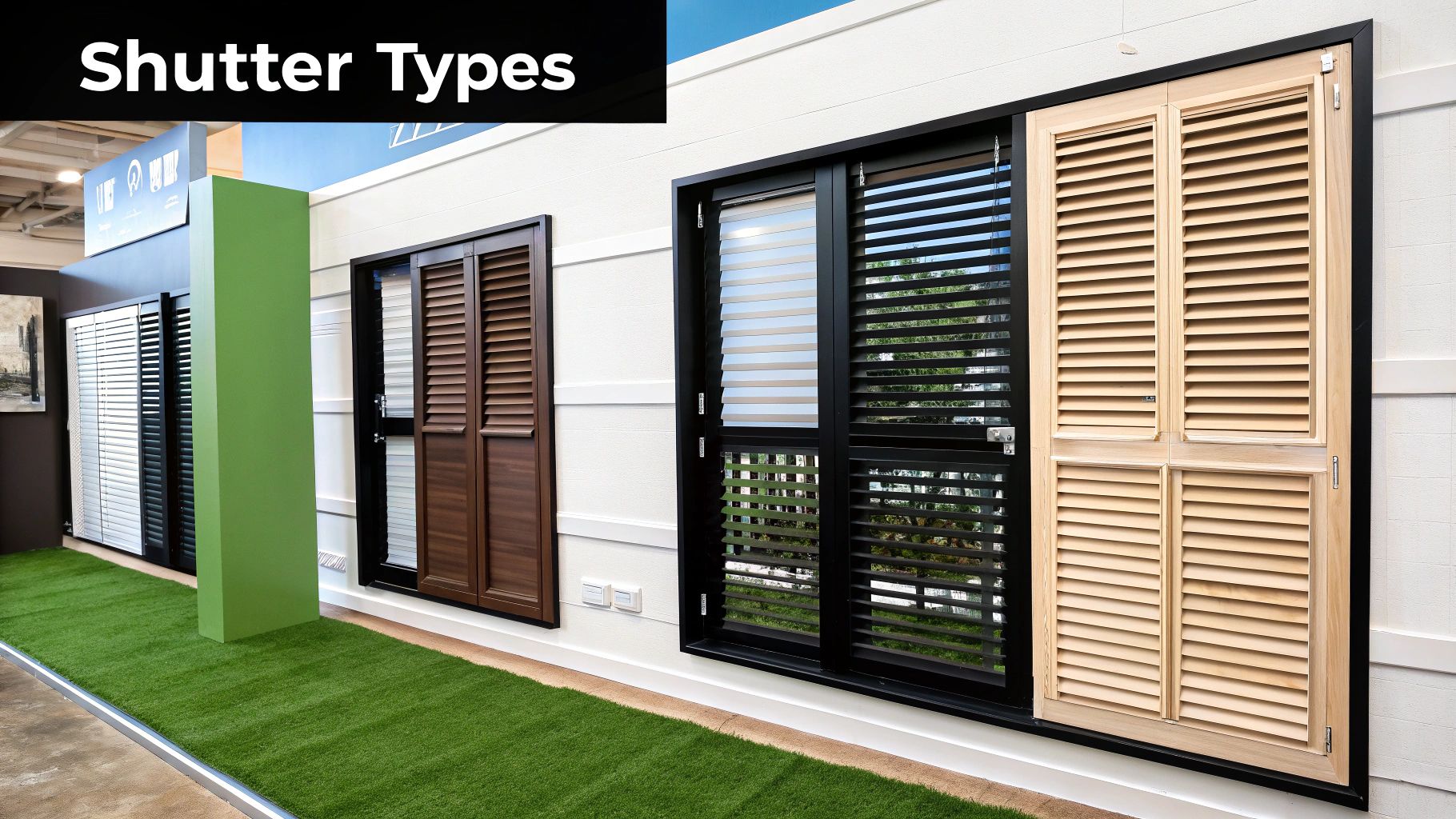
Before you even reach for your tape measure, let's talk about why precision is so important. Unlike curtains or blinds you might grab off a shelf, custom shutters are built to the exact, unique specifications of your windows. An error as small as a quarter-inch can mean the difference between a flawless fit and a frustrating installation with gaps or operational hiccups.
The very first decision you need to make will guide everything else: are you going for an inside mount or an outside mount?
An Inside Mount is when the shutter fits snugly inside the window casing. This gives you that clean, built-in look that's so popular in homes from Rehoboth Beach to Salisbury. The only catch is that your window frame needs to have enough depth to accommodate it.
An Outside Mount involves installing the shutter on the wall or trim around the window. This is the go-to solution for windows that don't have enough depth, aren't perfectly square (which is more common than you'd think!), or when you want to create the illusion of a larger window.
This choice is your starting line, as it determines exactly how and where you'll measure.
Inside Mount vs Outside Mount Quick Measurement Rules
To make things a bit easier, here’s a quick-reference table that breaks down the key differences for taking those initial measurements. Think of this as your cheat sheet for getting an accurate quote or preparing for a professional consultation.
Measurement Step | Inside Mount Shutters | Outside Mount Shutters |
|---|---|---|
Width Measurement | Measure inside the frame; use the smallest reading. | Measure the area to cover; use the largest reading. |
Height Measurement | Measure inside the frame; use the smallest reading. | Measure the area to cover; use the largest reading. |
Goal | Ensure the shutter fits within the tightest point. | Ensure the shutter fully covers the window opening. |
Best For | Deep-set, square windows for a clean, built-in look. | Shallow windows, out-of-square frames, or a bold look. |
The guiding principle of measuring is consistency and precision. Always measure to the nearest 1/16 of an inch and double-check your numbers before you write anything down. This one simple habit will save you from the most common DIY mistakes.
While shutters have their own specific requirements, the fundamental principles of accuracy overlap with other window treatments. For a bit more context, you can check out our guide on how to measure windows for blinds for a perfect fit. You’ll find that the core concepts are quite similar.
If you want to dive deeper into making sure everything in your home fits just right, these general tips for perfect furniture fit are a great resource. From free in-home consultations to flawless installation, Home Blinds & Floors takes the stress out of selecting window treatments.
Gathering the Right Tools for an Accurate Measurement
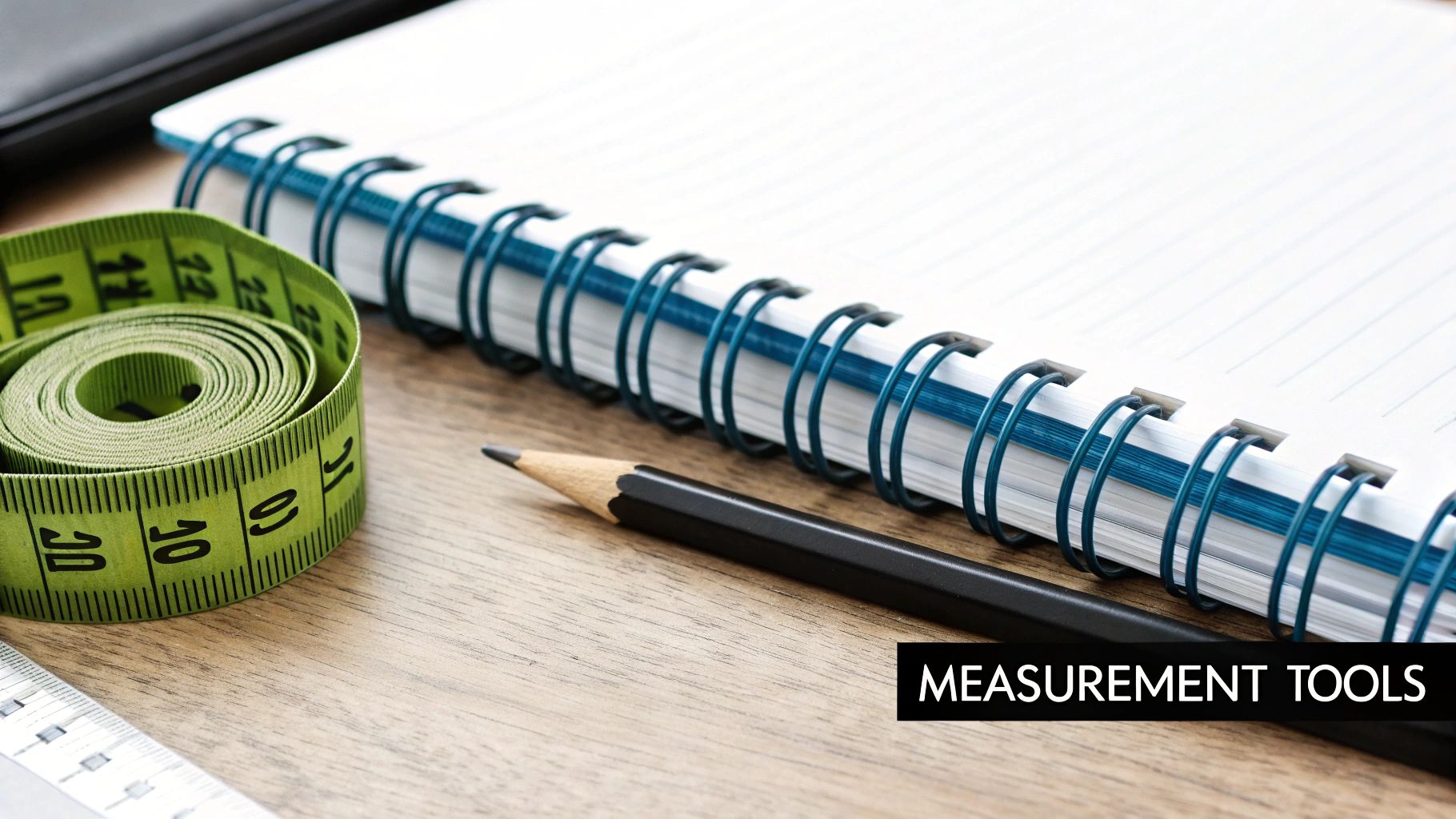
Before you even think about putting a tape measure to the wall, let's talk about tools. Getting this part right is absolutely critical. Using a flimsy tape or just "eyeballing it" is a one-way ticket to a frustrating project and shutters that simply don't fit. A few minutes of prep now will save you a massive headache later.
Your most valuable player here is a sturdy, steel measuring tape. Seriously, don't even think about using a cloth or vinyl sewing tape. Those can stretch and sag, throwing off your numbers just enough to cause a problem. A rigid metal tape is the only way to get a true, straight-line measurement every time.
As a local, family-run business, Home Blinds & Floors provides personal service, competitive pricing, and professional installation throughout Sussex, Wicomico, Kent, and beyond.
Your Essential Shutter Measurement Toolkit
You don't need a whole workshop to measure like a professional, just a few key items. Get these together before you start, and the whole process will be faster and far more accurate.
Steel Measuring Tape: A 25-foot tape is perfect. It's long enough for any residential window and has the rigidity you need for precise readings.
Pencil and Notepad: This sounds obvious, but you'd be surprised. Don't trust your memory! Jot down every measurement the second you take it, and make sure to label the width (W) and height (H) for each window.
A Small Level: Window frames are rarely perfectly square, especially in some of the beautiful older homes on the Eastern Shore. A small level will quickly show you if the frame is sloped, which is something we need to account for.
A Step Stool or Ladder: For taller windows, safety and accuracy are key. Use a sturdy ladder so you can comfortably reach the top of the frame without stretching or guessing.
Pro Tip: Precision is everything. You need to measure to the nearest 1/16th of an inch. Custom shutters are built to your exact specs, so rounding even a little bit can ruin the fit.
Reading Your Tape Measure Correctly
For those who don't use one every day, those little hash marks on a tape measure can be a bit confusing. It’s pretty simple once you break it down. Between any two inch marks, the longest line in the middle is the 1/2" mark. The next longest are the 1/4" marks, then the 1/8" marks, and the tiniest ones are the 1/16" marks.
It’s also helpful to understand why this level of detail matters so much for this specific window treatment. If you're curious, our guide on plantation shutters vs. blinds dives into what makes them unique. Take a moment to get comfortable with your tape measure; that confidence will translate into spot-on numbers.
Measuring for Inside Mount Shutters
Inside mount shutters are, by far, the most popular choice among homeowners, and for good reason. They give you that clean, seamless look, sitting perfectly flush right inside the window frame. It’s a classic, built-in style, but pulling it off means your measurements have to be dead-on.
Let’s walk through exactly how to get the numbers you need for this elegant look.
The entire process comes down to one simple, hard-earned truth: your window frame is probably not perfectly square. It's just a fact of life. Houses settle, frames shift, and things get a little out of whack over time—even in brand-new homes here on the Delmarva Peninsula. To get ahead of this, you have to measure everything in threes.
Taking Accurate Width Measurements
First up, let’s tackle the width. You’re going to take three separate horizontal measurements inside the window casement.
Measure across the top of the window opening, from one side of the frame to the other.
Next, do the same thing across the middle.
Finally, take one last measurement across the bottom.
Jot down all three numbers. Now for the most important part: circle the smallest of the three measurements. This is the number you’ll use for your final width. Trust me on this. Using the narrowest dimension ensures your shutter panel can actually swing open and closed without getting stuck on a slightly tighter spot in the frame.
This quick visual breaks down how to take one of these critical width measurements.
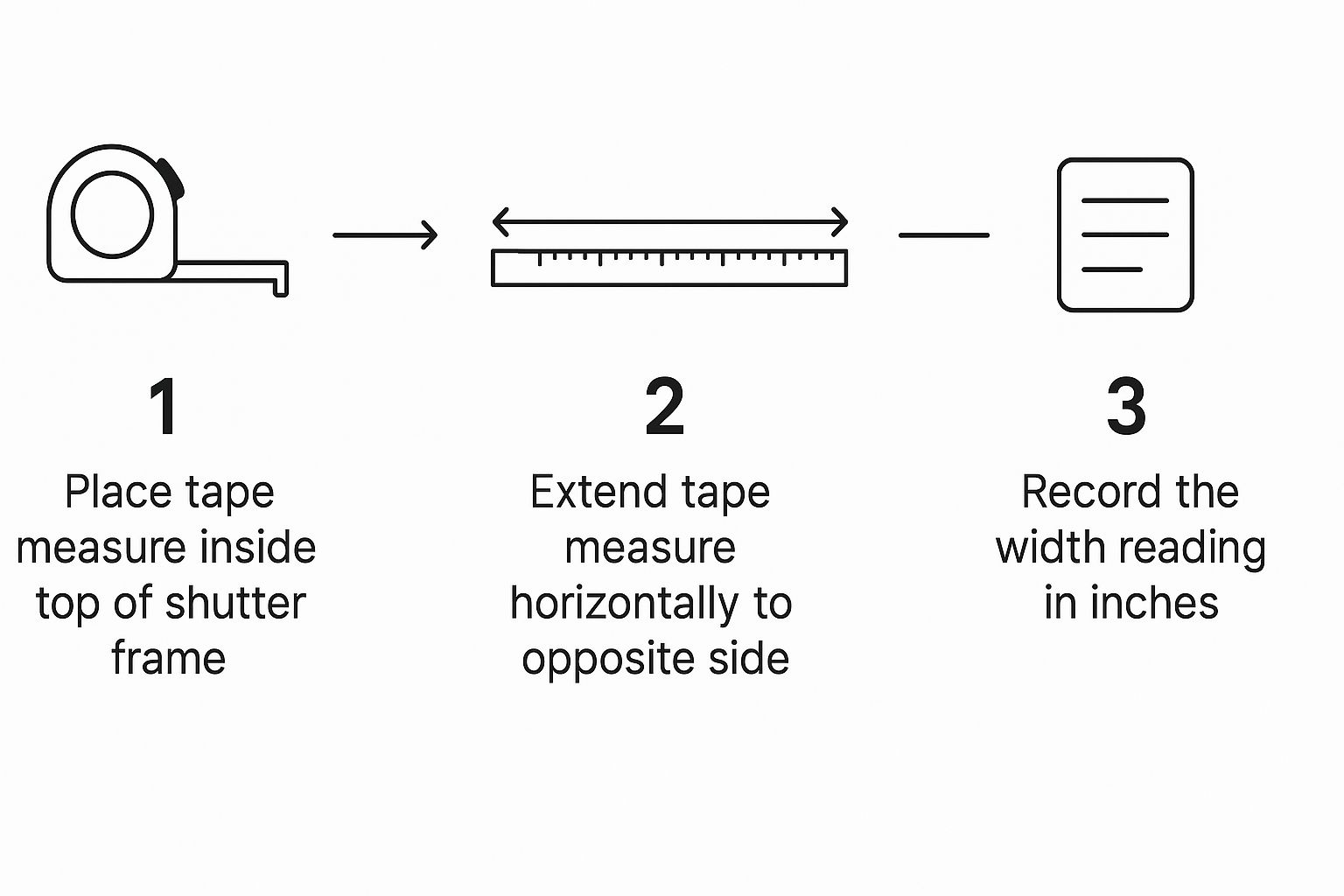
As you can see, the goal is a straight, level measurement from one interior side to the other. Just remember to repeat this at the different points to find the true width you need to work with.
Getting the Correct Height and Depth
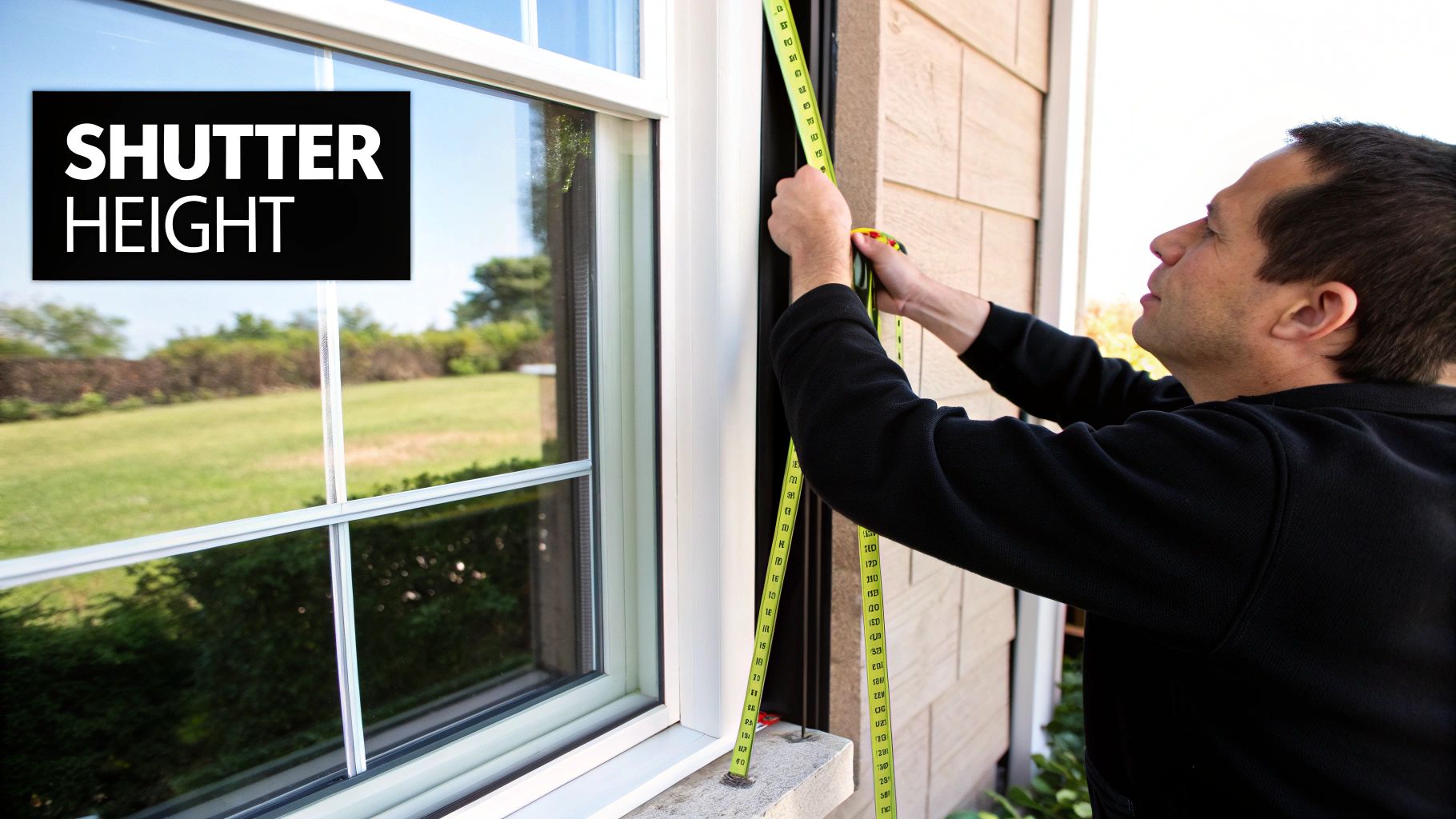
When it's time to measure the height, you’ll follow the exact same logic. You'll take three vertical measurements inside the frame.
Measure the height on the far left side of the window.
Then, measure right down the middle.
And finally, measure the height on the far right side.
Just like with the width, write them all down and use the smallest measurement for your final height. This guarantees the shutter will fit neatly within the shortest part of the opening. For a closer look at the nuances of plantation shutters, you might want to check out our ultimate guide to plantation shutter windows for your Delmarva home.
Now for the one measurement people always forget: depth. You need to measure from the surface of the window glass to the very edge of the interior trim. This is what tells you if you have enough clearance for the shutter louvers to tilt open without bumping into the glass or hitting a window crank.
The demand for this kind of precision is a huge driver in the industry. In fact, the global shutter slats market was valued at around USD 1.2 billion in 2023 and is on track to nearly double by 2033. This growth is all about homeowners wanting perfectly fitted, custom products. You can discover more insights about shutter market growth on datahorizzonresearch.com.
Home Blinds & Floors offers a wide selection of custom blinds and shades in Delmarva, with expert installers who bring the showroom to your living room.
Measuring for Outside Mount Shutters
What if your window frames are too shallow for an inside mount? Or what if you want to give a smaller window a bit more presence and visual weight? That’s the perfect scenario for an outside mount. These shutters create a bold, architectural statement by installing directly onto the wall or the trim surrounding your window, rather than sitting inside it.
This method offers a ton of creative flexibility, but accurate measuring is a different ballgame. You’re not just fitting an opening anymore; you're designing a new, visually balanced frame that elevates the entire look of the window.
Determining the Correct Width
With an outside mount, you need to think beyond the window opening itself. You're deciding how much of the surrounding wall or trim the shutter frame will cover. The goal is to create enough overlap on each side to block light and look intentional.
First, measure the full width of the window opening, including any trim you intend to cover. Once you have that measurement, it's time to add the overlap.
For light control: We recommend adding at least 1.5 inches of overlap to both the left and right sides. This is crucial for preventing those annoying slivers of light from peeking around the edges.
For a bolder look: Many of our clients in Delmarva opt for a more substantial frame, adding up to 3 inches of overlap on each side. It really makes the window a focal point.
The key takeaway? Consistency. Whatever overlap you add to the left, make sure you add the exact same amount to the right for a symmetrical, professional finish.
Establishing the Perfect Height
Measuring for height follows the same logic. You'll measure the full height of the window opening (again, including any trim you'll be covering) and then add your overlap to the top and bottom. Ideally, this overlap should match what you added to the sides.
Just like the width, adding a minimum of 1.5 inches to both the top and bottom is a safe bet. This ensures there's a solid surface for mounting the hardware and it helps with light blockage.
Pro Tip: If you have decorative molding, think like a designer. Where should the shutter frame begin and end? You could align the top of the shutter frame with the top edge of your head casing or have the bottom sit flush with your windowsill. This makes the shutter look like it was always part of the window's original design.
Accounting for Obstructions and Molding
Before you write down your final numbers, do a quick survey of the area around the window. Are there any light switches, outlets, thermostats, or even decorative corbels nearby? These are common culprits that can get in the way. Measure the distance from your window trim to any potential obstacle to be certain your new shutter frame has clear space.
If you have beautiful decorative molding you want to keep visible, you’ve got a couple of options:
Mount on the Molding: If your trim is flat and at least 1.5 inches wide, you can often mount the shutter frame directly onto it.
Mount Around the Molding: Measure to the outside edge of your decorative trim, and then add your desired overlap. This beautifully frames the existing molding.
Nailing these small details is what transforms a project from looking like a DIY job into a truly professional installation.
Common Window Measurement Mistakes to Avoid
Even the most careful DIYer can stumble into a few common traps when measuring for shutters. A small oversight can easily turn into a big headache, leading to frustrating delays or costly mistakes. But once you know what to watch out for, avoiding them is simple. Here are the most frequent slip-ups we see homeowners make across the Delmarva Peninsula.
It sounds almost too simple, but you'd be surprised how often people transpose the width and height. It happens. Get in the habit of writing your numbers down clearly and labeling them W for width and H for height every single time. This tiny step prevents a world of trouble later.
Another classic pitfall is assuming your windows are all the same size. They almost never are. Even in brand-new homes, it’s incredibly rare for two window frames to be perfect twins. You absolutely have to measure each window individually, no matter how identical they look.
Forgetting Key Details and Obstructions
Getting the right fit is about more than just the basic dimensions—it's about seeing the whole picture. A classic rookie mistake is forgetting to measure in three places for both width and height. Window frames are rarely perfectly square, so this "measure in three" rule is your secret weapon against a bad fit.
Just as important is spotting potential obstructions. People often measure the window but forget to account for the things around it that can get in the way of the shutter frame or the louvers.
Window Cranks and Handles: Is there enough depth for the louvers to tilt open without hitting the hardware?
Alarm Sensors: These little sensors on the glass or frame can stop a shutter from closing all the way.
Decorative Trim: For an outside mount, you have to decide if you want the shutter frame to cover your existing molding or sit neatly inside it.
Nearby Walls or Bookshelves: Make sure there’s enough clearance for the shutter panels to swing open completely. You don't want them bumping into a bookcase.
This level of detail is a huge part of what makes each shutter style unique. Our guide on the 7 common types of interior shutters can help you see how these little details influence the final look and function.
The Risk of Rounding Your Numbers
It can be tempting to see a measurement like 24 7/16" and just round it to a cleaner 24 1/2". Don't do it. This is one of the most critical mistakes you can make. Custom shutters are built to precise fractions of an inch, and that tiny 1/16" can be the difference between a shutter that fits perfectly and one that’s too tight to even install.
Always record your measurement to the nearest 1/16th of an inch. Never, ever round up or down. That commitment to precision is what separates a professional, seamless installation from a frustrating DIY project.
At Home Blinds & Floors, our expert installers take care of all this for you, bringing the showroom right to your living room and handling every single measurement. We eliminate any chance of error, guaranteeing your custom shutters for your Delmarva home fit flawlessly from day one.
FAQ: Your Shutter Measurement Questions Answered
Over the years, we've helped countless homeowners across the Delmarva Peninsula get the perfect plantation shutters. Here are a few of the most common questions we get.
Why do I have to measure in three different places?
Window frames are rarely perfectly square, especially in the beautiful historic and coastal homes across the Eastern Shore. Measuring width at the top, middle, and bottom (and height at the left, middle, and right) helps identify the frame's narrowest and shortest points. For an inside mount, you must use the smallest measurement to ensure the shutter fits without getting stuck.
How much depth do I need for an inside mount shutter?
The required depth depends on the louver size. Larger louvers (like 3.5" or 4.5") need more clearance to tilt open. As a general rule, you need at least 2.5 to 3 inches of clear, unobstructed depth from the window glass to the edge of the frame. Our team can confirm the exact depth needed during a free consultation.
What is the biggest mistake people make when measuring for shutters?
The two most common mistakes are rounding numbers and assuming all windows are the same size. Always measure to the nearest 1/16th of an inch and never round up or down. Additionally, you must measure every single window individually, even if they appear identical.
Can I just reuse my old shutter measurements?
We strongly advise against it. Window frames can shift over time, and different shutter styles have unique hardware and clearance needs. Taking fresh, accurate measurements for every new project is the best way to guarantee a perfect fit and protect your investment.
What cities in Delmarva do you serve?
Home Blinds & Floors is proud to serve homeowners and businesses across the Delmarva Peninsula. Our service areas include Salisbury, Ocean City, and Berlin in Maryland, as well as Rehoboth Beach, Lewes, Bethany Beach, and surrounding communities throughout coastal Delaware.
Your Local Shutter Experts on the Delmarva Peninsula
In summary, Home Blinds & Floors provides custom window treatments, expert advice, and in-home service to homes across the Delmarva Peninsula. From Rehoboth Beach to Easton, our team is here to help you choose the best shades, shutters, or blinds for your space. We take the guesswork out of measuring to ensure a flawless, professional installation every time. Schedule your free consultation today.


Comments