.avif)
.avif)
.avif)
Blinds Services: A Complete Practical Walkthrough


Blinds services refer to the full range of professional window treatment solutions: in-home consultation, precise measurement, custom fabrication, and expert installation of blinds, shades, and shutters tailored to your specific windows. Rather than guessing your way through a big-box store, a proper blinds service pairs you with a local specialist who handles every step so your treatments fit perfectly, operate smoothly, and last for years.
TL;DR
Professional blinds services span five stages: consultation, measurement, product selection, custom fabrication, and installation. Skipping any one stage is where most homeowners run into fit and function problems.
The global blinds and shades market is projected to reach USD 18.0 billion by end of 2026, driven by demand for motorized, energy-efficient window treatments (Future Market Insights).
Smart and motorized blinds now account for roughly 21% of all installations, with demand growing more than 42% over recent years, making automation a mainstream rather than niche option.
Choosing the right blind type by room matters: blackout cellular shades for bedrooms, moisture-resistant faux wood for bathrooms, solar shades for home offices and coastal sunrooms.
On the Delmarva Peninsula, salt air and high humidity make material selection especially critical. Standard aluminum blinds can corrode within two years in coastal environments like Rehoboth Beach or Ocean City.
Home Blinds and Floors provides free in-home consultations, precise custom measurements, and professional installation across the entire Delmarva Peninsula and Maryland's Eastern Shore.
Whether you are outfitting a new build in Lewes, DE, replacing salt-damaged blinds in a Rehoboth Beach vacation home, or adding motorized shades to a commercial office in Salisbury, MD, the process works the same way. A professional evaluates your windows, your light-control needs, and your budget, then recommends and installs solutions that genuinely work for that specific space. The difference between a professional blinds service and a DIY purchase is not just convenience. It is accuracy, longevity, and accountability when something does not fit.
In 2026, homeowners across the Eastern Shore and Delmarva Peninsula are navigating more window treatment options than ever before. Cellular shades, motorized rollers, plantation shutters, solar fabrics, woven woods: each serves a different purpose, and matching the right product to the right room is exactly what a skilled blinds service provider does. This walkthrough covers every stage of the process so you know what to expect, what to ask, and what separates a quality installation from one you will regret.

What Does a Professional Blinds Service Actually Include?
A professional blinds service is a structured, multi-stage process that begins with an in-home consultation and ends with a fully installed, correctly operating window treatment. It is not simply selling a product. The service includes needs assessment, window measurement, custom product fabrication to your exact dimensions, delivery coordination, and hands-on installation with hardware secured correctly to your window frame or wall.
Each stage matters. During the consultation phase, a specialist evaluates factors that most homeowners overlook: which direction your windows face (south-facing windows in coastal Delaware receive more intense afternoon UV than north-facing ones), how much light you need filtered versus blocked, whether children or pets create a cord-safety concern, and what your home's architectural style calls for aesthetically.
Measurement is where DIY projects most often go wrong. Professional installers take both inside-mount and outside-mount measurements, account for window depth and obstruction clearance, and verify that frames are square before ordering. Custom blinds fabricated to incorrect dimensions cannot simply be returned. The whole process restarts.
Installation itself involves more than hanging brackets. Professionals level every shade, ensure all tilt mechanisms and lift cords operate correctly, calibrate motorized systems to their programmed stops, and walk you through operation before leaving. At Home Blinds and Floors, the in-home consultation is free, and their team serves communities from Middletown, DE, and Kent Island, MD, down through Bethany Beach and Ocean City, MD.

What Types of Window Treatments Do Blinds Services Cover?
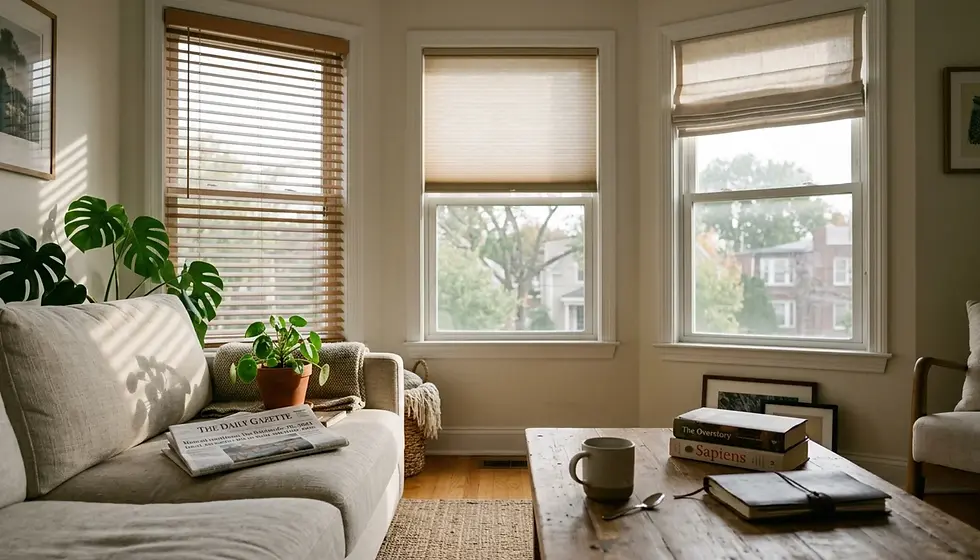
Window treatment blinds services cover a wide spectrum of products, from basic cordless faux wood blinds to fully motorized roller shades integrated with smart home systems. Understanding the main categories helps you enter your consultation with realistic expectations about what each type delivers.
Cellular and Honeycomb Shades
Cellular shades are constructed from a series of air-trapping honeycomb cells that create an insulation barrier between the glass and your interior. Single-cell varieties provide moderate insulation, while double-cell constructions add a second layer of air pockets for stronger energy efficiency. For Delmarva homeowners dealing with hot summers and cold Chesapeake winters, cellular shades are one of the most effective ways to reduce HVAC load without sacrificing natural light. They come in light-filtering and room-darkening options.
Faux Wood and Real Wood Blinds
Faux wood blinds use a composite or PVC material that resists moisture, warping, and UV fading. For coastal properties in Ocean Pines, MD, or Bethany Beach, DE, faux wood outperforms real wood blinds on durability in a salt-air environment. Real wood offers richer grain patterns and works well in climate-controlled interiors. If you want a deeper comparison, the faux wood vs. wood blinds guide for Delmarva homes breaks down the trade-offs for Eastern Shore conditions specifically.
Roller and Solar Shades
Roller shades operate on a simple tube mechanism and come in fabrics ranging from sheer solar weaves to full blackout coatings. Solar shades are particularly effective in home offices and sunrooms where glare reduction matters more than complete privacy. They filter UV without eliminating your view. For coastal sunrooms, the solar shades guide for Delmarva sunrooms outlines which fabric openness percentages work best for different light conditions.
Plantation Shutters
Plantation shutters are rigid panel window coverings with adjustable louvers, typically made from wood, composite, or vinyl. They provide excellent light control, strong insulation, and a clean architectural appearance. For custom shutter installation in coastal homes, composite and vinyl materials outperform real wood because they resist swelling, warping, and paint peeling in humid conditions. Shutters also add measurable resale value compared to soft treatments.
Motorized and Smart Shades
Motorized shades use battery-powered or hardwired motors to raise, lower, or tilt treatments via remote control, wall switch, or smartphone app. Many systems integrate with Google Home, Amazon Alexa, and Apple HomeKit. For high windows in beach houses or two-story great rooms, motorized operation is often the only practical solution. As of 2026, roughly 21% of all new blind and shade installations are motorized, and demand continues to grow.
How Does the Blinds Service Process Work Step by Step?
The blinds service process follows a consistent sequence from first contact through final walk-through. Knowing each stage in advance prevents surprises and helps you prepare the right questions before a consultant arrives at your home.
Initial Consultation: A specialist visits your home, reviews every window you want treated, discusses your light control and privacy goals, and identifies any architectural challenges (arched windows, sliding glass doors, French doors) that require specialty solutions.
Measurement: The consultant takes precise inside and outside mount dimensions for every window. For inside mounts, they check frame depth to ensure the blind sits flush. For outside mounts, they account for the overlap needed to block light gaps.
Product Selection: Based on your goals, budget, and measurements, the specialist presents options with physical fabric samples. You see and feel materials before committing. This is where room-by-room recommendations happen: blackout options for bedrooms, moisture-resistant for bathrooms, UV-filtering for south-facing living rooms.
Custom Fabrication: Your chosen treatments are fabricated to your exact window dimensions. Unlike off-the-shelf products, custom blinds are cut and assembled specifically for your measurements. Lead times vary by product: roller shades typically run 5-10 business days, while plantation shutters often require 3-6 weeks depending on material and customization.
Professional Installation: The installation team arrives with all hardware, anchors the brackets correctly into your frame or wall studs, hangs each treatment, and tests every operating mechanism. They level every shade and calibrate motorized systems if applicable.
Walk-Through and Handoff: Before leaving, the installer shows you how to operate tilt, lift, and (for motorized systems) programming features. Any operational issue is resolved on the spot rather than discovered days later.
At Home Blinds and Floors, this process covers every community on the Delmarva Peninsula, from Centreville, MD, and Grasonville, MD, through Easton, MD, Cambridge, MD, and south to Millsboro, DE, and Milton, DE. The free in-home consultation means you pay nothing until you have seen your options and agreed on a solution.

How Do You Choose the Right Blind Type for Each Room?
Matching the blind type to the room is one of the most consequential decisions in any blinds service project. The wrong product in the wrong room creates ongoing frustration: shades that let morning light flood a bedroom, bathroom blinds that warp from steam, or office treatments that cause screen glare rather than reducing it.
Room | Primary Need | Recommended Treatment | Key Feature to Prioritize |
Bedroom | Total darkness for sleep | Blackout cellular or roller shade | Zero light gaps at edges and top |
Bathroom | Privacy + moisture resistance | Faux wood blinds or composite shutters | PVC or composite core; no real wood |
Home Office | Glare reduction, view preservation | Solar roller shade (3-5% openness) | UV filtering without full blackout |
Living Room | Light control + aesthetics | Plantation shutters or Roman shades | Adjustable louvers or layerable fabrics |
Kitchen | Easy cleaning, humidity tolerance | Faux wood blinds or roller shade | Wipeable surface; no fabric that traps grease |
Sunroom / Patio Door | UV and heat control | Solar shade or vertical blind | High UV block rating; operates with door use |
Nursery / Child's Room | Blackout + cord safety | Cordless cellular shade | Cordless or motorized lift only |
For sliding glass doors and patio entrances, the treatment type must accommodate foot traffic without bunching or tangling. Vertical blinds, panel track systems, and sliding door treatments are specifically engineered for wide spans that open and close repeatedly. Standard horizontal blinds on a 72-inch sliding door are a functional mismatch you will regret within a few months.
Coastal homes in Rehoboth Beach, Lewes, and Ocean City face an additional variable: intense UV exposure accelerates fabric fading, and salt-laden air corrodes metal components. Prioritize UV-stable fabrics, coated hardware, and composite or vinyl frames over untreated aluminum or natural wood in any room with direct ocean-facing exposure.
Why Does Professional Installation Matter for Long-Term Performance?
Professional blinds installation matters because a treatment that is measured incorrectly, mounted off-level, or anchored into the wrong substrate will fail prematurely regardless of product quality. Fit, alignment, and hardware placement are skills developed over hundreds of installations, not something a first-timer can replicate by watching a tutorial.
Brackets anchored into drywall instead of studs or window framing pull loose over time, especially with heavier plantation shutters or motorized shades. A professional installer identifies the correct anchor points before drilling, avoiding damage to walls that you then have to repair. This is particularly important in older Eastern Shore homes where window frames may not be standard dimensions.
Motorized systems introduce an additional layer of precision. The upper and lower stop positions must be programmed so the shade does not over-travel and stress the motor. A professional calibrates these limits during installation and tests every stop. If you program these incorrectly on a DIY installation, you risk damaging the motor within months.
The long-term calculus is straightforward. Quality custom blinds from a professional service typically last 15-20 years with proper care. Off-the-shelf treatments installed without professional guidance often show wear within 3-5 years, partly from product quality and partly from installation errors that create uneven stress on operating mechanisms. The upfront investment in professional blinds services saves you on replacement costs across a decade-plus horizon.
Home Blinds and Floors brings this level of precision to every installation across the Delmarva Peninsula. Their team has seen the specific challenges coastal homes present, from warped frames in older Chesapeake-area cottages to oversized windows in new builds along Rehoboth Bay, and they adapt their approach accordingly.
What Should You Know About Lead Times and Production Schedules?
Lead time transparency is one of the most underserved topics in window treatment research, and most providers do not publish realistic timelines upfront. Knowing what to expect prevents frustration when your installation date is weeks away from your order date.
Production timelines vary significantly by product category. Roller shades and basic horizontal blinds fabricated to custom dimensions generally arrive within one to two weeks. Roman shades and woven wood products with custom fabric selections take longer because fabric must be sourced and cut, typically two to three weeks. Plantation shutters involve the most complex fabrication: frame construction, louver assembly, and finishing. Expect three to six weeks for composite or wood shutters, and potentially longer for specialty shapes like arched or angled windows.
Motorized systems add time when they require hardwiring rather than battery operation. An electrician may need to run low-voltage wiring before the installer can mount the shade, creating a scheduling dependency. If you are working toward a move-in date or a seasonal deadline (covering coastal windows before peak summer, for example), build at least two additional weeks into your timeline to account for any coordination delays.
The practical advice: book your consultation four to eight weeks before you need the installation complete. This buffer accommodates measurement, ordering, fabrication, and scheduling without pressure. If your project covers multiple rooms or a whole house, the production window is the same, since most items are ordered and arrive together, but installation scheduling may take an additional few days.
How Do You Maintain Blinds and Shades After Installation?
Blind and shade maintenance refers to the cleaning and care practices that preserve fabric integrity, operating mechanisms, and hardware over the life of the treatment. Most blinds fail prematurely not from product defects but from neglect of routine maintenance that takes minutes per window.
Dusting and Light Cleaning
Dust accumulates on horizontal blinds and shutter louvers quickly, especially in coastal environments where airborne salt and humidity bond particles to surfaces. Close the louvers or slats fully in one direction, wipe with a microfiber cloth or duster, then rotate to the opposite direction and repeat. For cellular shades, use a vacuum with a soft brush attachment on the lowest suction setting. Never pull or stretch cellular fabric during cleaning.
Deep Cleaning by Material
Faux wood blinds tolerate a damp cloth with mild soap. Real wood blinds should never be saturated with water. Remove them from the window for cleaning if heavy soiling occurs, and dry fully before rehanging to prevent warping. Fabric roller shades with light soiling respond to spot cleaning with an upholstery cleaner. For a detailed care protocol by material type, the official Cleaning, Maintenance and Operating Instructions reference document covers standard practices across major shade and blind categories.
Operating Mechanism Care
Lift cords and tilt rods should operate smoothly without resistance. If a blind becomes difficult to raise or tilt, inspect the cord lock or wand socket for debris before forcing the mechanism. Forced operation causes the most preventable damage. Motorized shades benefit from an annual check of battery levels (for battery-powered systems) and a test of all programmed stop positions.
Coastal-Specific Maintenance
On the Delmarva Peninsula, salt air deposits on window frames and hardware accelerate corrosion. Wipe hardware brackets and head rails with a dry or lightly damp cloth every few months, particularly in oceanfront properties in Bethany Beach or Ocean City. If you notice any white or rust-colored residue on metal components, address it promptly. Composite and vinyl hardware resists corrosion significantly better than untreated aluminum in these conditions.
How Does Home Blinds and Floors Serve the Delmarva Peninsula?
Home Blinds and Floors is a locally-owned window treatment company serving residential and commercial customers across the entire Delmarva Peninsula, covering communities in Delaware and Maryland's Eastern Shore. The company offers custom blinds, shades, and shutter installation backed by free in-home consultations that bring samples and expertise directly to your home.
What separates Home Blinds and Floors from online-only retailers is the local knowledge that shapes every recommendation. The team understands that a beachfront property on Kent Island, MD, faces different material demands than a historic colonial in Annapolis, MD, or a commercial office in Salisbury, MD. Salt air, humidity levels, UV intensity, and architectural styles vary across the service area, and product selection should reflect those differences rather than applying a one-size approach.
The brand's service area spans a wide geographic range: Middletown, DE, in the north through Lewes, DE, Rehoboth Beach, DE, Bethany Beach, DE, and Millsboro, DE, along Delaware's coast; and from Cambridge, MD, Easton, MD, and Centreville, MD, through Grasonville, MD, and Kent Island, MD, across to Ocean Pines, MD, and Ocean City, MD, along Maryland's shore.
For commercial customers, Home Blinds and Floors handles larger-scale projects requiring consistent product specifications across multiple windows or suites. Office managers, retail operators, and property managers across the Eastern Shore rely on the same consultation process, with the added consideration of durability for high-traffic environments and professional aesthetic requirements.
You can read firsthand accounts from Delmarva homeowners by visiting the reviews page, where customer experiences reflect the full range of project types the team handles. When you are ready to schedule a consultation, the contact page is the fastest path to booking your free in-home visit.
If you are exploring the full range of available treatments before your consultation, the custom window treatments resource section covers specific product categories in detail, from arched window solutions to patio door applications.
Frequently Asked Questions About Blinds Services
What is included in a free in-home blinds consultation?
A free in-home consultation for blinds services typically includes a full window review, precise inside and outside mount measurements, product recommendations with physical fabric samples, and a detailed quote for your specific project. The consultant assesses room function, light direction, privacy needs, and any architectural features (arched windows, sliding doors, French doors) that influence which treatment works best. You leave the consultation with a clear recommendation and pricing before committing to anything.
How long does professional blind installation take for an average home?
Professional installation for an average home with six to ten windows typically takes two to four hours on the day of installation. Larger projects, whole-house treatments, or rooms with motorized systems requiring calibration may extend to a full day. The longer part of the process is production time after you order: standard blinds and shades arrive in one to two weeks, plantation shutters in three to six weeks. Plan your consultation four to eight weeks ahead of when you need the installation complete.
What window treatment materials hold up best in coastal environments like the Delmarva Peninsula?
Composite and vinyl materials outperform real wood and untreated aluminum in coastal environments exposed to salt air and high humidity. Faux wood blinds made from PVC composite resist warping, fading, and corrosion that standard aluminum blinds develop within one to two years in oceanfront settings. For shutters, composite and vinyl frames with coated hardware are the practical choice for homes in Rehoboth Beach, Ocean City, and Bethany Beach. Solar shades with UV-stable fabrics hold their color longer than untreated fabric alternatives in high-sun coastal exposures.
Do motorized blinds work with smart home systems like Alexa or Google Home?
Yes. Most motorized blind and shade systems available through professional blinds services in 2026 are compatible with Amazon Alexa, Google Home, and Apple HomeKit via dedicated motor hubs or Wi-Fi-connected motors. Integration allows voice control, app-based scheduling, and scene programming. For hard-to-reach windows in beach houses or two-story great rooms, motorized systems are often the most practical long-term solution. Your installer will confirm compatibility with your existing smart home ecosystem during the consultation phase.
How do I know if my windows need custom blinds versus standard sizes?
Standard-size blinds fit only the most common window dimensions, typically found in newer tract-built homes. Most residential windows, particularly in older Eastern Shore homes, beach cottages, and custom builds, fall outside standard widths and heights. If your window measures any non-standard increment, or if you want an inside mount that fits flush to the frame without gaps, custom fabrication is the correct choice. A professional measurement during your free consultation will determine this definitively rather than requiring you to guess.
What maintenance do blinds and shades need after professional installation?
Most blinds and shades require light dusting every two to four weeks, particularly in coastal areas where airborne particles bond to surfaces faster. Faux wood and composite treatments tolerate damp-cloth cleaning. Cellular and fabric shades respond best to a soft-brush vacuum attachment. Avoid saturating any treatment with water. Inspect lift cords, tilt mechanisms, and motorized stop positions annually. In salt-air environments, wipe hardware brackets every few months to prevent corrosion buildup on metal components.
How much do professional blinds services typically cost in the Delmarva area?
Costs for professional blinds services vary based on window count, treatment type, and material selection. Basic faux wood blinds on standard windows typically run less than composite or wood alternatives. Cellular shades, roller shades, and plantation shutters carry progressively higher price points due to material complexity and fabrication time. Motorized systems add hardware and programming costs. For accurate pricing specific to your windows, a free in-home consultation with Home Blinds and Floors is the most reliable way to get a detailed quote without guessing. You can also reference the custom blinds cost guide for the Delmarva Peninsula for regional benchmarks.
Are there specific blind types recommended for sliding glass doors?
Yes. Sliding glass doors require treatments that accommodate repeated lateral movement without tangling or bunching. Vertical blinds, panel track shades, and purpose-built sliding door treatments are engineered for wide spans that open and close multiple times daily. Standard horizontal blinds are not suitable for full-width sliding doors because they bind and wear out quickly with regular door use. The window treatments for sliding glass doors in Delmarva article covers the most effective options for Eastern Shore homes specifically.
What Are the Next Steps for Getting Blinds Services on the Delmarva Peninsula?
Professional blinds services, done correctly, solve three problems simultaneously: light control, privacy, and energy efficiency, all tailored to the specific architecture and climate of your home. The global blinds and shades market is projected to reach USD 18.0 billion by end of 2026 (Future Market Insights), a figure that reflects how seriously homeowners everywhere are investing in window treatments as functional home infrastructure rather than afterthoughts.
For Delmarva homeowners, the stakes are higher than average. Salt air, intense coastal UV, and high humidity mean that material selection is not cosmetic. The wrong product in the wrong environment fails prematurely regardless of how carefully it was installed. Getting that selection right requires local expertise, not a website algorithm.
The practical next step is simple: schedule a free in-home consultation before making any purchasing decisions. Bring your questions about rooms, room orientation, budget, and whether motorized operation makes sense for your windows. A professional will give you a concrete recommendation, physical samples to evaluate, and a quoted price before you commit.
Ready to find the right window treatments for your home or commercial space? Home Blinds and Floors offers free in-home consultations across the entire Delmarva Peninsula, from Middletown, DE, to Ocean City, MD. Their team brings samples to your home, measures every window precisely, and handles installation from start to finish. Schedule your consultation here and get a custom quote with no obligation.

Sounds good. Time Duration Calculator