.avif)
.avif)
.avif)
Which Brands Make the Best Honeycomb Blackout Blinds?


The best honeycomb blackout blinds come from brands that combine sealed cell construction, a true room-darkening fabric backing, and side channels or U-channel mounting that closes the light gaps most cellular shades leave behind. No single national brand wins on every metric. What separates a genuinely dark bedroom from a dimly lit one is the combination of double-cell construction, fabric opacity, and installation precision, which is why Home Blinds and Floors treats blackout honeycomb shades as a measurement and fabrication problem first and a brand-name problem second.
TL;DR
Honeycomb (cellular) blackout blinds work by trapping air in sealed pockets while using a light-blocking fabric backing, and the darkest results come from double-cell construction paired with side channels that seal the light gaps along the frame.
National brands like Hunter Douglas, along with Norman and Graber, are widely specified by professional installers across the Delmarva Peninsula for their fabric consistency and warranty support, while budget-tier online sellers often skip the side-channel hardware that actually eliminates light leaks.
Double-cell honeycomb shades block more light and insulate better than single-cell versions, but they cost more and sit slightly deeper in the window frame, an important measurement detail near coastal window casings.
Cordless and motorized honeycomb blackout blinds reduce the mechanical failure points that plague corded versions, a detail that matters most to vacation rental owners in Rehoboth Beach, Ocean City, and Ocean Pines managing guest turnover.
Cellular shade insulation can meaningfully reduce heat transfer at the glass, a benefit particularly relevant to coastal Delmarva homes facing intense summer sun and salt-laden humidity.
Professional in-home measurement matters more for blackout performance than brand selection alone, since a quarter-inch gap at the frame undoes even the best fabric's light-blocking rating.
If you've spent any time comparing honeycomb blackout blinds online, you already know the research rabbit hole. Dozens of listicles rank the same handful of direct-to-consumer sellers, throw around vague phrases like "99% blackout," and rarely mention what happens when your window opening isn't a perfect rectangle. At Home Blinds and Floors, we've measured and installed cellular shades in hundreds of homes across the Delmarva Peninsula, from beach cottages in Lewes to Colonial-era windows in Easton, and the brand name on the headrail matters far less than most articles suggest.
This guide breaks down what actually determines blackout performance in a honeycomb shade, which brands and product tiers deliver on that promise, and where coastal Delaware and Maryland homeowners run into trouble that a generic buying guide never mentions. We'll also cover the content gap most articles skip entirely: how single-cell and double-cell construction perform differently on true blackout, how each tier holds up over years of coastal humidity, and what a local installer actually sees when a customer's "blackout" shade still lets in a strip of morning sun.
As of 2026, cellular shades remain one of the most requested window treatments we install across Rehoboth Beach, Bethany Beach, and Ocean Pines, largely because homeowners want both a dark bedroom and a lower cooling bill during peak summer sun.
Who Makes the Best Honeycomb Shades?
The best honeycomb shade makers combine consistent cell-depth manufacturing, a wide fabric and opacity selection, and hardware designed to seal light gaps at the frame, and that combination is what separates a premium line from a mass-produced import. Hunter Douglas is the brand most professional installers, including our team at Home Blinds and Floors, specify first for cellular shades because of its Duette platform's cell-depth consistency and its PowerView motorization ecosystem.
Norman and Graber round out the premium tier, both offering double-cell honeycomb constructions with side-channel or U-channel light-blocking options that most budget sellers skip entirely. Specifically, these three brands dominate professional installation because they manufacture to a tighter tolerance: a headrail that's off by an eighth of an inch across a six-foot window creates a visible light line that no fabric can fix.
Beyond the professional tier, online-only sellers such as Boolegon, Persilux, BlindsAvenue, Windowsandgarden, and Sbartar sell direct-to-consumer honeycomb shades at lower price points, though they typically skip the custom sizing and side-channel hardware that beach-facing bay windows in Lewes or oddly proportioned dormer windows in an Eastern Shore farmhouse actually require.
Who Makes the Best Blackout Blinds?
The best blackout blinds come from manufacturers that pair a triple-layer or foam-backed fabric with hardware that closes the gap between the shade and the window frame, since fabric opacity alone cannot achieve true room-darkening. Among premium brands, Hunter Douglas's Duette Blackout line and Norman's cellular blackout collection consistently rank highest in professional installations because both offer side-channel systems as an add-on, not an afterthought.
In the direct-to-consumer space, First Rate Blinds, Select Blinds, and LazBlinds are frequently referenced in retail roundups for their honeycomb blackout lines and standard window sizing.
Here's the distinction most buying guides miss: a shade advertised as "blackout" only performs that way if it's mounted correctly. We regularly get called out to a home along Route 1 near Bethany Beach where a homeowner installed an online blackout shade themselves, only to find a half-inch gap at each side letting in a visible strip of sunrise light. That's not a brand failure. That's a measurement and mounting failure, and it's exactly why cellular shades installed with proper side channels outperform even a premium fabric mounted loosely.
Are Bali or Levolor Cellular Shades Better?
Both Bali and Levolor produce mid-tier cellular shades sold through big-box retailers and online platforms, and the honest answer is that neither consistently outperforms the other on pure blackout capability, since both rely on similar single-cell and double-cell fabric constructions manufactured to retail, not custom, tolerances.
Levolor shades follow a similar retail model: pre-set sizes, a moderate range of opacities, and availability through national home improvement chains. Neither brand typically offers the same depth of custom fabrication, side-channel light-blocking hardware, or in-home measurement service that a dedicated window treatment installer provides.
For a Delmarva homeowner comparing these two names specifically for blackout performance, the more useful question isn't which retail brand you pick. It's whether either brand's off-the-shelf sizing actually fits your window. Coastal homes built in the 1980s and 1990s along the Maryland and Delaware shoreline frequently have window openings that don't match standard retail dimensions, and a shade that's a half-inch too small on either side will never achieve genuine blackout, regardless of the fabric's rated opacity.
Are Honeycomb Blinds Good for Blackout?
Honeycomb blinds are genuinely effective for blackout when built with double-cell construction and a foam-backed or triple-layer fabric, since the pleated cell structure itself adds a layer of light diffusion beyond what a flat roller shade fabric provides. In practice, a double-cell honeycomb blackout shade blocks meaningfully more light than a single-cell version because the second cell layer adds both an extra fabric barrier and additional dead-air insulation.
Single-cell honeycomb shades in a blackout fabric still perform well for most bedrooms, and they cost less while sitting shallower in the window frame, an advantage in older homes with narrower window casings common in historic Easton or Centreville properties. Double-cell versions perform best in rooms facing direct morning or afternoon sun, coastal-facing bedrooms in Ocean City or Bethany Beach being the clearest example, where the extra opacity and insulation genuinely earn their higher price.
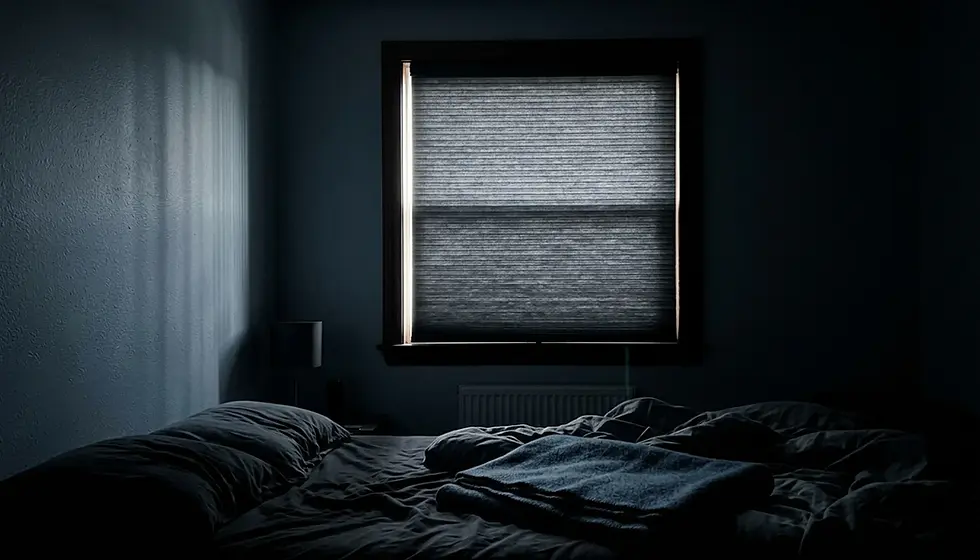
The honest caveat: even a well-reviewed blackout honeycomb shade will show a thin edge of light along the frame unless it's paired with side channels or mounted with minimal gap tolerance. That's the single biggest factor separating a shade that photographs well online from one that actually delivers total darkness in a real bedroom.

What Should You Look for in a Blackout Honeycomb Shade?
Choosing a blackout honeycomb shade means evaluating four factors together: cell structure, fabric backing, mounting hardware, and control type, since any one weak link undermines the others. First, cell structure determines both insulation and opacity, with double-cell versions outperforming single-cell on both fronts at a higher price point.
Second, fabric backing separates true blackout from light-filtering marketed as blackout. Look specifically for a foam-backed or triple-weave fabric rather than a simple dark-colored honeycomb fabric, which filters light but rarely blocks it completely. Third, mounting hardware, specifically side channels or a U-channel frame, closes the gap between the shade and the window casing that causes the edge-light problem described above.
Fourth, control type affects both usability and safety. Cordless and motorized options eliminate the loose cord hazard the Window Covering Safety Council has flagged as a concern in homes with young children, and they hold up better in vacation rental settings where guests operate the shades without instruction. For Delmarva homeowners weighing these four factors against a specific room, our guide to single versus double-cell shades breaks down the insulation and light-blocking tradeoffs in more depth.
Comparison Table: Blackout Honeycomb Shade Factors
Factor | Single-Cell Blackout | Double-Cell Blackout |
Light blocking | Strong, minor edge leak likely without channels | Strongest available, best paired with side channels |
Insulation value | Good, one air pocket layer | Better, two air pocket layers reduce heat transfer |
Frame depth needed | Shallower, fits older window casings | Deeper, may need mounting adjustment on historic homes |
Best room application | Guest rooms, home offices, north-facing bedrooms | Ocean-facing bedrooms, nurseries, shift-worker bedrooms |
Typical cost position | Lower than double-cell equivalent | Higher, justified in high-sun coastal rooms |
How Do Honeycomb Blackout Brands Perform on Energy Savings?
Honeycomb blackout shades reduce heat transfer at the window primarily through their sealed cell structure, which traps air between the glass and the room and slows conduction, a mechanism separate from and additional to their light-blocking fabric. Double-cell designs create two insulating air pockets instead of one, which is why premium double-cell blackout lines from Hunter Douglas and Norman are frequently recommended for south- and west-facing rooms that take on direct coastal sun for much of the day.
Notably, the insulation benefit compounds with the blackout benefit in coastal Delmarva homes. A bedroom facing the Atlantic in Ocean City or Bethany Beach absorbs intense solar heat gain through the glass during peak summer months, and a well-sealed double-cell blackout shade addresses both the light and the heat problem simultaneously rather than requiring two separate treatments.
Budget single-cell shades from online-only sellers still provide some insulation value, just less than a double-cell equivalent, and considerably less than a properly channel-mounted premium shade with no measurable frame gap. If energy performance is a primary driver of your purchase, ask any installer directly how their specific product line compares on cell depth and mounting tolerance, since marketing copy rarely specifies these details clearly.
What Does Long-Term Durability Look Like for Honeycomb Blackout Blinds?
Long-term durability for honeycomb blackout blinds depends heavily on fabric quality, cell fold memory, and how well the mounting hardware handles repeated opening and closing over years of daily use, not just the initial blackout rating at purchase. Cheaper honeycomb fabrics, common in budget online sellers, tend to develop permanent creases along the fold lines within two to three years of daily use, which slightly reduces both their appearance and their light-sealing performance at the folds.
Premium lines from Hunter Douglas, Norman, and Graber use fabrics engineered to resist fold memory over longer periods and typically back their cellular shades with manufacturer warranties that cover fabric and mechanism defects, a meaningful difference for vacation rental owners replacing shades across multiple units. In coastal environments specifically, humidity cycling near Rehoboth Beach and Ocean Pines can affect any fabric's fold consistency over time, which is one reason we recommend cordless and motorized mechanisms over corded pulley systems in rental properties: fewer moving parts means fewer failure points when guests operate the shades daily without care instructions.
Based on what we see across installations throughout Delmarva, the shades that fail earliest are almost never premium double-cell products installed with proper channels. They're budget single-cell shades mounted without side channels in high-humidity, high-sun rooms, where the combination of UV exposure and moisture accelerates fabric wear well before the mechanism itself fails.

How Much Do Custom Honeycomb Blackout Blinds Cost on the Delmarva Peninsula?
Custom honeycomb blackout blinds installed across the Delmarva Peninsula typically run higher than a comparable off-the-shelf single-cell shade from an online retailer, with the difference reflecting exact-fit fabrication, side-channel hardware, and professional installation rather than markup alone. Basic single-cell blackout cellular shades in standard sizes tend to sit at the lower end of the custom pricing range, while double-cell blackout shades with motorization or PowerView automation land considerably higher, especially across multiple windows in a great room or waterfront-facing wall of glass.
For homeowners comparing custom fabrication against a big-box or online purchase, the honest tradeoff is this: retail shades cost less upfront but require you to measure, order, and mount them yourself, with no adjustment if your window opening is even slightly irregular. Our detailed cost guide for custom blinds on the Delmarva Peninsula breaks down pricing by product tier and room type in more depth than we can cover here.
A free in-home consultation from Home Blinds and Floors remains the most reliable way to get an accurate number for your specific windows, since window count, motorization, and fabric tier all shift the final quote more than brand selection alone.
Why Choose Home Blinds and Floors for Blackout Honeycomb Shades?
Home Blinds and Floors is a locally-owned window treatment company serving homeowners and businesses across the Delmarva Peninsula, and our approach to blackout honeycomb shades starts with an in-home consultation rather than a catalog page. We carry premium cellular shade lines from Hunter Douglas, Norman, and Graber, which means you're choosing from fabrics and cell structures already proven in coastal Delaware and Maryland homes, not guessing based on online product photos.
What actually sets our process apart is the measurement step most retailers skip. Every consultation includes a precise, in-home measurement of your specific window opening, so the side channels and headrail fit tight against the frame instead of leaving the edge-light gap that undermines so many self-installed blackout shades. We've measured everything from oversized coastal great-room windows in Ocean Pines to narrow historic window casings in Centreville, and that range of experience shapes which cell structure and fabric we recommend for your room.
For rental property owners managing turnover across multiple units in Rehoboth Beach or Bethany Beach, we specifically steer clients toward cordless and motorized blackout honeycomb shades, since eliminating cords reduces the mechanical breakage that eats into maintenance budgets between bookings. And for tech-forward homeowners in Annapolis or Kent Island already running a smart home system, we install Hunter Douglas PowerView motorization compatible with Alexa, Google Home, and Apple HomeKit, so blackout scheduling becomes part of your existing routine rather than a manual chore. If you're deciding between fabric options for a specific room, our custom shades resource and our page on shades both walk through the material choices in more detail, and we welcome direct comparison against any online seller you're considering, since that comparison is exactly where our installation quality shows.
What Mistakes Do Homeowners Make When Buying Blackout Honeycomb Blinds?
The most common mistake homeowners make when buying blackout honeycomb blinds is assuming fabric opacity alone guarantees full darkness, when in practice mounting precision and side-channel hardware matter just as much as the fabric itself. A shade marketed as "99% blackout" can still leave a visible strip of light at the frame if it's ordered a half-inch too small or mounted without edge-sealing hardware.
A second common mistake is choosing single-cell construction for an intensely sun-exposed room to save money, then discovering the shade doesn't block enough heat or light for a coastal bedroom facing direct Atlantic sun. Third, many homeowners skip professional measurement entirely, ordering online based on a tape-measure guess, which is the single largest cause of the light-gap complaints we hear about most often.
Here's a practical checklist before you order:
Confirm whether the room needs true blackout or just light filtering, since these require different fabric backings entirely.
Choose double-cell construction for direct-sun coastal rooms and single-cell for shaded or north-facing rooms.
Ask specifically about side-channel or U-channel hardware, not just the fabric's opacity rating.
Get an in-home measurement rather than a self-measured online order, especially in homes built before 2000.
Decide on cordless or motorized control upfront if the room will be used by children, guests, or renters.
Frequently Asked Questions
What is the difference between light filtering and blackout honeycomb shades?
Light filtering honeycomb shades soften and diffuse natural light while allowing some brightness through the fabric, while blackout honeycomb shades use a foam-backed or triple-layer fabric specifically designed to block nearly all light. Light filtering works well for living rooms and home offices, while blackout is the right call for bedrooms, nurseries, and media rooms.
Do cordless honeycomb blackout blinds work well in rental properties?
Yes, cordless honeycomb blackout blinds are generally more durable in rental properties than corded versions, since guests frequently operate shades without care and cord mechanisms are the most common failure point. Motorized options add further durability by removing manual pull mechanisms entirely, which is why we recommend both cordless and motorized honeycomb blackout shades for vacation rentals across Rehoboth Beach and Ocean City.
Are motorized honeycomb blackout shades compatible with Alexa or Google Home?
Yes, motorized honeycomb blackout shades using Hunter Douglas PowerView or comparable platforms are compatible with Alexa, Google Home, and Apple HomeKit in most current installations. Compatibility depends on the specific motorization platform and hub, so it's worth confirming your existing smart home ecosystem during a consultation before ordering.
How long does professional installation of honeycomb blackout blinds take?
Professional installation of honeycomb blackout blinds typically takes a few hours for a standard room with several windows, though larger homes or multi-window great rooms take longer. The in-home measurement appointment itself usually takes about twenty to thirty minutes per room, separate from the installation visit.
Which honeycomb blackout blinds hold up best in coastal, high-humidity environments?
Premium double-cell honeycomb blackout shades with fold-resistant fabric and properly sealed side-channel mounting hold up best in coastal, high-humidity environments like those found throughout Delmarva. Budget single-cell fabrics without channel mounting tend to show fold memory and edge gaps sooner when exposed to repeated humidity cycling near the coast.
Can honeycomb blackout blinds be custom made for oddly shaped or oversized windows?
Yes, custom honeycomb blackout blinds can be fabricated for oversized, arched, or irregularly shaped windows, which is a common need in older Eastern Shore farmhouses and larger coastal great rooms. Off-the-shelf retail sizing rarely accommodates these window types, making custom fabrication and in-home measurement the more reliable route.
What brands does Home Blinds and Floors carry for honeycomb blackout shades?
Home Blinds and Floors carries premium cellular shade lines from Hunter Douglas, Norman, and Graber, ranging from affordable single-cell manual options to double-cell motorized systems with PowerView automation. All three brands offer blackout fabric options with side-channel hardware for true room-darkening performance.
The Bottom Line on Choosing the Best Honeycomb Blackout Blinds
The best honeycomb blackout blinds combine double-cell construction, a foam-backed blackout fabric, and side-channel mounting hardware installed with precise measurements, not just a well-known brand name on the headrail. Hunter Douglas, Norman, and Graber lead the professional installation tier for good reason: consistent manufacturing tolerances and warranty backing that budget online sellers rarely match, even when their marketing claims similar blackout percentages.
For Delmarva homeowners weighing this decision in 2026, the real differentiator isn't which brand you pick from a listicle. It's whether your specific window gets measured correctly and fitted with hardware that actually seals out light. That's the gap between a shade that looks good in a product photo and one that delivers a genuinely dark bedroom on a bright coastal morning. Home Blinds and Floors brings that measurement precision and brand selection together in one free in-home consultation across the Delmarva Peninsula, from Annapolis and Kent Island down to Rehoboth Beach and Ocean City.

If light leaking around the edges of your current shades is keeping you up at sunrise, a properly measured double-cell blackout shade solves that problem far more reliably than another online reorder. Schedule a free in-home consultation with Home Blinds and Floors and we'll bring fabric samples, measure your exact window opening, and recommend the cell structure and mounting hardware that will actually deliver full darkness in your room.
Content powered by inkSTR.co


Comments