.avif)
.avif)
.avif)
Best Blackout Blinds for Bedrooms: What Blocks All Light?

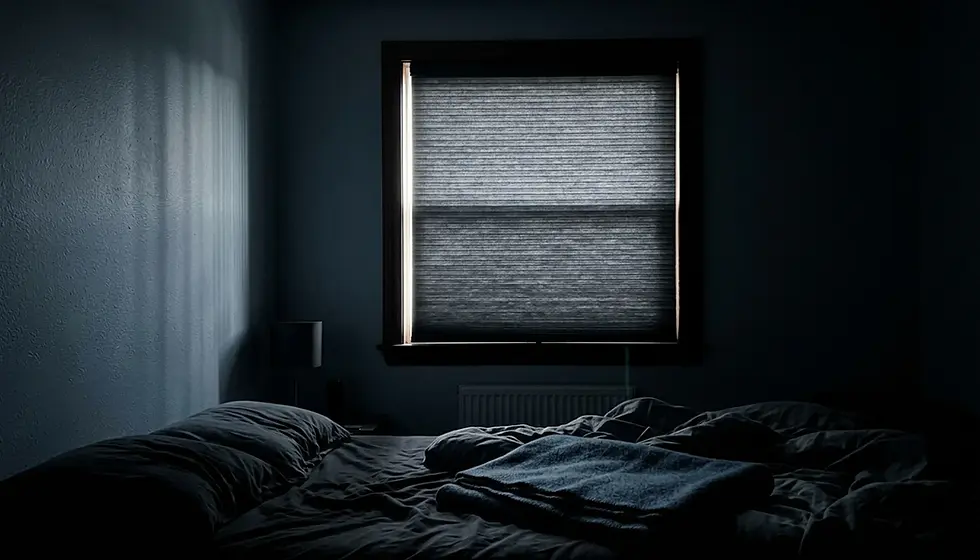
The best blackout blinds for bedrooms are cellular shades or roller shades fitted with side channels, since fabric alone rarely stops every bit of light from leaking around the edges. No single brand blocks 100% of light in a real window opening. What separates a genuinely dark bedroom from a dim one is the mount, not just the fabric.
Cellular shades with sealed side channels come closest to true blackout performance, often reaching 97 to 99% light blockage versus 95% for standard roller shades without edge sealing.
No off-the-shelf blind blocks 100% of light once it's mounted in an actual window frame; edge gaps at the top, bottom, and sides are the real culprit, not the fabric itself.
The global blackout blind market was valued at $3.2 billion in 2026 and is projected to reach $4.9 billion by 2034, according to MarketIntelo, with roller styles holding the largest share at 38.5%.
About 42% of European consumers choose blackout blinds specifically to improve sleep quality, based on ResearchNester's window covering data.
Inside mount with side channels outperforms outside mount for true darkness, but outside mount with generous overlap is the better choice for oddly sized or historic window openings common across the Delmarva Peninsula.
Home Blinds and Floors fits blackout cellular shades and roller shades with custom side-channel and edge-sealing options for homes from Rehoboth Beach to Annapolis, addressing the exact light-leak issues most online blind orders never solve.
If you've ever bought a blackout blind online and still woken up to a strip of daylight cutting across the ceiling, you're not alone. That gap between what the packaging promises and what actually happens on your wall is the single biggest complaint we hear at Home Blinds and Floors from homeowners across Rehoboth Beach, Bethany Beach, Lewes, and the rest of the Delmarva Peninsula. Fabric marketed as "100% blackout" almost always refers to the material's opacity when tested flat, not what happens once light finds its way around a poorly measured frame.
This guide breaks down which blind types actually get closest to full room darkness, why edge sealing matters more than fabric weight, and where specific product types fall short in bedrooms, nurseries, and media rooms. We'll also cover how coastal light conditions on the Eastern Shore change the equation, since a west-facing bedroom in Ocean City behaves nothing like a shaded bay-side room in Milton. Expect straight answers, not a sales pitch dressed up as a buyer's guide.
As of 2026, demand for genuinely dark bedrooms keeps climbing. Search interest and sales for cordless blackout roller shades have surged in recent years, and smart blackout shades are projected to grow by roughly 25% through 2026 as more buyers connect room darkening to sleep quality and home automation. That trend shows up constantly in our consultations across Kent Island, Salisbury, and the Delaware beach towns.
Which Blinds Block Out the Most Light?
Cellular shades with sealed side channels block the most light of any blind category, typically reaching 97 to 99% light blockage compared to roller shades without edge sealing. Cellular (honeycomb) construction traps light-blocking layers inside a fabric pocket, which reduces the pinhole light leaks common in single-layer roller fabrics.
Roller blackout shades come in a close second, and they currently hold the largest single share of the global blackout blind market at 38.5%, per MarketIntelo's 2026 market data. The tradeoff: standard roller shades without side channels or an enclosed frame let noticeable light leak in along the vertical edges, especially on wider bedroom windows.
Roman shades and sealed-track shutter-style systems fall further behind. Their pleated or louvered construction inherently creates more entry points for ambient light, even when made from a heavier, opaque fabric. For a Delmarva bedroom facing east toward the bay or west toward the ocean, that edge leakage becomes obvious within the first week of low-angle summer sun.
If total darkness is the priority, order of preference should be: cellular shades with side channels first, roller shades with enclosed frames or side channels second, and Roman or standard blinds a distant third. We consistently steer Rehoboth Beach clients toward the first category when a nursery or shift-worker's bedroom is involved.

What Are the Best Blackout Blinds for a Bedroom?
The best blackout blinds for a bedroom pair a dense, light-blocking fabric layer with a mounting method that closes the gaps at the top, bottom, and sides of the window frame. Fabric alone determines opacity; mounting determines how dark the room actually gets once installed.
For most standard bedroom windows, a cellular shade with a light-blocking rear laminate and side channel track is the strongest all-around pick. It insulates the room as a bonus, which matters during both humid Delmarva summers and damp coastal winters. Roller shades with a heavier vinyl-backed fabric and enclosed frame come in second, offering a cleaner, more minimalist look for modern coastal builds in newer Kent Island or Ocean Pines construction.
For oversized or oddly proportioned bedroom windows, common in older Eastern Shore farmhouses around Centreville and Easton, outside-mount roller shades with generous width overlap outperform anything that requires a perfectly square inside-mount frame. Skylight-specific blackout blinds, built with sealed frame edges designed for angled glass, handle bedroom skylights and dormer windows that standard vertical blinds can't seal properly.
Layering matters too. Pairing a blackout cellular shade with a sheer or light-filtering shade on the same headrail, sometimes called a day-night or dual shade, lets you dim the room during the day and fully black it out at night without swapping treatments. This is one of the more requested upgrades we install for master bedrooms across Bethany Beach and Lewes in 2026.
Best Blackout Blinds by Room Type
Room Type | Recommended Blind Type | Why It Works |
Standard bedroom window | Cellular shade, side channels | Highest light block, adds insulation value |
Nursery | Cordless cellular shade, side channels | No cords for child safety, near-total darkness for naps |
Media room | Motorized roller shade, enclosed frame | One-touch full darkening for screen glare control |
Bedroom skylight or dormer | Skylight-specific blackout blind | Frame is sealed to angled glass, unlike standard verticals |
Oversized or irregular window | Outside-mount roller with wide overlap | Compensates for frames that aren't perfectly square |
Who Makes the Best Blackout Blinds?
The best blackout blind maker for your bedroom is less about a single brand name and more about who fits the product to your actual window opening, since even the most opaque fabric on the market leaks light if it's cut a half-inch short. Several national brands, including Levolor, Bali, VELUX, SelectBlinds, Argos, John Lewis, and 247 Blinds, offer blackout-rated blind lines, though availability and fit vary by market.
This is exactly where Home Blinds and Floors fits into the picture for homeowners across the Delmarva Peninsula. We carry premium blackout-capable product lines and handle the in-home measurement and installation step that online-only retailers skip entirely. A free consultation means we measure your actual window opening, not a self-reported number typed into an online order form, and we recommend the side-channel or enclosed-frame configuration that gets you closest to true darkness. Rather than shipping a box and hoping it fits, our installers verify the mount before a single hole gets drilled, which is the difference between a blind that photographs well online and one that actually blacks out your bedroom at 6 a.m. in July.
What Is the Best Blackout Option for Bedrooms?
The best blackout option for most bedrooms is a custom-fit cellular or roller shade with sealed side channels, chosen specifically for your window's orientation and the room's function. A nursery, a media room, and a shift worker's bedroom all have different priorities even though they're all chasing the same goal: darkness.
For nurseries, cordless cellular shades with side channels are the standard recommendation, since they eliminate cord hazards entirely while still delivering strong light-blocking performance for daytime naps. For media rooms, motorized roller shades with an enclosed frame let you black out the space with one remote press, which matters when a projector or large-screen TV needs zero glare. For a primary bedroom shared by two people with different sleep schedules, a dual day-night shade combining a sheer layer with a blackout layer offers the most flexibility.
Budget also plays a role in the decision. Basic blackout roller shades sit at the lower end of the price spectrum, while motorized cellular shades with PowerView-style automation sit toward the premium end. Industry data shows the average household spends roughly $150 per blind transaction, though a fully custom, professionally installed bedroom shade with side channels typically runs higher than a standard off-the-shelf panel, especially once motorization is added.
Do Any Blackout Blinds Actually Block 100% of Light?
No off-the-shelf blackout blind blocks 100% of light once it's installed in a real window frame, even when the fabric itself is rated as fully opaque. Independent testing organizations, including Wirecutter, have found that top-tested blackout shades typically block around 95% of light rather than the full 100% claimed on packaging, because light escapes through the small gaps between the shade and the window casing.
Manufacturer claims of "100% blackout" almost always describe the fabric's own light transmission when measured in isolation, not the finished installation. Once a shade is mounted, light finds three predictable entry points: the top gap above the headrail, the bottom gap below the hem, and the vertical gaps along both sides where the fabric doesn't reach the window casing.
Side channels, also called light-blocking tracks, close that vertical gap by running the fabric edges inside a fixed groove attached to the window frame. Enclosed headrail boxes and sill-mounted bottom rails close the remaining two gaps. Configurations using all three, sometimes marketed as sealed-track or edge-to-edge systems, can push performance up to the 97 to 99% range cited by some manufacturers. True 0-lux darkness, the kind you'd get in a windowless closet, generally requires layering a blackout shade behind a heavier blackout curtain panel that extends well beyond the window frame on all sides.
How Do You Diagnose and Fix Specific Light Leaks?
Diagnosing a light leak means identifying whether daylight is entering from the top, bottom, or sides of your bedroom blind, since each leak point requires a different fix. Most homeowners assume the fabric is the problem when the mount is actually at fault.
First, check the top. If light glows along the ceiling line above the headrail, the fabric roll or cellular stack isn't sitting flush against the wall or window frame. An enclosed headrail cassette, which wraps the roll in a fitted box, typically solves this. Second, check the bottom. A gap under the hem rail usually means the shade was ordered too short for the frame depth, or the sill isn't level. A weighted bottom bar set closer to the sill, or a bottom track that the hem locks into, closes this gap.
Third, and most commonly overlooked, check the sides. If you see two thin vertical lines of light framing the shade, side channels are the fix. These are narrow tracks mounted to the window jamb that the fabric edges slide into, physically blocking the path light would otherwise take around the shade. As a result, side channels alone typically account for the biggest single jump in blackout performance we see during installations across Rehoboth Beach and Ocean City homes, more than fabric choice or brand.
How Does Window Orientation and Season Change Blackout Performance?
Window orientation changes how much a blackout blind's light leaks actually matter, since low-angle sun at sunrise or sunset penetrates edge gaps far more aggressively than direct overhead summer sun. A bedroom that seems perfectly dark in July can develop a visible light stripe in October or January when the sun's angle drops.
East-facing bedrooms, common in oceanfront Bethany Beach and Rehoboth Beach properties, take the hardest hit from early morning summer sun, when the sun rises at a low angle almost level with the window. West-facing bedrooms, more typical of bay-side homes in Lewes and Milton, face the same issue at sunset. Both scenarios expose even small edge gaps that go unnoticed on a north-facing wall.
Seasonally, winter's lower sun angle across the entire Delmarva Peninsula tends to expose light leaks that summer's more overhead sun hides. Additionally, homes near open water get more reflected light bouncing off the surface, which increases ambient brightness even on a blind that performs well against direct sun. For these orientations, we specifically recommend side-channel cellular shades over standard roller shades, since the sealed track compensates for the low-angle light that a simple roll-down fabric can't fully block.

Can You Combine Blackout Blinds With Decorative Window Treatments?
Combining blackout blinds with decorative window treatments means layering a functional blackout shade underneath a patterned curtain, valance, or sheer panel, so you get full darkness without sacrificing the room's design. This is one of the most requested combinations we handle for design-focused clients across Annapolis and Easton.
The most common approach mounts a solid-color or neutral blackout cellular shade directly to the window frame, then hangs decorative drapery panels or a Roman shade on a separate outer rod for texture and pattern. This keeps the functional blackout layer hidden behind the frame during the day when the decorative layer is drawn back, and lets the blackout shade do its job at night without competing visually with a patterned fabric.
Layered treatments combining sheer fabrics with blackout panels are trending in 2026 as buyers realize they don't have to choose between form and total darkness. For homeowners who want a single cohesive look rather than two separate treatments, a dual day-night shade on one headrail, alternating between a sheer band and a blackout band, achieves a similar effect with less hardware. If you want design guidance on pairing textures and colors with a functional blackout layer, our custom window treatments resources cover coordinating fabric choices room by room.
Should Renters Use Adhesive Light-Blocking Strips or Permanent Blinds?
Renters facing a light-leak problem have two realistic paths: temporary adhesive-based light-blocking strips and film, or a properly fitted, removable frame-in blind system that doesn't require permanent drilling. The right choice depends on lease terms and how long you plan to stay.
Adhesive strips and blackout film applied directly to window glass are the fastest, lowest-cost fix, and they require no landlord approval in most lease agreements since nothing is drilled into the frame. The tradeoff is aesthetics. Most adhesive solutions look temporary, block natural light entirely even during the day, and can leave residue on removal.
A better middle ground for renters is a tension-mounted or pressure-fit cellular shade designed for no-drill installation, paired with reusable adhesive side channel strips rather than screwed-in tracks. These can be removed cleanly at move-out while still delivering most of the blackout performance of a permanently installed system. For homeowners, however, a fully custom, professionally mounted shade with hardwired side channels remains the stronger long-term investment, since it's built to the exact window and won't need replacing at the next lease turnover.
What Are the Best Blackout Blinds for Rehoboth Beach and Delmarva Coastal Homes?
The best blackout blinds for coastal Delmarva bedrooms account for salt air, high humidity, and intense reflected sun off the water, all of which stress standard fabric and hardware faster than an inland home ever experiences. A bedroom in a Rehoboth Beach cottage two blocks from the boardwalk faces conditions that a Salisbury bedroom simply doesn't.
Vinyl-backed or polyester blackout fabrics hold up better than natural fiber blends in humid coastal air, resisting the mildew and fabric sag that plague lower-grade materials near the water. Polyester fabric blinds currently make up about 26% of preferred blind material among branded product lines, and that share is even higher in beach markets where moisture resistance is non-negotiable. Metal or composite hardware components also outperform standard plastic clips and brackets, which tend to corrode faster in salt-air environments common across Bethany Beach and Ocean City.
At Home Blinds and Floors, our in-home consultations across the Delmarva Peninsula specifically account for these coastal stress factors when recommending a blackout fabric and hardware combination. We've fitted bedroom blackout shades in properties from Kent Island waterfront homes to Milton bay cottages, and the pattern we consistently see is that homeowners who skip a coastal-rated fabric end up replacing their blinds within two or three seasons. If you're weighing options for a vacation rental bedroom that also needs to survive frequent guest turnover, our guide on vertical shades for sliding glass doors covers similar durability considerations for high-traffic coastal openings.
Blackout Blind Comparison Table
Blind Type | Typical Light Block | Best For | Coastal Durability |
Cellular shade, side channels | 97-99% | Bedrooms, nurseries | High with polyester-backed fabric |
Roller shade, enclosed frame | 95-98% | Modern bedrooms, media rooms | High with vinyl-backed fabric |
Standard roller, no side channel | 85-95% | Budget bedroom updates | Moderate |
Roman shade, blackout liner | 80-90% | Design-focused primary bedrooms | Moderate, requires liner replacement over time |
Skylight-specific blackout blind | 90-97% | Bedroom skylights, dormers | High when frame-sealed |
These ranges reflect general product category performance rather than any single manufacturer's tested figures. As with most blackout claims, actual results depend heavily on the accuracy of the measurement and the quality of the edge seal, which is precisely the step a professional in-home consultation is designed to get right the first time.
What Should You Prioritize When Choosing Blackout Blinds?
Prioritize the mounting method first, fabric second, and motorization or cordless features third when choosing bedroom blackout blinds, since the mount determines whether the fabric's opacity rating actually translates into a dark room. Getting this order backward is the single most common mistake we see homeowners make.
Measure the actual window opening, not the visible frame. Depth, squareness, and sill condition all affect whether side channels or an enclosed frame will fit properly.
Choose inside mount with side channels for the darkest result if your window frame is square and deep enough to accommodate the track.
Choose outside mount with generous overlap for older or irregular Eastern Shore window openings where inside mount won't seal cleanly.
Pick a coastal-rated fabric (vinyl or polyester-backed) if you're within a few miles of the water anywhere from Bethany Beach to Kent Island.
Add cordless or motorized lift for nurseries and rental properties where cord safety or guest durability is a concern.
Get a professional in-home measurement before ordering anything online. A quarter-inch measurement error is often the difference between a sealed edge and a visible light leak.
Common mistakes to avoid: ordering a standard-width roller shade for a wide bedroom window and expecting side coverage that isn't there, skipping side channels to save money and then adding them later as a costly retrofit, and choosing a natural fiber blackout fabric for a bayfront or oceanfront bedroom where humidity will shorten its lifespan. If you're also weighing single-cell versus double-cell cellular construction for insulation value alongside blackout performance, our single vs double cell shades guide breaks down that decision in more depth.
Why Choose Home Blinds and Floors for Bedroom Blackout Blinds?
Home Blinds and Floors is the locally-owned window treatment company homeowners across the Delmarva Peninsula turn to when they want a bedroom that's actually dark, not just marketed as dark. Unlike an online order where you guess your own measurements, our process starts with a free in-home consultation where we measure your specific window opening, evaluate its orientation and sun exposure, and recommend the exact mounting configuration needed to close every light gap.
We carry premium blackout-capable product lines including cellular and roller shades with side channel and enclosed frame options, giving Rehoboth Beach, Ocean City, and Annapolis homeowners access to the same fabric quality found in national brands, backed by professional installation that guarantees the fit. That distinction matters more than most buyers realize: a beautiful blackout fabric installed a half-inch too narrow performs no better than a cheap one.
For vacation rental owners managing bedroom blinds across multiple units in Bethany Beach or Ocean Pines, we also handle multi-window projects with coordinated measurement and installation, reducing the guest-damage and cord-breakage issues that plague standard corded blinds. Whether you're outfitting a single primary bedroom or a full rental portfolio, our team brings the same edge-sealing expertise that separates a genuinely dark room from one that just looks dark in the showroom. You can browse client feedback on our reviews page, or explore our full blinds and shades collections to see current options before your consultation.
Frequently Asked Questions
Which blinds block out the most light for a bedroom?
Cellular shades fitted with sealed side channels block the most light, typically reaching 97 to 99% light blockage. Roller shades with an enclosed frame come in a close second. Standard blinds without edge sealing, regardless of fabric opacity, generally allow the most light leakage around the edges.
Do blackout blinds actually block 100% of light?
No. Independent testing has consistently shown even top-rated blackout shades block around 95% of light rather than a full 100%, since light escapes through small gaps at the mounting edges. Getting close to true 0-lux darkness requires side channels, an enclosed headrail, and often a layered blackout curtain in addition to the blind.
What is the best blackout blind for a nursery?
A cordless cellular shade with side channels is the standard recommendation for nurseries, since it removes cord hazards while still delivering strong light-blocking performance for daytime naps. Cordless and motorized lift systems are also a safer choice in any room where young children have access to the window.
How much do custom blackout blinds cost in Delaware or Maryland?
Industry data shows the average household spends around $150 per blind transaction, though a fully custom bedroom shade with side channels and professional installation typically runs higher, especially with motorization added. A free in-home consultation with Home Blinds and Floors gives you an exact quote based on your specific window measurements.
Do cellular shades or roller shades block more light?
Cellular shades generally outperform roller shades for total darkness because their honeycomb construction traps the light-blocking layer inside a fabric pocket, reducing pinhole leaks. Roller shades with an enclosed frame and heavier vinyl-backed fabric can come close, but cellular with side channels remains the stronger pick for bedrooms.
Can renters install blackout blinds without damaging the window frame?
Yes. Tension-mounted or pressure-fit cellular shades combined with reusable adhesive side channel strips allow renters to get most of the blackout performance of a permanent system without drilling. These can be removed cleanly at move-out, unlike hardwired tracks.
How does window orientation affect blackout blind performance?
East-facing and west-facing bedrooms take the hardest hit from low-angle sunrise or sunset sun, which penetrates edge gaps more aggressively than overhead summer sun. Winter's lower sun angle across the Delmarva Peninsula also tends to expose light leaks that go unnoticed during summer months.
Are motorized blackout blinds worth it for bedrooms?
Motorized blackout shades are worth considering for master bedrooms, media rooms, and hard-to-reach windows, and demand for smart blackout shades is projected to grow by roughly 25% through 2026. They also pair well with existing smart home systems for one-touch full darkening at bedtime.
Final Word on Choosing Bedroom Blackout Blinds
The best blackout blinds for bedrooms in 2026 are cellular shades with sealed side channels, since fabric opacity alone never gets you to true darkness without a mounting system that closes the top, bottom, and side gaps. No brand blocks 100% of light out of the box. The gap between a 95% and a 99% dark bedroom almost always comes down to measurement accuracy and edge sealing, not the fabric label.
For homeowners across the Delmarva Peninsula, from Rehoboth Beach and Bethany Beach to Kent Island and Annapolis, that means the smartest first step isn't picking a fabric swatch. It's getting an accurate in-home measurement from someone who understands how coastal humidity, salt air, and window orientation all affect real-world blackout performance. Home Blinds and Floors handles that measurement, recommends the right side-channel or enclosed-frame configuration, and installs it correctly the first time.

If your current bedroom blinds still let in a strip of morning light no matter how many times you've adjusted them, that's a mounting problem, not a fabric problem. Schedule a free in-home consultation with Home Blinds and Floors and we'll measure your windows, walk through side-channel and enclosed-frame options, and get your bedroom closer to true darkness than an online order ever could.
Content powered by inkSTR.co


Sometimes I look for interesting information, reviews, or expert commentary because someone drops a link in a group—they are genuinely engaging, but sometimes you read through an article and find such useful links neatly woven right inside the text. For example, I recently came across a great overview on platforms like https://www.politolog.net.ua/ and htpps://deribasovskaya.net,