.avif)
.avif)
.avif)
How to Get Blinds Unstuck: A Step-by-Step Fix Guide

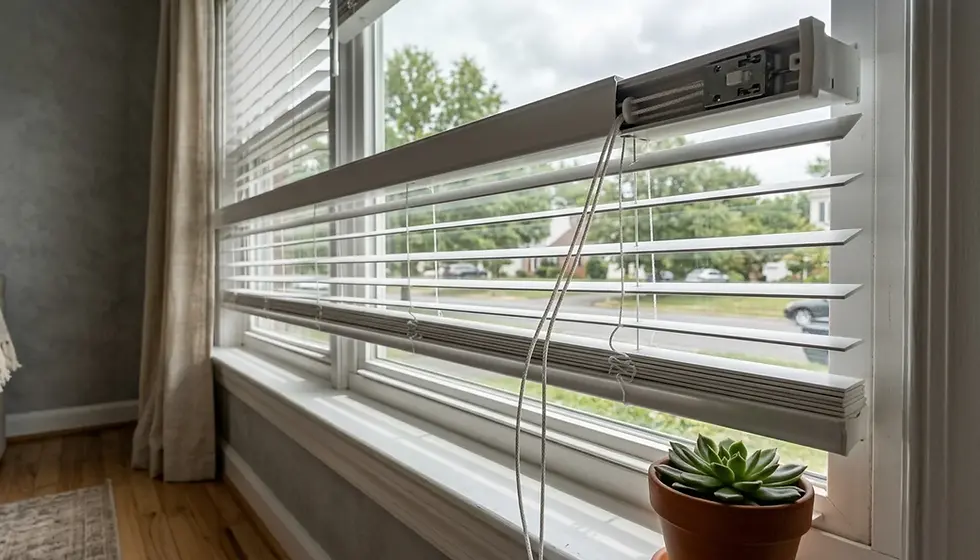
Getting blinds unstuck usually comes down to three things: clearing a physical obstruction, releasing the internal cord lock by pulling the cords straight down and then toward the center at roughly a 45-degree angle, or resetting the lift spring on a cordless unit by raising the bottom rail fully before lowering it again. Most jams release within a few minutes without tools.
Key Takeaways
Most stuck blinds are caused by a jammed cord lock, a misaligned pawl inside the headrail, or a physical obstruction along the window track, not a broken product.
The cord-release technique used by most repair guides involves pulling the lift cords straight down, then angling them toward the center at about 45 degrees until you hear a faint click.
Cordless blinds usually free up when you push the bottom rail all the way up first, then pull it down slowly and firmly to reset the internal spring mechanism.
The U.S. handyman services market reached an estimated $365.4 billion in 2026, according to IBISWorld, reflecting how common home repair needs like this have become nationally.
If a blind rejams within days of a repair, most guides recommend stopping the repair cycle and comparing replacement costs instead of repeating the fix.
Homeowners across Centreville, MD and the wider Delmarva Peninsula who deal with repeat jams often find replacement with a cordless or motorized system is cheaper long-term than ongoing repairs.
If you have ever stood on a stepstool yanking a cord that will not budge, you already know how frustrating a stuck blind can be. Stuck blinds are one of the most common window treatment complaints homeowners bring up, whether the culprit is a jammed cord lock, a tangled lift cord, or a spring mechanism inside a cordless shade that has lost its tension.
At Home Blinds and Floors, we field this question constantly from homeowners across Rehoboth Beach, Ocean City, and Centreville, MD, and the mechanism is almost always the same regardless of the brand printed on the headrail. In 2026, with more Delmarva homes running a mix of older corded blinds and newer cordless or motorized systems, knowing which fix applies to which type saves you a wasted afternoon and, often, a wasted service call.
This guide walks through the specific mechanical steps for releasing a stuck cord lock, freeing a jammed pawl, resetting a cordless spring, and knowing exactly when a repair stops making financial sense. This guide also covers the safety and headrail-access details that most repair articles skip entirely.
How Do I Fix Blinds That Won't Push Up?
Blinds that will not push up are almost always caught on a physical obstruction or jammed at the cord lock inside the headrail. To fix a blind that will not rise, first check for anything blocking the bottom rail, such as a windowsill lip, a handle, or nearby furniture, before touching the internal mechanism. If no obstruction is present, the cord lock likely needs to be released manually using the pull-and-angle technique described below.
Start with the simplest possible cause. Pull the blind all the way down as far as it will go, then look along the entire width of the bottom rail for anything catching, including a curtain rod, plant, or uneven sill. Many jams that look mechanical are actually just physical interference, and clearing the path solves the problem instantly.
If the path is clear and the blind still will not rise, the cord lock inside the headrail is likely engaged incorrectly. Pull all lift cords together, close to the headrail, keeping them evenly taut. Pull the cords straight down first, then angle them toward the center at roughly 45 degrees until you feel or hear a faint click. That click indicates the locking pawl has released.
As a result, the blind should rise smoothly once the lock disengages. Avoid yanking hard or fast. Excess force is the leading cause of snapped cords and bent pawls, according to most repair-focused resources, and a slow, deliberate pull works better than a sharp tug in almost every case.

How Do I Release Blinds That Push Up?
Releasing a blind stuck in the raised position means manually disengaging the pawl, a small spring-loaded piece inside the headrail that holds the lift cords in place. The pawl sits in a slotted track near the outer edge of the mechanism, and the pawl needs to be pushed to its lowest position to free the cords.
First, remove the blind from its mounting brackets and set the blind on a flat, stable surface. This positioning gives you room to work without the weight of the slats pulling against you. Next, remove the valance, the decorative cover strip along the top of the headrail, to expose the internal lift mechanism.
With the mechanism visible, locate the pawl. The pawl should be sitting inside its track; if the pawl has popped out of alignment, use a flathead screwdriver held perpendicular to the roller to gently press it back down into its lowest slot position. Some technicians instead turn the locking pin perpendicular to the headrail and push it inward to fully disengage the cords.
For example, if the pawl looks bent or worn rather than simply misaligned, that condition signals metal fatigue rather than a jam, and no amount of gentle nudging will fix the pawl permanently. In that case, the mechanism itself needs replacement rather than adjustment, which is where a professional consultation becomes worth the cost.
Why Won't My Blind Pull Down?
A blind that resists pulling down typically has a cord lock that is engaged too tightly, tangled lift cords, or, in cordless models, an internal spring that has lost its calibration after repeated use. Each cause has a distinct fix, and diagnosing the cause correctly saves you from forcing the wrong repair.
For corded blinds, first check whether the wand is turned to the fully open tilt position. Several troubleshooting guides note that the tilt wand needs to sit in the open position before the cord lock will release at all, and skipping this step is a common reason people think their blind is "stuck" when the blind is simply mis-set.
Additionally, inspect the cords themselves for tangling near the headrail. Lift cords that have crossed or knotted inside the mechanism create resistance that mimics a locked cord. Gently separating the cords by hand, without cutting or forcing them, often resolves this tangling on its own.
For cordless blinds specifically, the fix is different. Push the bottom rail all the way up first, hold the rail briefly, then pull the rail down slowly and firmly. This motion resets the internal spring tension that cordless lift systems rely on instead of a cord lock. If the blind still will not descend after two or three attempts, the spring itself may have lost tension permanently, which is a mechanical wear issue rather than a jam.
My Blind's Tilt Mechanism Is Stuck. What Can I Do to Fix It?
A stuck tilt mechanism usually means the tilt wand's internal gear has slipped, jammed with debris, or worn down after years of use. The tilt mechanism controls the angle of the slats independently from the lift cords, and the tilt mechanism fails differently than a cord lock does.
Start by removing the blind from the brackets and inspecting the tilt mechanism where the wand connects to the headrail. Dust, pet hair, and debris commonly build up inside this gear housing over time, especially in coastal Delmarva homes where salt air and humidity accelerate grime buildup on window hardware.
Use compressed air to clear debris from the gear teeth, then test the wand by turning it slowly in both directions. If the wand turns freely but the slats do not respond, the gear has likely stripped internally and needs replacement rather than cleaning. In contrast, if the wand feels gritty or resistant, a small amount of spray lubricant on the gear housing, applied sparingly, often restores smooth motion.
Notably, tilt mechanism failure is one of the most common reasons Delmarva homeowners end up replacing a blind entirely rather than repairing the blind, since the gear housing is rarely sold as a standalone replacement part. If your blind is more than five or six years old and the tilt gear has failed, replacement is usually the more practical route.
How Do You Fix a Stuck Cordless Blind Without Breaking the Spring?
Fixing a stuck cordless blind without damaging the internal spring means using slow, even, two-handed force rather than a quick yank on one side. Cordless systems rely on a coiled spring inside the headrail that stores tension as you raise the shade, and uneven force is the number one cause of permanent spring failure.
Specifically, grip the bottom rail with both hands, one on each side, and push the rail all the way up until it stops. Hold for a two count, then pull the rail down slowly and evenly, keeping equal pressure on both hands the entire way. Balanced force on both sides prevents the shade from binding sideways inside its track, which is a frequent cause of "stuck" cordless shades that are not actually broken.
If the shade moves on one side but not the other, stop immediately. Continuing to force an unevenly moving cordless blind is how the internal spring or the cord winding mechanism gets permanently damaged. Instead, check for kinks or visible misalignment inside the headrail before attempting the lift-and-lower motion again.
As a result of repeated misuse, some cordless blinds develop a jam that will not clear no matter how carefully you reset the mechanism. If the shade still will not move evenly after two or three careful attempts, the internal mechanism likely needs professional service rather than continued at-home troubleshooting.

How Do You Access and Fix the Headrail Without Voiding the Warranty?
Accessing a blind's headrail safely means removing the valance and mounting brackets carefully, without cutting cords, snapping plastic clips, or forcing the roller free of its end caps. Most manufacturer warranties are voided specifically by cord damage or broken clips, not by the act of opening the headrail itself. Working slowly and photographing each step protects both the warranty and the mechanism.
First, note the exact blind model and, if you can find it, the manufacturer diagram before starting. Many headrail assemblies use small plastic end caps that clip in rather than screw in, and forcing them with pliers instead of releasing the tab is the single most common cause of accidental warranty-voiding damage.
Second, work over a flat, padded surface, such as a folded towel on a table, so dropped screws or clips do not get lost and so the slats do not bend under their own weight while the headrail is exposed. Photograph each step as you go. This documentation matters more than it sounds. If you need to call in a professional afterward, photos of the internal mechanism speed up the diagnosis considerably.
For example, Hunter Douglas and similarly engineered systems often include a small reference diagram inside the headrail itself or in the original product packaging. Consulting that diagram before improvising with a screwdriver reduces the odds of bending a component that was never designed to flex.
Cord Safety Considerations During Headrail Repairs
Cord safety during headrail repairs matters most in homes with young children or pets, since loose or exposed cords inside an opened headrail can become a strangulation hazard if left accessible. As a precaution, keep children and pets out of the room entirely while the headrail is open, and never leave a partially disassembled blind unattended near a crib, playpen, or low seating area. Importantly, if your household includes small children, this hazard is also a strong argument for upgrading to cordless or motorized shades during your next window treatment update, which removes the risk permanently rather than managing around it during every future repair.
Should You Repair Stuck Blinds Yourself or Call a Professional?
Deciding between a DIY repair and professional service depends on how often the jam recurs, the age of the blind, and whether the mechanism shows physical wear versus a simple obstruction. A blind that jams once and releases cleanly with the cord-pull technique rarely needs anything more than what is described above; a blind that rejams repeatedly signals a deeper mechanical problem instead.
However, most repair-focused guides agree on one consistent signal: if a blind rejams within days of a fix, stop repeating the repair and start comparing replacement costs. Repeated jamming almost always means a worn pawl, a stripped tilt gear, or a spring that has lost its calibration permanently, none of which respond to another round of gentle nudging.
Situation | Recommended Action | Why |
Blind jams once, obstruction found and cleared | DIY fix, no further action needed | Physical obstruction, not a mechanical failure |
Cord lock click releases the blind smoothly | DIY fix using the 45-degree pull technique | Standard cord lock engagement, easily reset |
Blind rejams within days of a repair | Stop repairing, compare replacement options | Indicates worn pawl, spring, or gear rather than a jam |
Tilt gear turns freely but slats do not respond | Replace mechanism or the blind itself | Stripped internal gear, not a cleaning issue |
Blind is 6+ years old with multiple failure points | Schedule a free in-home consultation | Cost of repeated repairs often exceeds replacement |
For homeowners across Kent Island, Salisbury, and Centreville, MD, this repair-versus-replace decision point is exactly where a conversation with a local specialist pays off. At Home Blinds and Floors, we regularly walk homeowners through this same decision, and we are honest when a fix is not worth the labor compared to a fresh, properly fitted custom blind installation.
How Do You Prevent Blinds From Getting Stuck Again?
Preventing repeat jams comes down to routine cleaning, gentle operation, and periodic lubrication of the moving parts inside the headrail. Dust and debris accumulation is the most common cause of gradual mechanism stiffness, and this buildup is entirely preventable with basic upkeep.
Use a duster, a vacuum with a brush attachment, or a slightly damp cloth followed by drying to clean slats and the top mechanism every few months. Compressed air works well for clearing debris out of tracks and gear housings where a cloth cannot reach. In coastal Delmarva homes, salt air accelerates grime buildup on hardware faster than inland properties, so quarterly cleaning is worth the extra effort near Bethany Beach, Lewes, and Rehoboth Beach.
For blinds with rollers or bearings, a small amount of spray lubricant applied to those moving parts, followed by working the blind up and down several times to distribute the lubricant evenly, keeps the mechanism from stiffening over time. Avoid over-lubricating, since excess oil attracts more dust than it prevents.
Additionally, always operate blinds with even, two-handed pressure rather than yanking one side. This single habit prevents most of the sideways binding that eventually leads to a stuck mechanism. If you are managing a rental property, consider our cellular shades guide, since cordless cellular options hold up noticeably better against guest handling than traditional corded blinds.
When Does It Make Sense to Replace Instead of Repair Stuck Blinds?
Replacement makes more financial sense than repeated repair once a blind is showing multiple failure points, is more than five to seven years old, or has a mechanism that has failed more than once in the same year. At that stage, the labor and part costs of ongoing DIY fixes typically exceed the cost of a properly installed custom replacement.
Specifically, if you are dealing with a stripped tilt gear, a bent pawl, and faded or warped slats all on the same window, that combination is not a repair situation. Instead, this combination signals the entire unit has reached the end of its practical service life, and continuing to nurse the unit along costs more in frustration than it saves in dollars.
This scenario is exactly where our custom window blinds installation service comes in. At Home Blinds and Floors, our process begins with a free in-home measurement, so every slat and mechanism is matched precisely to your window rather than approximated the way big-box store products often are. We carry faux wood, real wood, and composite options suited to everything from a bay-facing home in Lewes to a sun-drenched living room in Ocean City.
For homes with recurring cordless spring failures, upgrading to a motorized system is often the better long-term answer, particularly for hard-to-reach windows or homes already using smart home ecosystems. If your current shutters are also showing stress cracks or warping alongside your blind troubles, it is worth reading our guide on custom window shutters installation for coastal-specific material options that resist the same humidity that causes cord and spring problems.
What Do Other Blind Repair Resources Get Wrong?
Most blind repair guides treat every blind type the same way, applying one troubleshooting method to horizontal blinds, vertical blinds, roller shades, and cordless systems interchangeably. This one-size-fits-all approach misses the real differences between mechanism types and often leads readers to force the wrong fix onto a blind that needs a different one.
Sites such as Hunker and Engineer Fix cover the cord-lock and pawl mechanics well, and community resources have documented the 45-degree pull technique thoroughly. In contrast, other resources, including We Fix Blinds and Behind The Blinds, focus more on maintenance and obstruction-clearing protocols. Where most of these guides fall short is in explaining how to safely open a headrail without voiding a manufacturer warranty, and in giving readers a clear cost-versus-repair framework instead of an endless list of manual troubleshooting steps.
These guides also rarely address child safety during cord manipulation, an important gap for any household with young kids or pets in the room while repairs are underway. Our approach at Home Blinds and Floors treats these safety and warranty details as equally important parts of the process, not afterthoughts, because in 2026 more Delmarva households are running a mix of legacy corded blinds and newer cordless systems in the same house, and each system deserves its own specific guidance rather than a one-size-fits-all fix.
Frequently Asked Questions
How much are Hunter Douglas blinds compared to standard custom blinds?
Hunter Douglas products sit at the premium end of the market due to their motorization options and fabric engineering, typically costing more than standard faux wood or basic vinyl blinds. Exact pricing depends heavily on window size, fabric choice, and whether you add motorization, so a free in-home consultation is the most accurate way to get a number specific to your windows.
Are Hunter Douglas blinds expensive compared to other brands?
Hunter Douglas blinds generally cost more upfront than basic hardware store options because of their engineered mechanisms, wider fabric selection, and longer product lifespan. As a result, many homeowners find the higher initial cost of Hunter Douglas blinds offset by fewer repairs and replacements over time, particularly with cordless and motorized PowerView options that reduce mechanical wear points. In contrast, budget hardware-store blinds often need replacement sooner, which can narrow or erase the upfront savings over several years of ownership.
How do I remove Hunter Douglas blinds from the brackets?
Removing Hunter Douglas blinds from their mounting brackets typically involves lifting the headrail slightly and pulling the headrail forward and down, away from the wall or window frame. Specific release mechanisms vary by product line, so checking the model-specific instructions before forcing the headrail free helps avoid snapping the bracket clips. For example, some Hunter Douglas lines use spring-loaded bracket clips that release with a gentle upward lift, while others require a small locking tab to be pressed first. Photographing the bracket assembly before removal, as recommended earlier in this guide, makes reinstalling the blind faster and more accurate afterward.
How do I clean vertical blinds without damaging the vanes?
Clean vertical blind vanes with a duster or a vacuum fitted with a brush attachment, working from top to bottom on each vane individually. For fabric vanes, a slightly damp cloth followed immediately by drying works well, while PVC vanes tolerate a bit more moisture. Avoid soaking any vane material, since trapped moisture inside the vane can warp the material over time.
How do I install vertical blinds correctly the first time?
Installing vertical blinds correctly starts with precise measurement of the window width and depth, followed by securely mounting the headrail track before attaching individual vanes to their carriers. Because vertical blind tracks rely on even weight distribution across all vanes, uneven or crooked mounting is the top reason DIY installations end up sticking or dragging. A professional measurement and installation eliminates this risk entirely.
What is the difference between a stuck cord lock and a broken pawl?
A stuck cord lock is a temporary jam that typically releases with the 45-degree pull technique described earlier in this guide, while a broken pawl is a physical component failure that no amount of pulling will fix. If gentle, repeated attempts at the cord-release method do not work after two or three tries, you are likely dealing with a worn or bent pawl rather than a simple lock engagement.
Do cordless blinds jam more or less often than corded blinds?
Cordless blinds generally jam less often than corded blinds because cordless systems have fewer external moving parts for cords to tangle or catch. However, their internal spring mechanism can lose calibration over years of use, which shows up as the shade refusing to stay in position rather than a cord getting stuck. Both mechanisms benefit from the same gentle, even-handed operation to extend their working life.
Final Thoughts on Getting Stuck Blinds Working Again
Getting stuck blinds working again usually takes just a few minutes of careful, deliberate effort: clearing an obstruction, releasing the cord lock at that 45-degree angle, or resetting a cordless spring with both hands moving evenly. Precision matters more than force here, and knowing how to get blinds unstuck without breaking a pawl or a spring saves you both money and a wasted trip to the store.
When a blind rejams repeatedly, or when the mechanism shows real wear rather than a simple snag, repair stops being the economical choice. Homeowners across Centreville, MD, Rehoboth Beach, and the rest of the Delmarva Peninsula who reach that point are usually better served by a properly measured, professionally installed replacement than another round of DIY troubleshooting. As of 2026, with more homes running a mix of aging corded blinds and newer cordless systems, this decision point comes up more often than it used to.

If you are tired of wrestling with the same jammed cord lock every season, a cordless upgrade solves the problem at the source instead of managing around the problem. Get started with Home Blinds and Floors for a free in-home consultation, and we will measure your windows, walk through material options built for Delmarva's climate, and handle the installation from start to finish.
Content powered by inkSTR.co


Comments