.avif)
.avif)
.avif)
Best Door Window Coverings: Brands and Styles We Recommend


The best door window coverings for most homes are cordless cellular shades for French and patio doors, faux wood or composite plantation shutters for entry door sidelights, and top-down-bottom-up cellular or roller shades for sliding glass doors. Home Blinds and Floors fits and installs all three across the Delmarva Peninsula, matching the covering to the door's exposure, traffic pattern, and your privacy needs rather than defaulting to whatever fits a standard size chart.
Key Takeaways
Cordless cellular shades are the safest and most energy-efficient choice for doors near high foot traffic, and they now come in top-down-bottom-up configurations that maintain privacy while still letting light in near the top of the door.
Faux wood and composite shutters outperform real wood on entry doors and sidelights exposed to direct sun, since they resist warping better in humid coastal climates like Lewes and Bethany Beach, Delaware.
Motorized shades are increasingly practical for tall or hard-to-reach sliding doors, with app and voice control through Alexa, Google Home, or Apple HomeKit now standard on mid-tier product lines.
Custom-fit door coverings from a professional installer typically run $150 to $600 per door depending on material and motorization, compared to $40 to $120 for big-box stock sizes that rarely fit French or sliding door glass precisely.
As of 2026, the most requested style for doors on the Eastern Shore is a light-filtering roller shade paired with a cordless lift, largely because it photographs well for vacation rental listings and holds up to repeated guest use.
If you have ever tried to hang a stock blind over a sliding glass door, you already know the problem: the width is almost never right, the cord dangles in a doorway where kids and pets pass through daily, and the slats catch on the door handle every time someone opens it. Doors present a different challenge than a standard window because doors move, doors get touched constantly, and door coverings need to clear hardware, thresholds, and sometimes a dog door.
At Home Blinds and Floors, we get this question constantly from homeowners in Centreville, Easton, and Kent Island, Maryland, plus the beach communities down toward Rehoboth and Bethany. Door windows, whether they are the glass panels beside a front entry, the full-length lites in a French door, or the wide expanse of a sliding patio door, need coverings built specifically for that geometry. A regular blind hung on a standard bracket will not hold up to a door that opens and closes fifteen times a day.
This guide walks through what actually works for each door type, which materials survive real-world use, and which brands and styles we recommend most often in 2026. This guide also covers accessibility considerations, weather resistance for high-sun coastal exposures, and motorized options for doors you cannot reach without a step stool.
What Is the Best Type of Covering for a Door Window?
The best covering for a door window is one that operates cordless, sits flush against the glass without interfering with the door handle or lock, and matches the light control needs of the room it faces. For most homes, the best options are cellular shades for French doors, vertical or panel-track shades for wide sliding doors, and plantation shutters for narrow entry sidelights.
Specifically, doors differ from windows in three ways: doors move, doors get touched, and doors are often floor-to-ceiling glass. A covering that works fine on a stationary window can jam or tear when mounted on an operable door. First, check clearance around the handle and hinge side. Second, decide whether the covering needs to move with the door, mounted directly on the door slab, or stay stationary on the frame around a fixed sidelight.
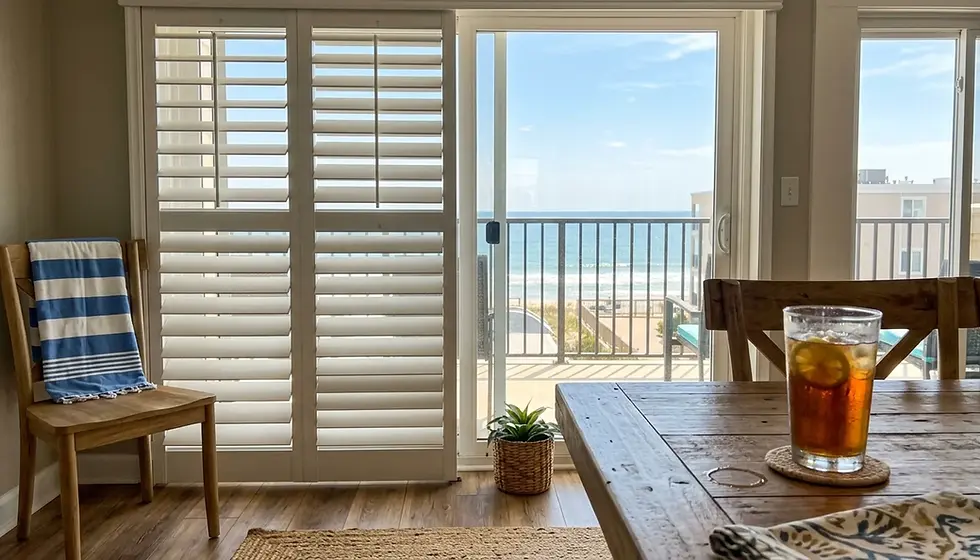
For entry door sidelights and transoms, composite or faux wood plantation shutters give homeowners adjustable privacy without a cord anywhere near a walkway. For French doors, cordless cellular shades mounted directly to the door slab with specialty door brackets are the standard recommendation. As a result, homeowners in coastal Delmarva communities increasingly ask for top-down-bottom-up cellular shades on doors, since this configuration blocks a passerby's view at eye level while still letting daylight in near the top.
What Are the Most Popular Window Coverings for Doors Right Now?
The most popular door window coverings in 2026 are cordless cellular shades, light-filtering roller shades, and composite plantation shutters, in that order of demand across the Delmarva Peninsula. Cellular shades lead because cellular shades are cordless by default, insulate against both summer heat and winter drafts, and fit the narrow depth clearance most doors require.
Specifically, cellular shades have overtaken traditional mini blinds for doors because cellular shades eliminate the tilt wand and lift cord that used to catch on door handles. Roller shades come in second, largely for sliding glass doors and larger French door openings, where a clean, flat fabric profile looks more current than horizontal slats. Composite and faux wood shutters round out the top three, particularly on entry door sidelights in colonial-style homes across Easton and Annapolis.
Additionally, vertical blinds still show up in older homes and some vacation rentals along the Delaware coast, but demand has dropped sharply as guests and homeowners alike find vertical blinds noisy and prone to snapping vanes. If you are updating a rental property, replacing vertical blinds is usually the first thing we recommend. Panel track shades have picked up the slack for wide sliders, offering the same wide coverage as verticals with a cleaner, fabric-panel look.

What Type of Blinds Look Most Expensive on a Door?
Composite plantation shutters and wood-look faux blinds with a matte finish read as the most expensive door window covering, even though these options often cost less than premium motorized fabric shades. The visual weight of a shutter louver, combined with a furniture-grade paint or stain finish, gives doors a built-in, architectural look that fabric shades cannot fully replicate.
Specifically, a 3.5-inch louver plantation shutter on a sidelight or French door reads as custom millwork rather than a hardware store add-on. That perception holds even when the material is a composite or vinyl-based product engineered for humidity resistance rather than solid hardwood. For example, homeowners near the water in Bethany Beach get the shutter look with none of the warping risk that real wood carries in a salt-air environment.
In contrast, roller and cellular shades in high-end fabrics with a matte, textured weave also look expensive, particularly in neutral tones like flax, oyster, or graphite. As a result, the "expensive" look is less about the covering category and more about finish quality and fit. For example, a cellular shade cut a quarter-inch too wide with visible gaps looks cheap no matter the fabric price point. This is exactly why measurement accuracy matters more on doors than on standard windows.
What Kind of Blinds Are in Style for Doors in 2026?
The dominant door blind style in 2026 is a low-profile, cordless cellular or roller shade in a warm neutral tone, paired with motorization on doors taller than standard 80-inch height. This trend reflects both a broader shift toward minimal hardware visibility and rising demand for smart home compatible window treatments.
Specifically, matte black hardware and slim headrails have replaced the bulky valance-and-cord look that dominated door coverings a decade ago. Additionally, two-tone cellular shades, light on one side and darker on the reverse, are gaining traction for French doors that face the street, since two-tone shades let homeowners control how much of the interior is visible from outside without sacrificing daylight.
Notably, faux wood blinds have lost ground to composite shutters and cellular shades specifically for doors, since the tilt wand mechanism remains a snag point for door hardware. For sliding glass doors, panel track systems with wide fabric panels are replacing traditional verticals almost entirely in new installations we complete across Queen Anne's County and the Delaware beach towns. If you are renovating and want a look that will not feel dated by 2030, cordless cellular or a panel track system in a solid neutral fabric is the safer long-term bet over patterned or high-gloss finishes.
Which Coverings Work Best for Each Door Type?
The right covering for a door depends on the door type: French doors need coverings mounted directly to the door slab that move with the door, sliding doors need wide-format solutions like panel track or vertical cellular shades, and entry sidelights need narrow, adjustable shutters or shades that maximize privacy in a tight space. Each door style presents distinct clearance and privacy challenges that dictate the mounting approach and material choice, as outlined below.
French Doors
French doors require door-specific mounting brackets since the covering travels with the door slab every time it opens. Cordless cellular shades with specialty French door clips are the standard here, since a corded lift would tangle immediately with normal door use. Composite shutters also work well on French doors in homes with wider stiles that can support the hinge hardware.
Sliding Glass Doors
Sliding doors need coverings that stay stationary on the frame while the door panel slides behind or in front of them. Panel track shades, vertical cellular shades, and light-filtering roller shades on a wide track are the three most common solutions. In vacation rental units along Ocean City and Rehoboth Beach, we specifically steer owners toward cordless panel track systems, since guests are far less likely to damage a wide fabric panel than a string of narrow vertical vanes.
Entry Door Sidelights and Transoms
Sidelights are narrow, tall, and usually fixed panes beside the front door. Plantation shutters with adjustable louvers give homeowners full control over privacy without blocking light entirely, which matters for entryways that also serve as the main source of natural light in a foyer. Cellular shades in a top-down-bottom-up configuration are the runner-up choice here, especially in modern-style homes.
How Do You Choose Coverings for Accessibility and Extreme Weather?
Choosing coverings for accessibility and weather resistance means matching the door to two separate needs: accessible door coverings need larger, easy-grip controls or full motorization, while weather-resistant coverings need UV-stable, moisture-tolerant materials that will not warp, fade, or seize in coastal humidity. Both factors matter more on the Delmarva Peninsula than in most inland markets and are frequently overlooked when choosing door window coverings.
For homes designed for aging in place or wheelchair access, motorized shades operated by a wall switch or remote eliminate the need to reach a cord or wand at a specific height. This is especially relevant for taller entry doors and two-story great room sliders, where a pull cord may be entirely out of reach from a wheelchair or for someone with limited mobility. Motorized cellular and roller shades from mid-tier product lines now include app-based scheduling, so a covering can open automatically each morning without anyone touching a switch.
On the weather side, homes within a mile or two of the Atlantic in Bethany Beach and Rehoboth Beach face near-constant salt air and UV exposure on south- and west-facing doors. Composite and vinyl shutters resist the swelling and cracking that real wood shutters develop after one or two humid seasons. For example, solar-rated roller shade fabrics with a tight weave block a significant share of UV transmission before it reaches interior flooring and furniture, which matters on wide sliding doors that face direct afternoon sun.

Are Smart or Motorized Door Coverings Worth It?
Motorized door window coverings are worth the added cost when the door is tall, hard to reach, or used frequently enough that a manual mechanism will wear out faster than a motorized one. Motorization removes the cord entirely, which also improves child and pet safety around doors that see constant foot traffic.
Specifically, a two-story great room slider or a French door with an 8-foot height is genuinely difficult to operate manually without a step stool, and that friction usually means the covering just gets left open or closed permanently, defeating the purpose. Motorized cellular and roller shades solve this problem with a simple remote, wall switch, or scheduled automation through an app.
Additionally, most current motorized shade lines integrate with Alexa, Google Home, or Apple HomeKit, letting homeowners group door and window coverings into a single "good morning" or "away" scene. For homeowners in Annapolis or Kent Island who already run a broader smart home setup, this integration is often the deciding factor over a manual lift. The tradeoff is upfront cost: motorized units typically run several hundred dollars more per door than a comparable manual version, though the price gap has narrowed as more manufacturers build motorization into standard product lines rather than treating it as a premium add-on.
What Do Custom Door Window Coverings Cost Compared to Stock Options?
Custom-fit door window coverings typically cost more upfront than stock big-box options, but custom coverings fit precisely, operate correctly with door hardware, and avoid the gaps and light leaks that come with an approximate stock size. Custom composite shutters for a standard sidelight generally run $250 to $550 installed, while custom cordless cellular shades for a French door pair typically fall between $300 and $700 depending on fabric and cell size.
Covering Type | Best Door Application | Typical Installed Cost Range | Coastal Durability |
Cordless cellular shades | French doors, sidelights | $150 to $450 per door | High; resists humidity swelling |
Composite plantation shutters | Entry sidelights, transoms | $250 to $550 per opening | Very high; salt-air resistant |
Panel track shades | Wide sliding glass doors | $300 to $700 per door | High; minimal moving parts |
Motorized roller shades | Tall sliders, hard-to-reach doors | $400 to $900 per door | High; sealed motor housings |
Vertical blinds | Older sliding doors | $120 to $300 per door | Low; vanes crack in humidity |
Stock options from a home improvement store cost less on the shelf, often $40 to $120 per door, but stock options rarely fit French or sliding door dimensions exactly. A gap of even half an inch on either side lets in unwanted light and defeats the privacy purpose entirely. As of 2026, Maryland's state sales tax of 6% applies to window covering purchases, and homeowners in designated historic districts around Easton or Centreville should also confirm whether Queen Anne's County permit rules or local historic guidelines affect exterior-visible shutter styles before ordering.
How Does the Home Blinds and Floors Process Work for Door Coverings?
Home Blinds and Floors handles door window coverings through a free in-home consultation, precise measurement of each door opening, and professional installation using hardware rated for the specific door type, whether that door is a French door, a sliding patio door, or an entry sidelight. This process removes the guesswork that leads to ill-fitting stock blinds catching on handles or leaving gaps at the edges.
We carry composite and faux wood shutter lines, cellular shade collections in dozens of opacities, and both manual and motorized roller and panel track systems, and we bring physical samples to your home so homeowners can see how a fabric or louver color performs in their actual light, not a showroom's. This distinction matters more on doors than on any other window type in the house, since door coverings get evaluated at close range every single day.
Homeowners across Centreville, Easton, Grasonville, and Kent Island call us specifically because stock blinds have already failed once, either warping from humidity or snapping at a lift cord that saw daily use. For coastal properties in Lewes, Milton, and Bethany Beach, we lean toward composite and vinyl shutter systems over real wood, since we have measured too many warped wood shutters in beach homes after a single humid summer. If you manage a vacation rental near Rehoboth Beach or Ocean City, cordless cellular and panel track shades hold up dramatically better against guest turnover than corded verticals, and these shades photograph better in listing photos too.
Beyond doors, we also install full-window custom blinds, shades, and shutters across every room, and many homeowners start with a single French door replacement before treating the rest of the home. If you want a deeper look at material selection for the region, our faux wood versus real wood comparison guide covers the humidity tradeoffs in more depth, and our piece on window treatments for sliding glass doors in Delmarva goes further into panel track sizing.
Other companies in the region, including regional blind and shutter installers serving Maryland's Eastern Shore, offer similar product categories, but the differentiator is the free in-home consultation and the depth of coastal-specific material guidance we bring to every appointment. We are a locally-owned company, not a franchise reading from a national script, and that independence shows in how specifically we can speak to what works in a Kent Island waterfront home versus a Centreville farmhouse.
What Common Mistakes Should You Avoid With Door Coverings?
The most common mistake homeowners make with door window coverings is buying a stock-size blind and forcing it to fit, which almost always results in visible gaps, a lift cord that catches on the handle, or slats that cannot clear the door hardware when it opens fully. Measuring incorrectly, or skipping professional measurement altogether, is the single biggest cause of a covering looking cheap.
Measure the actual door hardware clearance, not just the glass opening. Handles, deadbolts, and hinges all affect where a covering can mount.
Choose cordless options for any door with regular foot traffic. Cords near a doorway are a snag and safety hazard, and they wear out faster from repeated contact.
Avoid real wood shutters within a mile or two of saltwater unless you are prepared to refinish or replace them within a few seasons. Composite materials cost roughly the same and last significantly longer.
Do not assume inside mount always looks best. On doors with narrow stiles or shallow frame depth, an outside mount often provides better coverage and easier operation.
Skip patterned fabrics on doors facing direct west or south sun without confirming UV-fade resistance first, since door coverings get more direct light exposure than most interior windows.

Frequently Asked Questions
What blinds are best for curved windows near a door?
Curved or arched windows near an entry door typically need a custom shutter or specialty shade cut to match the arch profile, since standard rectangular blinds cannot follow a curved header. Composite shutters with a fixed arch panel above an operable lower section are the most common solution, and these shutters should always be custom-measured rather than trimmed from a stock size.
Which blinds are best for insulation on doors?
Cellular shades, particularly double-cell honeycomb styles, provide the best insulation for door windows because the pocketed cell construction traps air against the glass. This insulating benefit matters most on French and sliding doors, which typically have less insulating glass area coverage than standard windows and lose more heat in winter and gain more in summer. For homes on the Delmarva Peninsula facing both cold winter drafts and strong summer sun through wide glass doors, double-cell cellular shades address both problems with a single product rather than requiring separate seasonal solutions.
What are the best insulating blinds for a home with high energy bills?
Double-cell cellular shades are generally considered the best insulating option among common blind and shade categories, outperforming single-cell shades, roller shades, and traditional blinds in reducing heat transfer at the glass. Installing double-cell shades on doors alongside full-window coverage tends to produce a more noticeable difference than treating windows alone, since door glass is often larger and less efficiently sealed than standard window glass.
How do you clean vertical window blinds on a sliding door?
Vertical blinds on a sliding door should be dusted regularly with a microfiber duster or vacuum attachment, then spot-cleaned with a mild soap and water solution on a soft cloth for fabric or vinyl vanes. Avoid soaking fabric vanes fully, since repeated moisture exposure is what causes the vanes to warp or discolor over time, particularly in humid coastal climates like those along the Delaware coast.
How do you clean blinds on a window without removing them?
Most blinds and shades can be cleaned in place without removing them from their brackets. Use a vacuum with a brush attachment set to low suction, working from top to bottom with slats or vanes closed, to lift dust without scattering it across the room. For cellular shades specifically, a handheld hair dryer on the cool, no-heat setting can dislodge dust trapped deep in the pleats, since the honeycomb pockets are difficult to reach with a vacuum brush alone. This method works for both door-mounted and window-mounted shades and avoids the risk of misaligning door-specific brackets during removal and reinstallation.
Do window shades add home value?
Well-fitted, professionally installed window and door shades can support home value by improving curb appeal and signaling that a home has been well maintained, though shades are rarely a standalone driver of resale price. In markets like Centreville, where the median home value has climbed notably in recent years, buyers increasingly notice dated or ill-fitting blinds as a sign of deferred updates, which can work against a listing during showings.
What is the difference between plantation shutters and traditional blinds for doors?
Plantation shutters are a fixed, framed system with wide adjustable louvers mounted permanently to the door or window frame, while traditional blinds are a lighter, retractable system of slats on a headrail. Shutters generally offer more durability and a more finished architectural look on entry sidelights, while blinds and shades are typically more budget-friendly and easier to replace on doors that see heavy daily use.
Can door window coverings be custom ordered for oversized or oddly shaped doors?
Yes, custom cellular shades, roller shades, and composite shutters can all be fabricated to fit oversized sliding doors, tall French doors, and non-standard sidelight shapes that stock products cannot accommodate. A professional in-home measurement is the only reliable way to confirm exact specifications before ordering for an unusual door opening.
Final Recommendation on Door Window Coverings
Cordless cellular shades, composite plantation shutters, and panel track systems remain the best door window coverings heading into 2026, largely because these three options solve the two problems stock blinds cannot: precise fit and safe, cord-free operation on a surface that moves and gets touched daily. Coastal humidity and salt air make material choice even more important on the Delmarva Peninsula than in most inland markets, which is why composite and vinyl materials are recommended over real wood for properties near the water.
If your current door coverings are warping, snagging on hardware, or simply do not fit right, a professional measurement and consultation solves that problem permanently rather than temporarily. Home Blinds and Floors serves homeowners and businesses from Annapolis and Kent Island down through Easton, Centreville, and Salisbury, all the way to Rehoboth Beach, Bethany Beach, and Ocean City, with free in-home consultations, custom fabrication, and full installation for window blinds, shutters, and shades. Whether you need one sidelight fixed or every sliding door in a rental property upgraded, the process starts with a single visit and an accurate measurement.

If your entry door sidelights are already showing stress cracks or fading, composite shutters built for coastal exposure are worth a serious look before another humid season sets in. Get started with Home Blinds and Floors for a free in-home consultation and see exactly which door coverings will hold up in your specific light and climate conditions.
Content powered by inkSTR.co


Comments