.avif)
.avif)
.avif)
Different Style Shutters: Your Complete Guide for 2026


Window shutters fall into two broad families: interior shutters, which mount inside the window frame and adjust to control light and privacy, and exterior shutters, which frame the outside of the window for architectural character and weather protection. In 2026, homeowners across the Delmarva Peninsula are choosing from a wider range of different style shutters than ever before, from classic plantation louvers to coastal Bahama designs that handle salt air and storm season alike.
TL;DR: Key Takeaways
Window shutters divide into two categories: interior shutters (plantation, café, tier-on-tier, full-height, bi-fold, solid panel) and exterior shutters (louvered, panel, board and batten, Bahama).
Plantation shutters feature wide louvers ranging from 2.5 to 4.5 inches and are the most popular interior style in coastal and contemporary homes as of 2026.
Bahama shutters are the top choice for coastal Delmarva properties because their top-hinged, angled design deflects wind-driven rain while still admitting sea breezes.
Material choice matters as much as style: composite shutters outperform real wood in high-humidity, salt-air environments, while vinyl offers the most budget-friendly entry point.
Installed costs vary significantly by style and material: vinyl shutters typically run lower than composite or hardwood options, and professional measurement ensures a perfect fit that off-the-shelf products cannot match.
Home Blinds and Floors offers personalized in-home consultations across the Delmarva Peninsula, helping homeowners match the right shutter style to their architecture, climate, and budget.
Choosing among the different style shutters available today can feel like a maze, especially when your home sits a few blocks from the Atlantic or the Chesapeake Bay. Salt air, high humidity, and intense summer sun all narrow the field quickly. This guide walks through every major interior and exterior shutter style, compares materials honestly, and connects each option to the room conditions and architectural profiles where it actually performs best, whether you're on Kent Island, MD, in Lewes, DE, or anywhere across the Eastern Shore.
The team at Home Blinds and Floors has worked through these decisions with hundreds of Delmarva homeowners. The guidance here reflects what actually works in coastal conditions, not just what looks good in a product catalogue. By the end, you'll know exactly which style fits your windows, your home's exterior character, and your long-term maintenance tolerance.

What Are the Different Styles of Shutters?
Window shutters refer to solid or louvered panels mounted at a window, either inside the frame or on the exterior facade, that control light, airflow, and privacy. The different style shutters available today break into six primary interior types and four primary exterior types, each suited to specific architectural settings, climates, and room functions.
Interior shutter styles include plantation shutters, café shutters, tier-on-tier shutters, full-height shutters, bi-fold shutters, and solid panel shutters. Exterior shutter styles include louvered shutters, panel shutters (raised, flat, or recessed), board and batten shutters, and Bahama shutters. A separate category, hurricane shutters, serves a protective rather than decorative function and is discussed later in this guide.
The distinction between decorative and functional matters most when you're budgeting. Decorative exterior shutters add curb appeal but don't necessarily close over the window. Functional shutters, both interior and exterior, actually operate and interact with light, air, and weather. On the Delmarva Peninsula, where Nor'easters and tropical systems roll through regularly, understanding that difference before you buy can save you thousands.
Interior Shutter Styles at a Glance
Plantation shutters are the reigning favorite across the Eastern Shore, and for good reason. Their wide louvers, typically 2.5 to 4.5 inches, let you dial in light precisely without sacrificing the view. Café shutters cover only the lower sash, leaving the upper glass clear. Tier-on-tier designs split the panel into two independently adjustable sections, ideal for bay windows. Full-height shutters run the entire window height as one panel. Bi-fold styles fold back along a track, making them practical for wide patio doors. Solid panel shutters block light completely when closed, functioning more like an interior blind than a louvered treatment.
Exterior Shutter Styles at a Glance
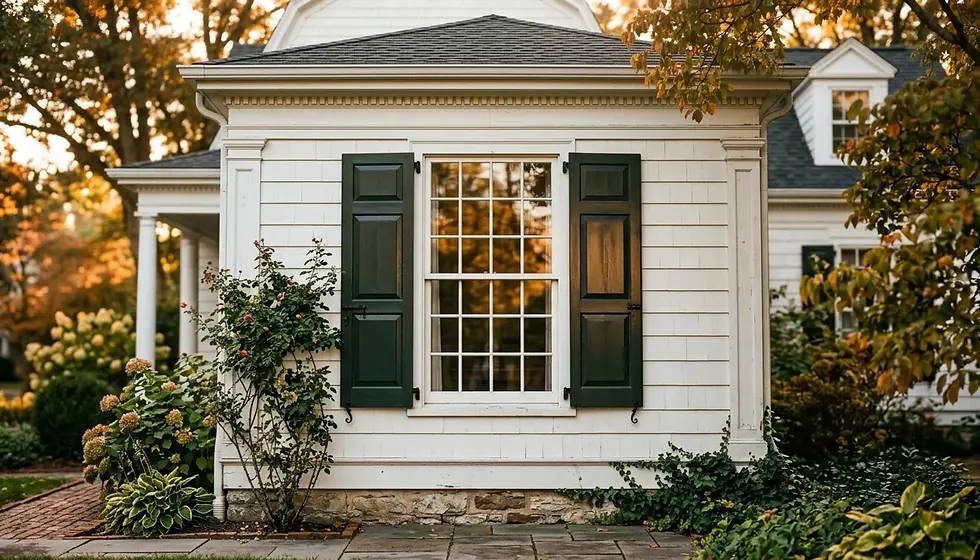
Louvered exterior shutters carry angled slats that can be fixed or operable. Fixed-louver versions are primarily decorative; operable versions allow airflow adjustment from inside. Panel shutters come in raised, flat, and recessed configurations. Raised panel shutters with their three-dimensional profiles complement colonial and traditional architecture found throughout Annapolis, MD, and the historic districts of Easton, MD. Board and batten shutters use vertical boards joined by horizontal or diagonal crosspieces and read as farmhouse or cottage. Bahama shutters are top-hinged and prop open at an angle, a design purpose-built for coastal climates.
What Are the Different Types of Window Shutters?
Window shutter types refer to the specific design configurations that determine how a shutter operates, how it looks on the window, and where it performs best architecturally. Each type has a distinct set of structural characteristics that make it more or less suitable depending on room function, window size, and home style.
Plantation Shutters
Plantation shutters are interior shutters defined by wide, horizontal louvers mounted in a solid frame that fits inside the window casing. Louver widths range from 2.5 to 4.5 inches, with wider slats creating a more contemporary feel and narrower slats reading as more traditional. A tilt bar or rod connects the louvers so they all adjust in unison. Plantation shutters work in virtually every room and are the single most requested style at Home Blinds and Floors consultations across the Delmarva area.
Café Shutters
Café shutters are interior shutters that cover only the lower portion of a window, leaving the upper half open to admit natural light while blocking street-level sightlines. This style originated in French bistros and remains popular in kitchens, dining areas, and ground-floor rooms where privacy and light coexist as competing priorities. In beach cottages in Bethany Beach, DE, café shutters let ocean breezes through the top while keeping passersby from seeing inside.
Tier-on-Tier Shutters
Tier-on-tier shutters, sometimes called double-hung shutters, feature two independently operable panels stacked on a single window. The upper panel and lower panel each have their own hinges and louver controls. This configuration offers maximum flexibility: open the top for light, close the bottom for privacy, or reverse the arrangement entirely. They're particularly effective on tall windows common in Victorian-era homes throughout Cambridge, MD.
Full-Height Shutters
Full-height shutters cover the entire window opening from top to bottom in a single panel unit, with no rail dividing the shutter into separate sections. This gives a clean, unbroken look that suits modern and transitional interiors. Larger windows typically require a center rail for structural stability, but the visual effect remains seamless. Full-height shutters are a strong choice for master bedrooms and living rooms where clean lines matter.
Bi-Fold Shutters
Bi-fold shutters are designed for wide openings. The panels fold back against the wall along a top and bottom track, clearing the entire opening when stacked. This makes them the practical solution for sliding glass doors, wide picture windows, and room dividers. If you're looking for guidance on treatments for large openings, the sliding door treatments resource covers how bi-fold shutters compare to other panel systems for oversized glass.
Solid Panel Shutters
Solid panel shutters contain no louvers. When closed, they block light entirely. This makes them appropriate for media rooms, bedrooms where total blackout is preferred, or as purely decorative exterior elements. Interior solid panel shutters often appear in historic homes where the original design called for opaque closure rather than light filtering. They're the least common style in residential installations today but remain relevant in heritage renovations.
Board and Batten Shutters
Board and batten shutters are exterior shutters constructed from vertical planks joined by horizontal or diagonal cross-members called battens. The diagonal batten pattern, sometimes called a Z-brace, is particularly associated with farmhouse and rustic cottage architecture. In the rural stretches of the Delmarva Peninsula between Salisbury, MD, and Millington, board and batten shutters complement the agricultural vernacular architecture that defines the interior of the Eastern Shore.
Bahama Shutters
Bahama shutters, also called Bermuda shutters, are exterior shutters hinged at the top of the window frame and propped open at an angle using support arms. The angled position shades the window from overhead sun while still allowing air circulation, a design that evolved in Caribbean and Gulf Coast architecture. For homeowners in Ocean City, MD, Rehoboth Beach, DE, and the barrier island communities along the Delmarva coast, Bahama shutters are functionally superior to most other exterior styles because they handle both intense summer sun and the lateral wind-driven rain that comes with coastal storms.

Are Shutters Out of Style in 2026?
Shutters are not out of style in 2026. Industry market research tracked by sources including Cognitive Market Research and Grand View Research consistently shows the North American shutters market growing through 2026 and beyond, driven by demand for both functional interior plantation shutters and decorative exterior panel styles. The design trend in 2026 leans toward cleaner louver profiles, muted paint palettes, and composite materials that require less maintenance than painted wood.
What has changed is the way homeowners use shutters. The decorative-only exterior shutter, sized incorrectly for its window and mounted purely for visual effect, is increasingly viewed as dated. Architects and interior designers in 2026 favor shutters that could functionally close over their windows, a proportion called "shutter to window" sizing that signals authenticity and craftsmanship. When shutters look like they belong to the house rather than applied as an afterthought, they read as timeless rather than trendy.
Interior plantation shutters specifically show no sign of declining. Their combination of light control, privacy, insulation, and longevity makes them a practical investment rather than a fashion statement. Homeowners who install quality plantation shutters in Grasonville, MD, or Milton, DE, can reasonably expect them to outlast multiple cycles of other window treatments. That durability argument becomes even stronger when you account for the coastal climate, which degrades fabric shades and painted wood blinds faster than the national average.
The styles gaining ground in 2026 include café shutters in kitchen and dining applications, tier-on-tier configurations on statement windows, and Bahama shutters as a functional coastal design element rather than a purely decorative one. Styles that feel tired are undersized decorative exterior shutters in builder-grade vinyl that don't match the window proportions. The shutter itself isn't out of style. The careless application of it is.
What Type of Shutters Are the Best?
The best type of shutter depends on three variables: the room's primary function, the home's architectural style, and the local climate. There is no universally superior shutter style, but there are clear category leaders for specific situations. For interior use on the Delmarva Peninsula, plantation shutters with composite or moisture-resistant frames perform best overall. For exterior use in coastal zones, Bahama shutters or properly proportioned louvered shutters in aluminum or composite outperform painted wood in longevity.
Best for Light Control: Plantation Shutters
Plantation shutters give you the most precise light control of any shutter style because the louver angle adjusts through a full range of positions. You can admit diffused light without direct glare, block morning sun entirely, or open the panels fully for an unobstructed view. No other shutter style matches this range of adjustment.
Best for Coastal Climates: Bahama Shutters (Exterior) and Composite Plantation (Interior)
Bahama shutters handle the coastal environment better than any other exterior style. Their top-hinged design keeps the mounting hardware protected from standing water, and their angled position prevents wind-driven rain from entering around the frame. For interior shutters in coastal homes in Ocean Pines, MD, or Lewes, DE, composite frames outperform real wood because they do not warp, swell, or delaminate in the humidity swings common between July and October on the Eastern Shore.
Best for Privacy: Café or Tier-on-Tier Shutters
Café shutters and tier-on-tier configurations allow you to manage privacy at different heights of the window independently. In a ground-floor kitchen in Centreville, MD, for example, a café shutter keeps the lower half blocked while the upper sash remains open. Tier-on-tier shutters do the same job on a full-length window, with the added ability to reverse the privacy-versus-light arrangement depending on the time of day.
Best for Historic and Traditional Architecture: Raised Panel or Louvered Exterior Shutters
Raised panel exterior shutters complement the colonial and Federal-style architecture found throughout Annapolis, MD, and the older neighborhoods of Easton, MD. The three-dimensional profile of a raised panel shutter echoes the door and millwork detailing common in these homes. Louvered exterior shutters suit slightly less formal traditional architecture, including the Cape Cod and colonial revival homes scattered across Kent Island, MD, and Grasonville, MD.
Best for Modern and Transitional Interiors: Full-Height Shutters
Full-height shutters with wide louvers, 3.5 to 4.5 inches, read as contemporary rather than traditional. When painted in a tone that matches the wall color rather than contrasting sharply, they integrate into the room rather than dominating it. This approach works particularly well in the newer construction communities around Middletown, DE, and the build-to-rent developments near Millsboro, DE.
How Do Different Shutter Materials Compare?
Shutter materials refer to the substrate from which shutter frames and louvers are manufactured: real hardwood, MDF-core composite, vinyl (PVC), or aluminum for exterior applications. Material choice directly affects durability, maintenance requirements, cost, and how the finished shutter responds to moisture and temperature swings.
Material | Best For | Moisture Resistance | Typical Lifespan | Maintenance Level |
Real Hardwood | Dry interiors, heritage homes | Low | 15-20 years (dry climates) | High (regular painting/sealing) |
Composite (MDF/PVC core) | Coastal and humid interiors | High | 20+ years | Low (wipe clean) |
Vinyl (PVC) | Bathrooms, budget-conscious buyers | Very High | 15-20 years | Very Low |
Aluminum (exterior) | Coastal storm-prone zones | Very High | 20-30 years | Low (powder-coat finish) |
Cedar (exterior wood) | Traditional architecture, low-humidity areas | Moderate | 10-15 years (painted) | High (repainting every 3-5 years) |
For most Delmarva Peninsula homes, composite is the pragmatic choice for interior shutters. It replicates the appearance of painted hardwood closely enough that the visual difference is negligible once installed, but it won't develop the warping or joint separation that real wood experiences when a beach house stays closed through a humid August. Vinyl costs less upfront but can feel lighter and less substantial than composite, particularly noticeable on wide louver configurations.
Real hardwood still makes sense for heritage homes in the historic districts of Cambridge or Annapolis where authenticity matters and the interior climate is controlled year-round. If you're retrofitting a 19th-century property and the existing woodwork is all real wood, matching material and finish is worth the premium. For every other situation on the Eastern Shore, composite outperforms wood without the maintenance burden.
Which Shutter Style Works Best Room by Room?
Matching shutter style to room function is one of the most practical decisions in the entire selection process. The light control, privacy, and moisture resistance requirements of a kitchen differ completely from those of a bathroom or a living room facing west into afternoon sun. Choosing a shutter style based on aesthetics alone, without accounting for how the room is actually used, is the single most common mistake seen during in-home consultations.
Kitchen and Dining Room
Café shutters are the strongest choice for kitchen windows above countertops. They keep the upper sash clear for light and airflow while blocking the lower portion where privacy from street level matters. Plantation shutters work in dining rooms, especially when the window sits above head height and there's no privacy concern. Avoid solid panel shutters in cooking spaces: the airflow from operable louvers helps manage cooking odors and steam.
Bedroom
Full-height plantation shutters with a center rail are the workhorse option for bedrooms. The center rail divides the panel at roughly window-midpoint, allowing the lower half to stay closed for privacy while the upper half opens for morning light. For primary bedrooms where complete darkness aids sleep, pairing plantation shutters with a cellular shade behind the shutter adds a blackout layer without changing the room's aesthetic.
The modern bedroom shown in the photo below, with white plantation shutters alongside a contemporary tufted headboard, illustrates how shutters integrate with current interior design rather than fighting it.

Bathroom
Vinyl plantation shutters are purpose-built for bathrooms. The fully waterproof PVC construction handles steam and splashing without swelling or discoloring. Tier-on-tier vinyl shutters work particularly well on bathroom windows because you can open the upper tier for ventilation while keeping the lower section closed. This is a detail worth specifying at consultation rather than discovering after installation.
Living Room
The living room tolerates the widest range of shutter styles. Full-height plantation shutters in composite or hardwood anchor a traditional or transitional space. Bi-fold configurations open completely on wide picture windows or sliding glass doors, which is covered in more depth in the guide to window treatments for sliding glass doors in Delmarva. In rooms with bay windows, tier-on-tier shutters handle the angular geometry more gracefully than any flat panel treatment.

What Do Different Style Shutters Cost, and What Affects the Price?
Shutter pricing refers to the installed cost per window or per panel, which varies significantly based on shutter style, material, window dimensions, and local labor rates. As a general market reference in 2026, vinyl shutters represent the most affordable installed option, composite shutters sit in the mid-range, and real hardwood plantation shutters command the highest price. Exterior custom styles like Bahama and board and batten fall in a wide range depending on size and material.
Shutter Style | Typical Installed Range (per window) | Material | Best Climate Fit |
Vinyl Plantation Shutters | $150: $350 | PVC | Bathrooms, humid zones |
Composite Plantation Shutters | $250: $550 | MDF/PVC core | Coastal, high-humidity interiors |
Hardwood Plantation Shutters | $350: $700+ | Real wood | Dry, climate-controlled interiors |
Café Shutters (composite) | $150: $350 | Composite or vinyl | Kitchens, dining rooms |
Tier-on-Tier Shutters | $350: $650 | Composite or wood | Living rooms, bay windows |
Exterior Bahama Shutters | $200: $600 per pair | Aluminum or composite | Coastal exterior |
Board and Batten Shutters | $100: $350 per pair | Cedar or PVC | Farmhouse, cottage exteriors |
These ranges reflect professional installation. The cost of DIY alternatives, typically off-the-shelf products sized to standard window dimensions, may appear lower upfront but often creates problems: gaps at the frame edge, sagging louvers from undersized frames, and louver rods that don't align with the window's center rail. Over a 10-to-15-year ownership period, a correctly measured and installed custom shutter typically costs less per year than replacing a poor-fit product twice.
Window shape adds cost in any category. Arched windows require shaped frames cut to the arch profile, covered in more depth in the arched window treatments resource. Specialty shapes add to fabrication time and material waste, so budgeting conservatively for non-rectangular windows is good planning practice.
How Do You Choose the Right Shutter Style for Your Home?
Choosing the right shutter style involves matching five factors simultaneously: your home's architectural character, the room's functional requirements, the local climate conditions, your maintenance tolerance, and your budget. Working through these in order prevents the most common mistakes, specifically selecting a style purely on appearance without accounting for how it will perform over years of use.
A Practical Checklist for Shutter Selection
Identify your home's exterior style. Colonial and Federal architecture suits raised panel or louvered exterior shutters. Farmhouse and cottage architecture suits board and batten. Coastal and tropical vernacular suits Bahama shutters. Contemporary architecture suits clean-louver plantation shutters inside and minimal louvered or flat panel styles outside.
Assess each room's function. High moisture (bathrooms, laundry rooms): vinyl material only. Light-critical rooms (living rooms, home offices): plantation louvers for adjustability. Privacy-critical rooms (ground-floor bedrooms, street-facing kitchens): café or tier-on-tier configurations.
Check your climate exposure. If you are within half a mile of tidal water anywhere on the Delmarva Peninsula, salt-air exposure is real and degrades real wood faster than most product warranties acknowledge. Composite or vinyl interior, aluminum or composite exterior.
Decide on material based on maintenance tolerance. If you want zero seasonal maintenance, vinyl or powder-coated aluminum. If you're prepared for repainting every three to five years, cedar exterior shutters are an option. If you want the look of painted wood with low upkeep, composite interior is the answer.
Size exterior shutters to the window. An exterior shutter that could functionally close over its window should be as wide as half the window opening. A shutter that is visually too narrow for its window reads as an architectural error, not a design choice.
Get an in-home measurement before committing. Window frames in older homes are rarely perfectly square, and standard sizes rarely account for interior casing depth. Professional measurement before ordering prevents the two most common installation problems: frames that don't fit the opening and louvers that don't clear the casing when open.
Home Blinds and Floors offers free in-home consultations across the Delmarva Peninsula, including Rehoboth Beach, Salisbury, Easton, and Annapolis. During a consultation, a specialist measures every window precisely, assesses the room conditions, and walks through material and style options with physical samples rather than online swatches. That process routinely surfaces requirements that an online order process misses entirely.
For a deeper look at how custom treatments are specified and ordered, the custom shutters resource covers the consultation-to-installation workflow in detail.
Frequently Asked Questions About Different Style Shutters
What is the difference between plantation shutters and regular shutters?
Plantation shutters are a specific type of interior shutter defined by wide, adjustable louvers ranging from 2.5 to 4.5 inches. "Regular shutters" typically refers to older interior shutters with narrow louvers (under 1.5 inches) or solid panels. Plantation shutters became popular in the American South and coastal regions because wide louvers allow more airflow while still controlling light, making them particularly practical in warm, humid climates like the Delmarva Peninsula.
Are Bahama shutters a good choice for coastal homes in Delaware and Maryland?
Yes. Bahama shutters are specifically designed for coastal and tropical climates. Their top-hinged design keeps hardware above standing water, and their angled position deflects wind-driven rain away from the window frame. For properties in Ocean City, MD, Rehoboth Beach, DE, or anywhere along the barrier island communities of the Eastern Shore, Bahama shutters outperform flat panel and louvered exterior styles in storm and salt-air resistance. Aluminum Bahama shutters require the least maintenance in these environments.
What material should I choose for shutters in a high-humidity or salt-air environment?
For interior shutters in coastal or high-humidity settings, composite is the best-performing material. It replicates the appearance of painted hardwood but will not warp, swell, or delaminate when exposed to the humidity swings typical of Eastern Shore summers. Vinyl is the correct choice for bathrooms specifically, given direct water contact. For exterior applications near tidal water, powder-coated aluminum or high-grade composite are the most durable options. Real wood, including cedar, requires repainting every three to five years and is not recommended for properties within half a mile of tidal water.
How long does professional shutter installation typically take?
A typical residential shutter installation covering five to eight windows takes one to two days. The measurement consultation and product fabrication period runs two to four weeks before installation day, depending on the style and material ordered. Custom configurations like tier-on-tier shutters on bay windows or arched frames may require additional fabrication time. An in-home consultation with Home Blinds and Floors provides a project-specific timeline based on your window count and style selection.
Are shutters more energy efficient than blinds or shades?
Interior plantation shutters provide measurable insulation because their solid frame and adjustable louvers create a barrier between the window glass and the room's interior air. When the louvers are closed, the air pocket between the shutter and the glass reduces heat transfer in both directions, helping in summer and winter. However, cellular shades specifically engineered with honeycomb air pockets typically outperform plantation shutters on raw insulation metrics. The right answer depends on whether you prioritize insulation or the operational flexibility of adjustable louvers. A comparison of these options is covered in the single vs double cell shades guide for Delmarva homeowners.
What is the best shutter style for a farmhouse or cottage-style home?
Board and batten exterior shutters are the strongest architectural match for farmhouse and cottage-style homes. The Z-brace or diagonal batten pattern echoes the barn door and agricultural building traditions that define the rural character of the Delmarva interior. Inside the same home, full-height plantation shutters in a wide-louver configuration complement the clean lines of modern farmhouse interior design without introducing a competing period style.
How do I know if my windows need custom shutters or if standard sizes will work?
Standard shutter sizes work on windows that are perfectly square, built to standard residential dimensions, and have a casing depth that accommodates the shutter frame. In practice, older homes on the Delmarva Peninsula frequently have windows that are slightly out of square, non-standard in width, or have trim profiles that interfere with standard frames. The only reliable way to determine this is professional measurement. An in-home consultation with Home Blinds and Floors takes precise measurements of every window and identifies fit issues before any product is ordered, avoiding the cost of returns and reorders.
What are the most popular shutter styles chosen by Delmarva homeowners in 2026?
Based on what Home Blinds and Floors sees across consultations throughout the Eastern Shore, composite plantation shutters with 3.5-inch louvers remain the most requested interior style in 2026. For exterior applications, Bahama shutters in coastal communities and raised panel shutters in the historic towns of Annapolis, Easton, and Cambridge represent the two strongest demand categories. Café shutters are gaining ground in kitchen applications as homeowners seek the combination of lower-half privacy with upper-half light.
The Right Shutter Style Makes a Lasting Difference
The different style shutters available in 2026 cover every architectural character, room function, and climate condition you'll encounter across the Delmarva Peninsula. Interior shutters, from plantation to café to tier-on-tier, solve the specific light and privacy challenges of individual rooms. Exterior shutters, from Bahama to board and batten to raised panel, anchor a home's curb appeal while serving real functional purposes in coastal storm seasons.
Material choice is not secondary to style. On the Eastern Shore, where salt air and humidity are facts of life from Lewes to Ocean Pines, composite and vinyl outperform real wood in longevity without sacrificing appearance. Getting the sizing right matters just as much as getting the style right: a correctly proportioned shutter reads as intentional architecture; a poorly sized one reads as an afterthought.
The most consistent recommendation from this guide is to see physical samples in your actual windows before ordering, and to have a professional measure the openings before any fabrication begins. Those two steps eliminate the most common and costly mistakes in shutter selection.
If you're ready to see how the different shutter styles covered in this guide would look in your specific home, schedule a free in-home consultation with Home Blinds and Floors. The team serves homeowners across the Delmarva Peninsula, from Annapolis and Kent Island to Rehoboth Beach and Ocean City, bringing physical samples, professional measurements, and specific material recommendations suited to your windows, your rooms, and your coastal climate. There's no obligation, and the difference between a guessed selection and a measured one is typically visible from the street.


Comments