.avif)
.avif)
.avif)
Cordless Shades Safety Benefits Your Family Needs to Know


Cordless shades safety benefits go far beyond simple convenience. Removing exposed pull cords from your windows eliminates what the U.S. Consumer Product Safety Commission classifies as one of the top five home safety hazards, protecting children, pets, elderly family members, and anyone with limited mobility. As of June 1, 2026, federal regulations now require it.
Federal law now mandates cordless designs: The revised ANSI/WCMA A100.1-2022 standard, effective June 1, 2026, bans free-hanging operating cords on all custom window coverings manufactured in the U.S. and Canada.
Child strangulation is silent: The CPSC states that window cord strangulation often happens without audible signs, meaning a caregiver nearby may not realize a tragedy is unfolding.
Older homes carry significant risk: Most window blinds manufactured before November 2000 contain inner cords that can form a dangerous loop, per CPSC guidance, and should be replaced immediately.
Pets and seniors benefit too: Dangling cords pose entanglement risks for cats and dogs, and cordless mechanisms are far easier to operate for elderly homeowners or anyone with reduced grip strength.
Cordless cellular shades add energy value: Cellular honeycomb shades can achieve up to R-4 insulation, helping reduce heating and cooling costs alongside their safety advantages.
Local expertise matters for compliance: Home Blinds and Floors helps Delmarva Peninsula homeowners transition to fully compliant, code-current cordless window treatments through in-home consultations and professional installation.
If you still have corded blinds anywhere in your home, the situation is more urgent than most homeowners realize. The window covering industry has undergone a fundamental regulatory shift, and catching up with current safety standards is not complicated when you know what to look for. This guide covers every major cordless shades safety benefit, the 2026 federal rule change, a practical room-by-room audit, and specific guidance for households with children, pets, or older residents.
Working with homeowners across Rehoboth Beach, Ocean City, Lewes, Salisbury, and the broader Delmarva Peninsula, the team at Home Blinds and Floors regularly helps families identify which windows carry the highest risk and select cordless replacements that meet both safety requirements and coastal living demands. The information below reflects what we consistently see in those consultations.

Are Cordless Blinds Safer Than Corded Ones?
Cordless blinds are definitively safer than corded ones for households with children, pets, or elderly residents. The U.S. Consumer Product Safety Commission classifies window covering cords as a substantial product hazard, citing them among the top five home safety risks. Cordless designs eliminate the free-hanging loop entirely, which is the specific hazard responsible for accidental strangulation incidents. No retrofit device or cord cleat achieves the same protection.
The CPSC's position is unambiguous. According to federal guidance published under 16 CFR Part 1260, warning labels alone are inadequate, cord cleats and tension devices are inadequate, and relying on parental supervision alone is inadequate. The only solution the CPSC identifies as fully addressing the strangulation hazard is eliminating accessible cords entirely.
This is why the regulatory landscape changed so decisively. The mandatory CPSC safety standard (effective May 30, 2023 for custom products) and the revised ANSI/WCMA A100.1-2022 standard (effective June 1, 2026 for all manufactured products) together represent the strongest window covering safety standard in the world, according to the Window Covering Manufacturers Association. Going cordless is no longer a lifestyle preference. For new products, it is the law.
Homes with multiple levels and stairways carry elevated risk because cords at stair landings or near bunk beds can be accessed from unexpected angles. If your home has any of these configurations and still contains corded blinds, treat replacement as a priority, not a future renovation item.
What Are the Benefits of Cordless Blinds Beyond Child Safety?
Cordless blinds offer five distinct safety and functional benefits that extend well beyond protecting young children. Specifically, they improve pet safety, help elderly and mobility-limited residents operate window treatments independently, deliver cleaner aesthetics, support energy efficiency, and eliminate the tangling and wear that cause corded mechanisms to fail prematurely. Each benefit addresses a real household need that corded designs structurally cannot solve.
Pet Safety: An Overlooked but Serious Risk
Cats and dogs are drawn to dangling cords. Cats swat at them, dogs chew them, and both species can become entangled around the neck or limbs. While comprehensive vet-reported statistics on cord entanglement injuries in pets are not as widely published as child strangulation data, veterinary professionals consistently flag dangling cords as a preventable household hazard. Kittens and puppies face the same fundamental loop-and-entangle risk that makes cords dangerous for toddlers.
Cordless shades remove the stimulus entirely. There is no cord to bat, no loop to catch a collar, and no dangling length to wrap around a small animal's body during play. If you have a multi-pet household or frequently board animals, replacing corded treatments with cordless alternatives is one of the simplest pet-proofing upgrades available.
Accessibility and Senior Safety
Cordless window treatments are significantly easier to operate for anyone with arthritis, reduced grip strength, or limited shoulder mobility. Operating a corded blind requires grasping a thin cord, applying precise tension, and releasing at the right moment to lock the slat position. For many older adults, this mechanism is genuinely difficult to manage and often goes unadjusted as a result, leaving windows either fully exposed or perpetually blocked.
Spring-loaded cordless mechanisms work by pressing up or pulling down on the bottom rail directly. The movement is intuitive, requires no cord dexterity, and can be done with an open palm. Motorized cordless shades go further: a single button press or voice command via Alexa, Google Home, or Siri Shortcuts adjusts every shade in the room without any physical manipulation at all. For aging-in-place homeowners across the Delmarva Peninsula, motorized cordless shades are among the most practical accessibility investments available in the home improvement category.
Cleaner Aesthetics and Design Flexibility
Pull cords add visual noise. They interrupt the clean line of a window, collect dust, and become tangled over time in ways that look unkempt regardless of how well the shade itself is maintained. Cordless designs present an uninterrupted profile from headrail to sill, which reads as intentional and contemporary rather than improvised.
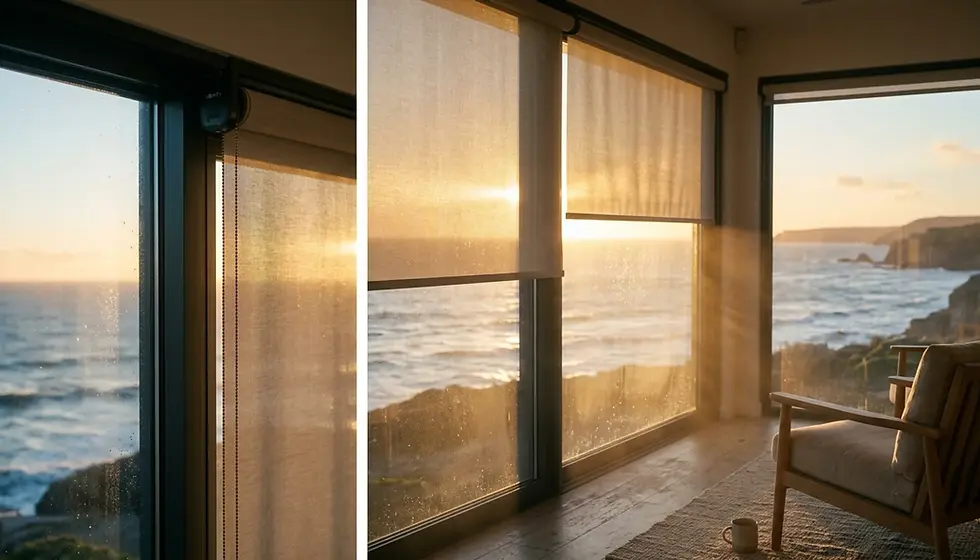
This matters especially in coastal homes on the Eastern Shore, where large windows, panoramic water views, and open-plan living spaces make window treatments a prominent design element. A shade without a cord disappears into the architecture. A shade with a dangling cord competes with it. Cordless treatments can also be layered with drapery without the cord-tangling issues that complicate corded-plus-curtain combinations. For guidance on layering options, the custom shades page covers the most popular combinations for coastal interiors.
Energy Efficiency
Cordless cellular shades, also called honeycomb shades, trap air inside their structured pockets to create an insulating barrier between the window glass and the room interior. Product specifications for cellular shades document insulation values reaching up to R-4, which meaningfully reduces heat transfer in both summer and winter. For coastal homes on the Delmarva Peninsula dealing with humid summers and cold Atlantic winters, this translates to measurable reductions in heating and cooling costs.
The cordless mechanism has no impact on the cellular structure itself, but it does enable a tighter, flush fit against the window frame. Corded versions sometimes hang slightly away from the sill to accommodate cord routing, which creates small gaps where conditioned air can escape. Cordless and motorized versions close more completely against the frame, maximizing the insulating contact area. For a detailed comparison of single-cell versus double-cell options, the guide on single vs. double cell shades for Delmarva homeowners covers the insulation tradeoffs directly.

What Did the 2026 Ban on Corded Blinds Actually Change?
The 2026 rule change means that all custom window coverings manufactured on or after June 1, 2026 must be cordless or have fully inaccessible cords, under the revised ANSI/WCMA A100.1-2022 standard. Specifically, the standard eliminates free-hanging operating cords, free-hanging tilt cords, multiple cords joined into a cord connector, continuous cord loops, and bead chains on all custom horizontal slatted products. This applies to every company manufacturing, distributing, or selling window covering products in the United States and Canada.
The regulatory path to this point was long. The CPSC initiated rulemaking under Docket No. CPSC-2013-0028, published an advance notice in January 2015, and ultimately codified a mandatory safety standard under 16 CFR Part 1260, effective May 30, 2023 for custom products. The Federal Register rule (87 FR 73144) spans 52 pages of regulatory history and risk assessment, reflecting how seriously the CPSC treated the evidence it reviewed.
What the ban does NOT do is require existing homeowners to replace corded blinds already installed in their homes. The regulation applies to manufacturers and sellers, not to current owners. But this distinction is smaller than it sounds. If you are renovating, replacing a broken blind, or moving into a home with pre-2000 window coverings, every new product you purchase must comply. And the CPSC continues to urge homeowners, especially those with children under 8 or visiting grandchildren, to proactively replace corded blinds regardless of current condition.
The Window Covering Safety Council still offers free retrofit cord safety kits for existing corded blinds (call 800-506-4636 or visit windowcoverings.org). However, the CPSC explicitly states that retrofit kits do not address the dangling pull cord hazard. They are a stopgap, not a solution. The only complete solution remains replacing corded blinds with cordless ones.
What Are the Disadvantages of Cordless Blinds?
Cordless blinds have three genuine limitations worth understanding before you commit: they typically cost more upfront than basic corded alternatives, some spring-loaded mechanisms lose tension over time, and cordless designs are not suitable for every window size or weight class. These are real tradeoffs, not marketing objections, and a good installation consultation will address all three directly.
Cost is the most common concern. Cordless mechanisms require more precision engineering than simple cord-and-pulley systems, which raises the base manufacturing cost. For budget-conscious homeowners, this difference can feel significant across a whole house. The practical counterargument is durability: the cord tension mechanisms in standard corded blinds are typically the first component to fail, often within three to five years. Cordless spring systems, when correctly sized and installed, routinely outlast corded alternatives by a significant margin.
Spring-loaded mechanisms can lose tension after years of use, especially on very wide or very heavy shades. The fix is usually a mechanism replacement rather than a full shade replacement, but it is worth knowing this is a potential maintenance item. For very large windows, motorized cordless shades often outperform spring-loaded options in long-term reliability because the motor provides consistent lifting force regardless of shade weight or width.
Some older window configurations, particularly unusually deep sill depths or historic window profiles, can make standard cordless hardware more complex to fit. This is precisely where a professional in-home measurement and consultation adds value. An experienced installer can identify fit challenges before purchase rather than after, which prevents costly remeasuring or returns. Home Blinds and Floors conducts these consultations across all its Delmarva service areas, including Kent Island, Easton, Cambridge, and Annapolis, specifically to catch these edge cases before installation day.
How Do You Audit Your Home for Cord Hazards Room by Room?
A room-by-room cord hazard audit means systematically checking every window in your home against the CPSC's four primary risk criteria: accessible pull cords, proximity to furniture children can climb, inner looped cords, and windows adjacent to sleeping areas. Most homeowners who complete this audit find two or three high-priority windows they had not consciously identified as risks. Start with the rooms where children sleep or play, then work outward.
Step 1: Identify Pre-2000 Blinds Immediately
Check the date of any blinds you did not personally purchase. According to the CPSC, most window blinds manufactured before November 2000 contain inner cords that can be pulled out by a child to form a loop. These represent the highest-risk category. If you cannot confirm the manufacturing date, treat the blind as pre-2000 and replace it. The age alone justifies replacement regardless of visible condition.
Step 2: Check Every Room Adjacent to Sleeping Areas
Nurseries, toddler bedrooms, and rooms with bunk beds are the most critical rooms to audit. The CPSC specifically recommends moving all cribs, beds, and furniture away from windows and cords, but explicitly states this will not eliminate the hazard on its own. A child who climbs a crib rail or bed frame to reach a window can access a cord even when furniture has been repositioned. Cordless shades in sleeping areas are not optional for families with children under 8.
Step 3: Assess Multi-Level Stairway Windows
Stairway windows are frequently overlooked because they seem inaccessible. But cords on a landing window at adult shoulder height are at face height for a child standing on a step above. Multi-level homes on the Delmarva Peninsula, particularly the beach houses common in Bethany Beach and Ocean Pines, often have long cord runs at stair landings that create exactly this risk profile.
Step 4: Check Cord Stop Placement
For any corded blinds you are not yet ready to replace, the CPSC recommends that cord stops should sit within 1 to 2 inches from the head rail when the blind is fully lowered. If your cord stops hang significantly lower than this, reposition them or contact the Window Covering Safety Council at 800-506-4636 for a free retrofit kit. Understand that this is an interim measure while you arrange replacement.
Step 5: Note Every Window Where Cords Are Accessible to Pets
Walk through your home at pet height. Anything a cat can swat from a perch or a dog can mouth while standing is a cord that should move to the replacement list. Pets rarely discriminate between a cord at waist height and one at ankle height when exploring.
How Do Motorized Cordless Shades Compare to Spring-Loaded Ones?
Motorized cordless shades and spring-loaded cordless shades both eliminate exposed pull cords, but they serve different households. Spring-loaded cordless mechanisms are manual: you raise or lower the shade by pressing on the bottom rail, and internal springs hold the position. Motorized systems use battery-powered or hardwired motors controlled by remote, app, wall switch, or smart home voice commands. The right choice depends on window height, household mobility needs, and smart home integration goals.
Spring-loaded cordless shades are the more affordable entry point and work reliably for standard-size windows at accessible heights. For most single-story homes and ground-floor windows, they deliver all the cordless safety benefits without the additional investment of motorization. They are also simpler to maintain and have no electronic components that can require firmware updates or battery replacement.
Motorized cordless shades solve problems spring-loaded mechanisms cannot. High windows in coastal A-frame homes or two-story great rooms are physically difficult to reach by hand. Motorized shades adjust via Alexa, Google Home, Siri Shortcuts, Samsung SmartThings, or similar smart home platforms, making them practical for spaces where manual adjustment would require a step ladder every time. Battery-powered motors eliminate the need for hardwiring, recharge via standard USB cable, and typically run for months between charges under normal use patterns.
For homeowners considering motorized options, the custom shades resource library covers the full range of motorized configurations available for both residential and commercial applications on the Delmarva Peninsula.
What Does a Corded vs. Cordless Comparison Look Like?
The table below compares corded and cordless window shades across the key dimensions that matter most for Delmarva homeowners evaluating a replacement or upgrade.
Feature | Corded Shades | Cordless Shades | Motorized Cordless |
Child safety (CPSC) | Substantial hazard (top 5 home risk) | Hazard eliminated | Hazard eliminated |
Pet safety | Entanglement risk | Risk eliminated | Risk eliminated |
Senior / accessibility | Requires grip dexterity | Open-palm operation | Voice or remote control |
U.S. compliance (post June 2026) | Non-compliant for new custom products | Compliant | Compliant |
Insulation (cellular) | Up to R-4 | Up to R-4 | Up to R-4 |
Aesthetics | Cord visible, tangles over time | Clean, uninterrupted profile | Clean, fully hidden hardware |
Smart home integration | None | None | Alexa, Google Home, Siri, SmartThings |
Upfront cost | Lower | Moderate | Higher |
Long-term durability | Cord mechanism fails 3-5 years | Spring mechanism lasts longer | Motor lasts longer with minimal maintenance |

What Are the Cons of Using No-Drill Blinds Compared to Professionally Installed Cordless Shades?
No-drill blinds are a specific installation method, not a separate product category. They attach via adhesive or tension-mounted brackets rather than screws drilled into the window frame. The cordless safety benefits of a no-drill blind are identical to any other cordless shade, but the installation method introduces its own set of limitations that homeowners should weigh carefully before choosing this approach.
The primary limitation of no-drill mounting is weight capacity. Adhesive and tension brackets typically support lighter shades reliably but can fail with heavier cellular or blackout fabrics, particularly in humid coastal environments where adhesive bond strength degrades faster. Ocean City, Lewes, and Rehoboth Beach homeowners who have tried no-drill solutions in bathrooms or kitchens near windows that capture sea air frequently find the brackets release within one to two seasons.
No-drill solutions also tend to fit less precisely than professionally measured and drilled installations. Light gaps around the frame edge reduce both privacy and energy efficiency, and an imprecise fit undermines the clean aesthetic that is one of the core selling points of cordless designs in the first place.
For rental properties across the Delmarva Peninsula, professionally installed cordless shades offer a practical advantage beyond fit quality: they stay in place through heavy use cycles that would dislodge adhesive-mounted alternatives. Vacation rental owners in Millsboro, Milton, and Ocean Pines who have moved to professionally installed cordless shades report significantly lower replacement and maintenance frequency compared to tension or adhesive-mounted alternatives. The custom blinds section covers mounting options in more detail for homeowners comparing installation approaches.
How Does the Psychological Safety Benefit Factor In?
The psychological safety benefit of cordless shades refers to the reduction in parental anxiety and constant vigilance that comes from permanently removing a known hazard from the home environment. This is a genuine but widely overlooked dimension of the cordless shades safety benefits conversation. Most articles focus exclusively on the physical risk statistics. None address what it actually costs a parent to spend years monitoring cord access in a home with young children.
Parental hypervigilance around known household hazards is a documented source of stress. When a hazard is structural, meaning built into the architecture rather than removable (like a sharp toy or a dangerous food), the vigilance required is continuous and involuntary. Every time a child moves toward a window, a parent with corded blinds has a reflex response. Multiply that by the number of corded windows in a home and the number of waking hours in a day, and the cumulative cognitive load is real.
Replacing corded blinds with cordless shades does not just reduce the probability of injury. It removes the vigilance requirement entirely. Parents who complete a full-home conversion consistently describe the change in similar terms: they simply stop thinking about the windows. For families who recently moved into an older home on the Eastern Shore, or who are preparing a home for a first child, this cognitive benefit compounds every day and is worth factoring into the true cost-benefit analysis of the upgrade.
October is recognized as Window Covering Safety Month by the CPSC, making it a natural annual prompt to reassess your home's compliance status. But the motivation to act does not need to wait for an awareness month when the benefit of removing daily parental stress is available year-round.
Frequently Asked Questions About Cordless Shades Safety Benefits
Are cordless blinds required by law in the United States?
For all custom window coverings manufactured on or after June 1, 2026, yes. The revised ANSI/WCMA A100.1-2022 standard, enforced alongside the CPSC mandatory safety rule under 16 CFR Part 1260, requires all new custom window coverings to be cordless or have fully inaccessible cords. The regulation applies to manufacturers, distributors, and retailers. Existing homeowners are not legally required to replace currently installed corded blinds, but the CPSC strongly urges replacement in homes where children live or visit.
What should I do right now if I still have corded blinds?
First, identify any blinds manufactured before November 2000 and treat replacement of those as urgent, per CPSC guidance. Second, move furniture, cribs, and beds away from windows with cords, though the CPSC notes this reduces but does not eliminate the risk. Third, contact the Window Covering Safety Council at 800-506-4636 or windowcoverings.org for free retrofit cord safety kits as a short-term measure. The only complete solution the CPSC endorses is replacing corded blinds with cordless ones.
Do cordless shades work well for large windows?
Spring-loaded cordless mechanisms perform reliably for standard residential window sizes, but very large or very heavy shades can put excessive strain on the spring tension system over time. For wide windows or floor-to-ceiling glass common in coastal homes on the Delmarva Peninsula, motorized cordless shades are typically the better long-term choice. The motor provides consistent lifting force regardless of shade width or weight, and battery-powered systems require no hardwiring.
Can cordless shades integrate with smart home systems?
Motorized cordless shades support integration with Alexa, Google Home, Siri Shortcuts, Samsung SmartThings, Control4, Savant, and IFTTT, among other platforms. Battery-powered motors eliminate the need for any electrical work and recharge via standard USB cable. Smart integration is particularly practical for high windows, homes with elderly residents, or vacation rental properties where remote adjustment between guest stays simplifies management.
How long do cordless shade mechanisms typically last?
Spring-loaded cordless mechanisms generally outlast standard cord-and-pulley systems because there is no thin cord to fray or snap under repeated tension. With professional installation and correct sizing for the window weight, cordless spring mechanisms commonly perform reliably for ten years or more under normal residential use. Motorized systems add electronic components that may require maintenance over a longer ownership period, but battery-powered motors are designed for straightforward user servicing.
Are cordless shades better for rental properties?
Yes, for two reasons. First, they meet the current federal safety standard for window coverings, which protects property owners from liability related to cord strangulation hazards. Second, there is no cord mechanism for guests to break, which is one of the most common maintenance issues in vacation rentals with corded blinds. Cordless designs hold up better through high-turnover use cycles, reducing both replacement frequency and maintenance costs over time.
What is the WCMA Best for Kids certification?
The Window Covering Manufacturers Association created the Best for Kids certification program in 2015 to help consumers identify cordless window covering products that meet child safety standards. As of June 1, 2026, the ANSI/WCMA A100.1-2022 standard effectively makes cordless the default for all new custom products, which means the certification is now more relevant for stock products sold in stores where compliant and non-compliant items may still coexist on the shelf.
How do I know if my home's current blinds are the risky pre-2000 type?
Check for inner cords by gently pulling on the bottom slats: if a separate cord loop emerges from inside the blind when you pull a slat sideways, the blind contains inner cords and should be replaced immediately per CPSC guidance. If you cannot identify the manufacturing date, treat any blind you did not personally purchase as potentially pre-2000. A professional window treatment consultation can assess your full window inventory and prioritize replacements by risk level.
Ready to Make Every Window in Your Home Safer?
Cordless shades safety benefits span child protection, pet safety, senior accessibility, energy efficiency, and the often-undervalued reduction in daily parental anxiety. The 2026 federal mandate made cordless the legal standard for all new custom window coverings in the U.S., but the practical case for upgrading existing corded blinds is compelling regardless of regulatory deadlines. Every window with an accessible pull cord is a risk that a straightforward product replacement can permanently eliminate.
For Delmarva Peninsula homeowners navigating material choices, window sizing, and the spring-loaded versus motorized decision, the process is much simpler with a local expert who knows coastal conditions. Home Blinds and Floors serves homeowners across Rehoboth Beach, Lewes, Ocean City, Bethany Beach, Salisbury, Kent Island, Annapolis, and the broader Eastern Shore with in-home consultations that evaluate your specific windows, identify your highest-priority replacements, and recommend cordless solutions matched to your budget and aesthetic goals.
In 2026, the combination of federal compliance requirements and expanded motorized options has made transitioning to cordless window treatments more accessible than it has ever been. The barriers to upgrading, whether cost, complexity, or uncertainty about what to choose, are all addressable with the right consultation.
If you are ready to remove cord hazards from your home and replace them with professionally installed cordless shades built for coastal living, schedule your free in-home consultation with Home Blinds and Floors. Bring your window list, your questions about motorization, and your room measurements. The team will handle everything else.


Comments