.avif)
.avif)
.avif)
Discount Window Blinds: A Smart Buyer's Guide for 2026

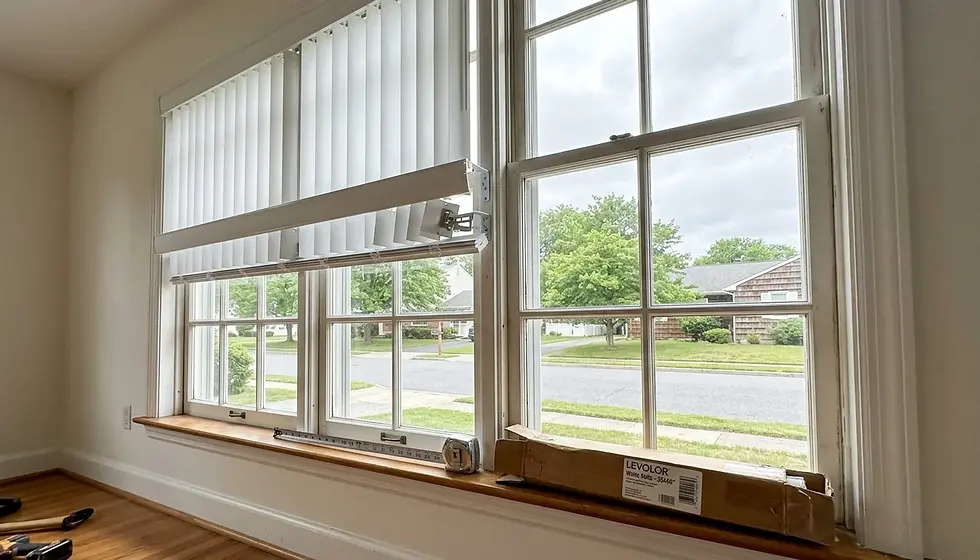
Discount window blinds are budget-priced or sale-priced window coverings, typically faux wood, mini, cellular, roller, or vertical styles, sold at reduced rates through promotions, closeout inventory, or lower-cost materials. The lowest sticker price does not always mean the lowest cost over time. For example, a $58 faux wood blind that warps in a humid sunroom within eighteen months costs more than a properly fitted, mid-priced option that lasts a decade.
Key Takeaways
Faux wood, mini, and cellular blinds are typically the least expensive materials, with online sale pricing often based on a standard 24-inch by 36-inch window rather than your actual window size.
The global blinds and shades market runs into the billions of dollars, and blinds make up the majority share of that segment, a sign of how much competition exists in the value tier.
Millsboro's median owner-occupied housing value was $297,000 in 2019-2023 according to U.S. Census Bureau QuickFacts, and homeowners here make up about 67.9% of households, a strong base for replacement and renovation window treatment projects.
Discount pricing rarely accounts for coastal humidity, salt air, or oddly sized windows, all of which drive up real-world cost on the Delmarva Peninsula.
Cordless and motorized options now compete on price with corded discount blinds while addressing child safety, a growing priority among Eastern Shore families.
Professional in-home measurement typically prevents the sizing mistakes that make "cheap" blinds expensive to replace.
If you have searched for discount window blinds, you are probably comparing sale banners, percentage-off headlines, and starting prices that all look similar at first glance. That is a reasonable place to start, but pricing pages rarely tell you which materials hold up in a beach house bathroom or a sunroom that faces west all afternoon.
This guide breaks down what "discount" means across blind categories, what drives the real installed cost, and where corners get cut. Home Blinds and Floors serves homeowners from Bethany Beach to Salisbury, and the pattern that shows up again and again is a homeowner who saved forty dollars on a blind that needed replacing two summers later because nobody measured for humidity swelling or mounting depth.
As of 2026, Home Blinds and Floors works directly with homeowners across the Delmarva Peninsula to sort through material options, from entry-level faux wood to motorized cellular shades, so the "discount" choice is the right one for your specific windows, not just the cheapest one on a sale page.
Where's the Cheapest Place to Buy Blinds?
The cheapest place to buy blinds is typically a direct-to-consumer online retailer running a sitewide sale, since these companies cut out showroom overhead and price against a standard reference window size. Online sale events commonly advertise faux wood blinds in the $58 to $65 range and wood blinds or Roman shades discounted 40 to 45 percent off list price.
Those numbers look attractive, but they are based on a 24-inch by 36-inch window, smaller than most standard residential windows on the Eastern Shore. As a result, a typical bedroom or living room window runs larger, which pushes the real price up once a homeowner enters their actual dimensions.
Big-box home improvement stores and online marketplaces also run frequent blind sales, competing directly with dedicated blind retailers on price for basic mini blinds and vertical blinds. The tradeoff at every one of these outlets is the same: the buyer self-measures and self-installs, and if the fit is wrong, the buyer absorbs the cost of a return or a redo.
For coastal Delaware and Maryland homes specifically, self-measured online orders miss depth restrictions around window casings and humidity-related sizing more often than homeowners expect. For example, a quarter-inch miscalculation on a bay window in Rehoboth Beach can mean a blind that will not close flush.
Where Can I Find the Cheapest Blinds?
The cheapest individual blinds by material category are typically mini blinds, followed closely by faux wood and basic vertical blinds, according to how discount retailers categorize their value tiers. Some retailers specifically identify mini blinds as one of the least expensive categories, while others group economy blackout shades, faux wood blinds, and vertical blinds together as their discount lineup.
Aluminum mini blinds remain the entry point of the category because they use the least material and the simplest manufacturing process. Mini blinds work fine in low-traffic rooms like laundry areas or guest closets, but the slats bend easily and the cord mechanisms wear out faster than heavier alternatives.
Faux wood blinds sit one tier up in price and hold up better in humid environments, which matters more on the Delmarva Peninsula than in most other regions. In contrast, real wood swells and warps near ocean-facing windows, while faux wood, made from PVC or wood composite, does not absorb moisture the same way.
Vertical blinds remain the budget standard for sliding glass doors and large patio openings. If you are weighing options for a sliding door specifically, our guide to vertical shades for sliding glass doors covers which styles perform best against salt air exposure.
What Are the Most Affordable Window Blinds by Material?
The most affordable window blinds by material, ranked from lowest to higher cost, are aluminum mini blinds, faux wood blinds, basic vertical blinds, then cellular and roller shades. Each material trades off differently between upfront price, durability, and room performance, so the right pick depends on the specific room and its exposure to sun or moisture.
Material | Typical Price Tier | Best For | Coastal Durability |
Aluminum mini blinds | Lowest | Closets, laundry rooms, rentals | Low, slats bend and corrode near salt air |
Faux wood blinds | Low to mid | Bathrooms, kitchens, sunrooms | High, resists humidity and warping |
Vertical blinds | Low to mid | Sliding glass doors, patio openings | Moderate, vane clips can wear |
Cellular (honeycomb) shades | Mid | Bedrooms, energy-conscious homes | High when cordless mechanisms are used |
Roller and solar shades | Mid | Sunrooms, glare-heavy rooms | High, minimal moving parts |
Real wood blinds | Higher | Interior rooms away from moisture | Low near coastal exposure |
Real wood, often assumed to be the premium standard, performs worst in coastal conditions despite costing more. This disconnect is one of the biggest gaps between what discount retailers advertise and what survives a Delmarva summer. Faux wood blinds cost less upfront and resist humidity better, while real wood offers a warmer grain look some homeowners still prefer for interior dining rooms or studies away from ocean-facing glass.

Is Budget Blinds Cheaper Than Home Depot?
Comparing specialty blind retailers against home improvement chains on price alone misses the more important variable: installation and measurement accuracy. Both types of retailers run frequent percentage-off promotions, and pricing shifts constantly based on sales calendars, material choice, and window size, so there is no fixed answer to which retailer is cheaper on any given week.
What matters more for Eastern Shore homeowners is who measures the windows and who stands behind the fit. Big-box and online options generally rely on self-measurement, while a local installer measures in person and accounts for casing depth, frame irregularities common in older Eastern Shore homes, and mounting surface condition.
Other retailers in the market run direct-to-consumer sales similar to the pricing patterns described above. Price comparisons across these retailers are not meaningful without knowing the exact window dimensions and mounting conditions involved, since advertised prices are built around a reference size, not a specific home.
How Do You Spot Misleading Blind Sale Pricing?
Misleading blind sale pricing typically hides behind a small reference window size, a short list of excluded product categories, or a minimum purchase requirement that is not obvious until checkout. A 40 to 45 percent discount headline sounds identical whether it applies to the shopper's actual order or only to a narrow subset of products.
First, check what size the advertised price is based on. Most discount blind pricing, based on industry sale pages, uses a 24-inch by 36-inch reference window. If the actual window measures 48 inches wide, expect the real price to run well above the advertised figure.
Second, look for exclusions. Some sitewide sales specifically exclude prior purchases, motorization upgrades, or certain fabric collections. One published promotion, for example, explicitly excludes previous purchases and carries a hard expiration date, a common structure across the industry.
Third, check the free shipping threshold. Some retailers advertise free shipping only on orders under a specific width, meaning a wider window (common in coastal great rooms and sunrooms) may trigger a shipping charge that erases part of the discount.
Fourth, factor in samples and returns. Free sample programs are common, but they are usually capped at a limited number per household, and return shipping on an oversized blind order is rarely free.
Cordless, Child Safety, and No-Drill Options: What Belongs in This Category?
Cordless and no-drill window treatments belong in the discount conversation because these options now compete on price with traditional corded blinds while solving a problem corded options cannot: child safety, alongside renter-friendly installation. Cordless cellular shades use a spring-lift or continuous-loop mechanism instead of a hanging cord, removing the strangulation risk that pediatric safety advocates have flagged for years.
For families with toddlers or grandchildren visiting a coastal second home, cordless is worth the small price premium over a standard corded mini blind. Many manufacturers have shifted default production toward cordless designs specifically because of this safety concern, which has narrowed the price gap compared to a few years ago.
No-drill mounting brackets matter for renters and vacation property owners who cannot make permanent changes to window casings. These clip-on or tension-mounted systems work well for lightweight cellular and faux wood shades but are not rated for heavier wood blinds or wide vertical blind panels.
If you are outfitting a rental property, durability under guest turnover matters more than initial price. As a result, a $58 blind that needs replacing after every other guest stay costs more annually than a mid-tier option built for repeated use. If safety and cord-free operation matter for your household, our cellular shades resource covers cordless mechanisms in more depth.
Custom Sizing: How Inside Mount vs Outside Mount Changes Your Price
Inside mount and outside mount are the two ways a blind attaches to a window, and choosing the wrong one is one of the most common reasons a discount blind ends up costing more than expected. Inside mount fits within the window frame for a clean, built-in look, but inside mount requires at least an inch and a half of depth clearance, something older Eastern Shore homes with shallow casings often lack.
Outside mount attaches to the wall or trim surrounding the window and works when frame depth is insufficient, when a homeowner wants to visually enlarge a smaller window, or when better light-blocking coverage at the edges is needed. Outside mount typically requires a slightly larger blind, which increases material cost even on a discount product line.
During in-home consultations, Home Blinds and Floors always measures the depth of the window casing before assuming inside mount is possible. This single measurement step, skipped constantly on self-measured online orders, prevents the most common return reason seen across the industry: a blind that physically cannot mount the way the homeowner intended.
For French doors and sliding glass doors specifically, outside mount is almost always the right call, since inside mount rarely clears the door hardware. Our guide to window treatments for sliding glass doors walks through mounting decisions for these openings in detail.
What Does Home Blinds and Floors Offer for Budget-Conscious Homeowners?
Home Blinds and Floors provides in-home measurement and installation for faux wood, cellular, roller, and vertical blinds sourced from established manufacturer partners including Hunter Douglas, Norman, and Graber, serving homeowners across Rehoboth Beach, Lewes, Millsboro, Bethany Beach, and the broader Delmarva Peninsula. Every project starts with a free in-home consultation where the team brings physical samples and measures the actual windows.
This distinction matters most for the budget-conscious segment of Home Blinds and Floors' customers, who often assume "custom" automatically means expensive. Custom does not have to mean expensive: a 2-inch faux wood slat typically runs in a moderate per-square-foot range installed, less than premium real basswood, while still resisting the humidity that causes warping in coastal homes.
Home Blinds and Floors sources from manufacturer product lines rather than unbranded overseas suppliers, which means better warranty coverage and more consistent color matching if a homeowner needs a replacement slat years down the road. You can review the CADdetails architectural specifications for Hunter Douglas products, including the E Screen GREENGUARD Gold Certificate, if indoor air quality is part of the decision.
A professional installation differs from a discount online order in accountability. If a blind does not fit correctly, Home Blinds and Floors addresses the issue directly rather than routing homeowners through a returns department. This difference is why homeowners who tried the self-install route once tend to call the company for the second project.
Millsboro's residential building permit activity, which totaled 1,111 permits between 2014 and 2019 according to the state's Office of State Planning Coordination data, reflects a steady stream of new construction and renovation projects across the service area, many of which need window treatments installed correctly the first time.

How Do You Choose Between Upfront Price and Lifetime Cost?
Choosing between upfront price and lifetime cost means weighing the sale-tag number against how many years the product will realistically last in a specific window's conditions. A faux wood blind priced around $58 to $65 in a typical online sale looks like an obvious win against a $150 wood blind, until replacement frequency enters the calculation.
Here is a practical framework Home Blinds and Floors walks clients through:
Identify the room's humidity exposure. Bathrooms, kitchens, and any window within view of the bay or ocean face the highest moisture risk.
Check how many hours of direct sun the window gets daily. West-facing and south-facing windows fade cheap vinyl and PVC faster than north-facing ones.
Estimate how often the blind will be operated. High-traffic rooms wear out cord mechanisms and lift systems faster than rarely touched formal rooms.
Factor in whether children or pets are present, which pushes cordless designs from "nice to have" to a practical requirement.
Compare the total installed price, not just the product price, since self-installation errors often require professional correction later.
A blind that lasts twelve years at a moderate price beats one that needs replacing every two years at a lower price, even before counting the labor of removing and remounting the blind repeatedly. This calculation matters most for vacation rental owners managing guest turnover, where durability directly affects annual maintenance cost.
What Mistakes Do Homeowners Make When Buying Discount Blinds?
The most common mistake homeowners make with discount window blinds is measuring only the glass opening rather than the full window frame, leading to a blind that does not cover the intended area. A close second is ignoring mounting depth, resulting in an inside-mount blind that will not close because the blind collides with window hardware or a slanted sill.
Measuring the wrong dimension. Inside mount requires the exact frame opening; outside mount requires the trim-to-trim width plus overlap.
Choosing real wood for a humid room. Real wood swells and warps in bathrooms and sunrooms; faux wood or composite handles moisture better.
Overlooking motorization compatibility. If a homeowner plans to add smart home control later, checking whether the shade's lift system supports a retrofit motor before buying is essential.
Skipping the depth check on French doors. Door hardware often prevents inside mounting; verify clearance before ordering.
Buying based on a reference-size price. A quoted sale price built around a 24-by-36-inch window rarely reflects the actual cost.
Home Blinds and Floors has walked into more than a few Ocean Pines and Ocean City condos where a homeowner's self-installed blind sits crooked because the bracket spacing did not account for a slightly out-of-square window frame, common in older coastal construction. That problem is fixable, but a professional measurement visit prevents it from the start.
Frequently Asked Questions
How does the discount blind market compare on durability, warranty, and installation quality?
Discount and mid-tier blind providers vary widely on warranty length and installation support. Direct-to-consumer online retailers typically offer product warranties but leave installation and measurement to the homeowner. In contrast, local installers like Home Blinds and Floors combine manufacturer warranties from partners such as Hunter Douglas, Norman, and Graber with professional in-home measurement and fitting, reducing the return and re-order rate common with self-measured orders.
How do you clean window blinds properly?
Cleaning window blinds properly starts with weekly dusting: use a microfiber cloth or a vacuum brush attachment on faux wood and vinyl blinds, working slat by slat with the blind closed to catch buildup on the wide surface. For deeper cleaning, wipe each slat with a damp cloth using mild soap and water. Importantly, dry the slats immediately afterward, since standing moisture can warp certain materials over time, especially in coastal humidity common on the Delmarva Peninsula. This two-step routine, weekly dusting plus occasional damp wiping, keeps faux wood and vinyl blinds looking clean without shortening their lifespan.
How do you clean vertical window blinds?
Vertical blinds should be dusted with a soft brush attachment or microfiber duster, running the tool top to bottom along each vane while the blind is closed. Fabric vertical vanes with removable inserts can often be spot-cleaned or hand-washed, while vinyl vanes wipe clean with a damp cloth. Always check the manufacturer's care instructions before submerging any fabric component, since some fabrics are not rated for full washing.
What's the best way to clean window blinds without removing them?
The best way to clean window blinds without removing them is to use a vacuum with a brush attachment set to low suction, running the attachment across each slat while the blind is fully closed in one direction, then flipping the tilt wand and repeating on the reverse side. This method works for mini blinds, faux wood blinds, and most cellular shades without needing to take the unit down, saving time on routine maintenance.
Are cordless cellular shades safe for homes with young children?
Yes, cordless cellular shades remove the hanging cord entirely, eliminating the strangulation hazard associated with traditional corded blinds. Most manufacturers, including Hunter Douglas and Norman lines carried by Home Blinds and Floors, now default to cordless or continuous-loop designs specifically for this reason. As a result, cordless cellular shades are a practical choice for families with toddlers or frequent young visitors, since the shades operate with a spring-lift or loop mechanism instead of a dangling cord.
How much do custom blinds cost on the Delmarva Peninsula?
Custom blind costs on the Delmarva Peninsula vary based on material, window size, and mounting type, with faux wood generally landing in the lower-to-moderate range and real wood or motorized options costing more. For example, a 2-inch faux wood slat typically runs in a moderate per-square-foot range installed, well below premium real basswood pricing. Our detailed custom blinds cost guide for the Delmarva Peninsula breaks down pricing by material and window type, and a free in-home consultation from Home Blinds and Floors gives homeowners an exact number for their specific windows.
Does Home Blinds and Floors serve my town on the Eastern Shore?
Yes, Home Blinds and Floors serves homeowners and businesses throughout Rehoboth Beach, Lewes, Millsboro, Milton, Bethany Beach, Ocean City, Ocean Pines, Salisbury, Easton, Cambridge, Centreville, Grasonville, Kent Island, Annapolis, and Middletown, covering both Delaware and Maryland's Eastern Shore. Each project in this service area begins with a free in-home consultation and professional measurement, regardless of which of these towns the home is located in.
Conclusion: Making Sense of Discount Window Blinds in 2026
Discount window blinds can stretch a renovation budget, but the sale banner rarely tells the full story. Faux wood, mini, and cellular styles remain the most affordable materials, while reference pricing based on a 24-by-36-inch window, mounting depth, and coastal humidity all shift the real number for a given home. As of 2026, with steady residential permitting activity across Millsboro and the surrounding Eastern Shore, more homeowners are weighing this tradeoff between upfront savings and long-term durability.
The right answer usually comes down to the specific windows involved, climate exposure, and budget, not the biggest percentage-off number on a sale page. A quick consultation with Home Blinds and Floors turns that decision from a guessing game into a clear plan, backed by manufacturer partnerships and measurement done right the first time.

If salt air or humidity has already warped your current blinds, or you just want to compare discount window blinds against longer-lasting alternatives for your specific windows, request a free in-home consultation with Home Blinds and Floors and get a straightforward quote instead of a guessing game.
Content powered by inkSTR.co


Comments